Tabella
Angelus News

Angelus News

About

Multimedia Catholic News

Latest Articles

Angelus News
AS
Angelus News
Angelus Staffabout 13 hours ago

Archdiocese announces prayer campaign for Pope Leo after cancer diagnosis

Catholics from across the Archdiocese of Los Angeles are being asked to pray for Pope Leo XIV, offering a spiritual bouquet following the pontiff’s cancer diagnosis. 

On the archdiocese’s website and social media channels, Catholics were asked to participate in the spiritual bouquet by praying certain devotions, such as the rosary or the Stations of the Cross, spending time in adoration with the Blessed Sacrament, or completing acts of charity or sacrifice for another.

Local parishes and schools were also asked to hold special Masses and novenas for the sick and Pope Leo.

On a special LACatholics.org web page, visitors can submit prayer offerings for Pope Leo’s recovery following the Oct. 13 surgery that revealed lung cancer.

“Friends, we continue to pray for the Holy Father’s full and swift recovery,” wrote Archbishop José H. Gomez on social media. “I invite you to join me in offering a spiritual bouquet for Pope Leo XIV as he recovers.”

Pope Leo, 71, announced after his Oct. 11 Angelus address that doctors had found a small nodule in his lung and that he would have surgery to remove it. After a 90-minute surgery on Oct. 13, doctors confirmed that lung cancer was detected in what was removed.

The pope was expected to stay in Rome’s Gemelli Hospital for a week, and the Vatican canceled all of Leo’s scheduled audiences through Oct. 20.

Doctors are performing more tests before announcing what comes next, including whether or not Leo might need chemotherapy or other treatments.

The archdiocese’s last prayer campaign for the pope’s health was in February 2025, when Pope Francis fell ill. The archdiocese’s Digital Team asked for videos of prayerful support, leading to a flood of submissions that were compiled into a five-minute video titled “To Pope Francis with Love.”

The post Archdiocese announces prayer campaign for Pope Leo after cancer diagnosis first appeared on Angelus News.

Angelus News
GC
Angelus News
Gina Christian1 day ago

What Pope Leo’s lung nodule surgery involves, according to medical experts

As Pope Leo XIV undergoes surgery for a lung nodule, medical experts consulted by OSV News said the condition is typically benign -- but requires careful scrutiny and early intervention to address any possible cancer.

In addition, the experts -- none of whom are part of Pope Leo's care team -- offered varying views on how much post-operative downtime patients typically face after the type of procedure Pope Leo is undergoing Oct. 13.

That downtime may affect the pope's planned Nov. 6-17 apostolic visit to Latin America.

Nodules due to 'laundry list of reasons'

Pope Leo was admitted to Rome's Gemelli Hospital Oct. 13 for lung surgery, following his Oct. 11 disclosure that a scan had revealed a "well-contained" lung nodule that had been "detected at a very early stage."

The pope's expected week-long hospitalization, confirmed by the Vatican, has led to a slew of cancelled papal appearances, including meetings, addresses, ceremonies and participation in a Mass in St. Peter's Square.

While not speculating on Pope Leo's specific circumstances, medical experts with whom OSV News spoke explained that lung nodules, or abnormal growths on the lungs, are far from unusual -- and, for the most part, are not life-threatening.

"Lung nodules are very common, and 90% of the time, they are benign," said Dr. Stacey Su, chief of thoracic surgery at Fox Chase Cancer Center in Philadelphia and associate professor of surgical oncology at Temple University's Lewis Katz School of Medicine.

But, she said, "the potential impact of lung cancers is so grave that any lung nodule deserves serious attention."

Dr. Sonali Sethi, an interventional pulmonologist at the Cleveland Clinic, told OSV News that "in the U.S. alone, 1.5 million lung nodules are seen in imaging a year" -- and of those, "95% of the time, what we see is benign."

Such nodules "can be caused by a whole laundry list of reasons," said Su. "Sometimes it's from infection, sometimes it's an old scar. But in some cases, it is a growth, with the potential to grow and spread."

Lung nodules, "depending on their size and location," can develop "without any symptoms at all" for the patient, said Su. "Patients will come all the time to the clinic saying, 'I feel completely fine,' and they doubt the veracity of the lung nodule."

"Size is an important component," said Dr. Nirmal Veeramachaneni, professor of cardiothoracic surgery at St. Louis University School of Medicine and medical director for lung cancer screening at SSM Health. "So if you see a lesion that's 4 or 5 millimeters versus 8 or 10 millimeters -- we're talking fractions of an inch -- the guidelines on what the follow-up should look like are different, and they're evidence-based."

He pointed to standards from the Fleischner Society -- an international, multidisciplinary group of medical experts focused on chest diseases -- that recommend a range of follow-up protocols for lung nodules discovered outside of formal lung cancer screening.

The guidelines take into account the size, location and margins of the nodule, as well as the patient's overall risk factors, including age and tobacco use.

Pope Leo does not have any history of tobacco use, said Veeramachaneni -- but he and other experts pointed out that lung nodules can sometimes be attributed to genetics, exposure to particulates such as asbestos, and pulmonary histoplasmosis.

The fungus that causes histoplasmosis is particularly found in the Mississippi and Ohio River valleys, and in certain areas of Central and South America -- including Peru, where Pope Leo once spent some two decades as an Augustinian missionary.

However, said Sethi, while histoplasmosis "does cause a lot of scares," the condition "doesn't cause malignancy."

Surgical options for lung nodules

Medical experts at Sweden's renowned Karolinska University Hospital said surgical intervention for a lung nodule is standard when imaging raises concerns "that the nodule may be more serious."

In a joint response sent to OSV News Oct. 13, Simon Ekman and Signe Friesland, senior oncologists at Karolinska University Hospital, also noted generally that if a "nodule is difficult to biopsy, surgery is a way to get material (tissue) to analyse."

Both experts stressed that their remarks reflected standard clinical practice rather than direct knowledge of the pontiff's medical history.

Veeramachaneni said that treating lung nodules involves "a multidisciplinary approach."

"You have lung doctors, surgeons, radiation oncologists, medical oncologists involved," he said.

According to Ekman and Friesland, the typical surgical procedure "for all patients regardless of condition" is a Video-Assisted Thoracoscopic Surgery. VATS is a minimally invasive surgery using a camera inserted through one to three keyhole incisions.

After the operation: Risks and recovery time vary

The oncologists told OSV News that postoperative recovery includes pain medication, breathing exercises to expand the lungs, and having the patient move around "as early as possible."

While chest tubes with suction are sometimes required to evacuate trapped air, the specialists noted that "this is not the usual case."

While Pope Leo expressed his intention pre-surgery to carry out a 12-day apostolic visit to Uruguay, Argentina, and Peru in November, his medical team may advise the pontiff otherwise depending on the outcome.

Ekman and Friesland noted that some risks of flying not long after lung surgery include possible air leakage "when the outside pressure (cabin pressure) gets lower."

"If you get an air leakage, the lung may collapse if the air gets trapped inside the chest wall. Blood clots are also a risk," they said.

However, both specialists noted that "potential risks in individual cases depend on the recovery of the patients, and it varies between patients when it is deemed safe to fly again."

"It really depends on the type and extent of the surgery and of course the speed of the recovery afterward, any complication factors, etc.," Ekman and Friesland said. "Generally, we recommend not to fly within a month after lung surgery, but it is really a judgment by the treating physicians to recommend what is safe or not."

Veeramachaneni said his patients typically spend just over two days in the hospital following surgery, "especially with minimally invasive techniques."

"Usually at the one- to two-week standpoint, if it's somebody who's not doing hard physical labor, I pretty much clear them to do whatever their body tells them is OK," he said.

Sethi said Pope Leo "may in one week be perfectly fine to continue with whatever he had scheduled."

Su said that a needle biopsy "should be relatively well tolerated," with a patient "potentially going back to work the next day."

But, she said, a patient whose biopsy involves an excision, or full removal, would possibly need "three to four weeks to recover before they're back at work."

"They may be home from surgery within one to three days," she said. "But it still requires recovery time, management of pain that may be associated with the surgery, and just getting up and moving around well enough to go back to work."

The post What Pope Leo’s lung nodule surgery involves, according to medical experts first appeared on Angelus News.

Angelus News
AS
Angelus News
Angelus Staff1 day ago

Saint of the day: Edward the Confessor

St. Edward was born in 1003, the son of the Duke of Normandy and the nephew of King Edmund Ironside of England. From the age of 10, he lived in exile in Normandy, after the Danes gained control of England. This early experience of loss and his religious piety caused him to renounce worldly ambitions, and devote himself to God. 

When the Danish king Canute died in 1042, Edward was called to the throne of England. He accepted his duty and ruled until 1066. His sanctity made him a popular king — he abolished an unjust tax, and was said to be able to heal people with his touch.

Edward accepted marriage for the sake of his kingdom, but he had previously made a vow of chastity, so he lived in celibacy with his queen.

Edward had also made a vow to make a pilgrimage to St. Peter’s tomb, but he was unable to leave his people vulnerable to attack. The pope commuted his vow to rebuilding St. Peter’s Abbey in Westminster. A week after its dedication, Edward died, on January 5, 1066, and was buried there. 

The post Saint of the day: Edward the Confessor first appeared on Angelus News.

Angelus News
SH
Angelus News
Scott Hahn1 day ago

Remembering the other Judas from the Bible

Few parents in the early Church named their sons Judas. The name had once been honorable. It recalled Judah, son of Jacob, and Judas Maccabeus, the great defender of Israel against gentile domination.

But one man went and ruined it: Judas Iscariot, the apostle who betrayed Jesus with a kiss.

This helps us understand why the Gospel writers take such pains to identify another apostle with the same name. Luke calls him “Judas the son of James” (Luke 6:16). Matthew and Mark call him Thaddeus (Matthew 10:3; Mark 3:18). John, determined to prevent any misunderstanding, identifies him as “Judas (not Iscariot)” (John 14:22).

This Judas — also known as Jude or Thaddeus — is the saint whose feast the Church celebrates every year on my birthday, Oct. 28. Tradition remembers him as a missionary who traveled with the apostle Simon into Persia, where both suffered martyrdom.

The Gospels preserve only one sentence spoken by Jude. At the Last Supper, Jesus promises that he will reveal himself to those who love him. Jude asks: “Lord, how is it that you will manifest yourself to us, and not to the world?” (John 14:22)

It’s a good question, and Jesus answers that God makes his dwelling with those who love him and keep his word. So Jude’s question draws from Jesus a magnificent promise: a Christian’s soul can become a home of the Father, Son, and Holy Spirit.

Jude may also have left us one book of the Bible. The brief Letter of Jude begins: “Jude, a servant of Jesus Christ and brother of James.” Scholars debate whether this author was the apostle or another relative of Jesus. But there is good reason to believe the letter comes from the first generation of Christians.

Some have suggested that it was written much later by an anonymous author using Jude’s name. That seems unlikely. A forger hoping to give his work prestige could have chosen Peter, Paul, or John. Why choose Judas? After the betrayal, almost any Christian name would have carried more authority.

And why would the Church preserve this very short letter — only 25 verses — as sacred Scripture if it came from no one of consequence? Its exhortations resemble teachings found elsewhere in the New Testament. Its inclusion makes best sense if the letter came from a man whose authority the earliest Christians knew and revered.

Jude wrote to Christians endangered by corrupt teachers who twisted God’s grace into an excuse for immorality. He urged believers to “contend for the faith” while showing mercy to those led astray. “Save some,” he commanded, “by snatching them out of the fire” (Jude 23).

That verse may help explain his later reputation as the patron of lost causes. Jude does not abandon people who seem beyond recovery. He goes after those nearest the fire.

No cause is truly lost while God’s grace is at work. And perhaps the apostle who bore the most dishonored name became the perfect saint to teach us that lesson.

And I’m pleased today that my youngest grandchild bears his name.

The post Remembering the other Judas from the Bible first appeared on Angelus News.

Angelus News
CM
Angelus News
Courtney Mares2 days ago

Pope to be admitted Oct. 13 for upcoming lung surgery, public appearances canceled

The Vatican has confirmed that Pope Leo XIV will be admitted to Rome’s Gemelli Hospital on Oct. 13 before undergoing lung surgery, prompting the cancellation of several public appearances and meetings for the coming week.

In a statement to journalists Oct. 12, the Vatican press office said that Pope Leo will enter Rome's Gemelli Hospital late tomorrow morning. The Vatican did not confirm whether the operation will be performed on Oct. 13 or the following day.

The Vatican spokesman has said the pope is expected to remain hospitalized for about a week following the operation, prompting changes to a schedule that included a Mass in St. Peter's Square, an awards ceremony in Castel Gandolfo, an address to an infertility conference, a meeting with bishops from Nicaragua, and closing remarks at the Vatican family summit.

Cardinal Luis Antonio Tagle, who was elected as dean of the College of Cardinals last week, will preside in the pope's place at the Oct. 14 Mass in St. Peter's Square to close the Vatican meeting of the world's bishops' conference presidents and the heads of Eastern Catholic Churches marking the 10th anniversary of "Amoris Laetitia." Pope Leo had also been scheduled to deliver the congress' closing address later that evening, but will no longer attend.

Changes to the 'Amoris Laetitia' meeting

Father Giacomo Costa, a consultant to the General Secretariat of the Synod, confirmed at an Oct. 12 press briefing that the pope would be admitted to the hospital and that it would affect Pope Leo's attendance at the gathering.

"As you can imagine, the Holy Father truly wished to listen and then share his own reflection on what he heard, but that has proven difficult," Father Costa said.

He also said the pope requested to postpone the meeting's final report, noting that Pope Leo "wanted to listen to it and be able to offer his own word on it himself."

"So, he reserves the right to receive it and, once he is discharged from this period of hospitalization, to take up the materials and what has been said over these days again, and offer his reflection," he explained.

While apologizing for the delay, Father Costa said it was "wonderful that he genuinely desires to listen, not to let the meeting just pass by, and to have the opportunity to truly say a word about what he heard to support the commitment of the entire Church."

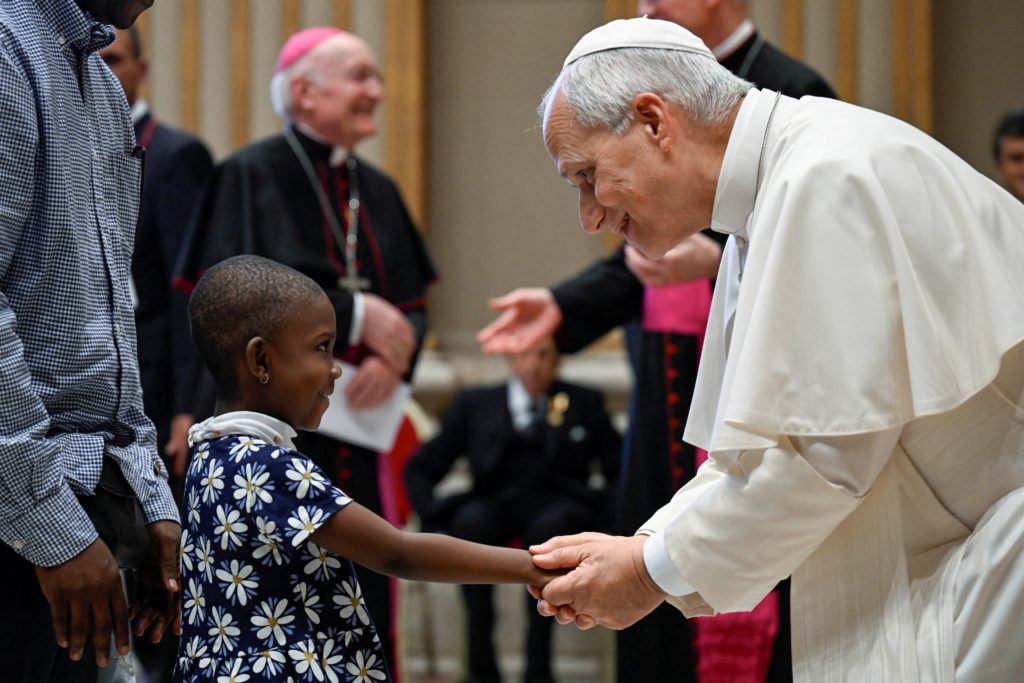
Pope Leo XIV greets a child during a meeting with members and volunteers of the Circolo San Pietro at the Vatican Oct. 12, 2026. Political and religious leaders worldwide offered prayers and support for Pope Leo after he announced Oct. 11 that he will undergo surgery to remove a small, localized lung nodule detected by doctors. (OSV News photo/Matteo Pernaselci, Vatican Media)

Sustainability medal and infertility conference without the papal involvement

The pope likewise canceled his appearance at an Oct. 13 ceremony in Castel Gandolfo for the inaugural "Pope Leo XIV Sustainability Medal," an award established by the pope's alma mater, Villanova University. The event will proceed as planned at Borgo Laudato Si' in the Pontifical Gardens of Castel Gandolfo without the presence of the pope.

Because of his anticipated recovery period, Pope Leo is also expected to miss his previously announced speech to open the international infertility conference, "The Splendor of Humanity: Preserving Fertility, Curing Infertility," on Oct. 16. The conference is co-sponsored by Gemelli Hospital, where the pope is scheduled to have surgery.

Bishops from Nicaragua, who are visiting Rome for their scheduled ad limina visit, were also expecting to meet the pope for a private audience this week. Pope Leo received Bishop Carlos Enrique Herrera Gutiérrez, the president of the Nicaraguan bishops' conference, for a private audience at the Vatican on Oct. 12, one of six private audiences the pope held on the day before his scheduled surgery.

Papal surgery ahead of Latin America trip

Pope Leo's surgery is taking place about four weeks before he is scheduled to depart for Latin America for what would be the longest international trip of his pontificate, which includes stops in Uruguay, Argentina and Peru. The Vatican has not announced any changes to the trip.
However, the pope indicated he still intends to visit Peru when speaking to pilgrims after the Angelus Oct. 11, shortly before publicly announcing the surgery.

Addressing pilgrims in St. Peter's Square, Pope Leo said doctors discovered a nodule in his lung during a medical examination. He said the growth was detected "at a very early stage" and was "well-contained."

"The doctors believe intervention is advisable, so, following their advice, I have decided to undergo surgery to have it removed," he said. "The procedure is already scheduled for the coming days."

The 71-year-old pope's surgery is the first major surgical intervention he has publicly disclosed during his pontificate. Popes rarely announce medical procedures themselves.

Pope Francis' visits to Gemelli for checkups or medical procedures, including his 2021 colon surgery and his 2023 abdominal surgery, were disclosed by the press office.

On July 12, 1992, St. John Paul II told pilgrims: "I would now like to share something personal with you," and announced that he would be visiting Gemelli "for some diagnostic tests," which resulted in him undergoing surgery to remove a large tumor from his colon.

The post Pope to be admitted Oct. 13 for upcoming lung surgery, public appearances canceled first appeared on Angelus News.

Angelus News
CM
Angelus News
Courtney Mares2 days ago

Carlo Acutis and the 4 popes

Oct. 12, 2026, marks the 20th anniversary of the death of St. Carlo Acutis, the Italian teenager who captivated a generation of young Catholics with his love of the Eucharist and passion for technology.

Acutis’ journey to sainthood has unfolded alongside the lives of the last four popes, each of whom has marked a different chapter in the teenager’s short life and legacy.

Carlo went on pilgrimage to see John Paul II, offered up his suffering from cancer for Benedict XVI, and was later beatified during the pontificate of Pope Francis. Finally, Pope Leo XIV canonized him, along with Pier Giorgio Frassati, on Sept. 7, 2025, making him the first millennial to ever be made a saint.

A childhood inspired by John Paul II

Born in 1991 during the pontificate of John Paul II, Carlo Acutis grew up at a time when the Polish pontiff was inspiring millions with his travels and teaching. It was Carlo’s Polish nanny, herself devoted to the pope, who helped cultivate Carlo’s early faith.

In October 2000, the Acutis family traveled to Rome to attend a landmark moment of the Great Jubilee: Pope John Paul II’s act of entrusting the new millennium to the Immaculate Heart of Mary. Standing in St. Peter’s Square, the then-9-year-old Carlo witnessed a crowd united in prayer, gathered beneath Bernini’s colonnade and in front of a statue of Our Lady of Fátima.

“The Church today, through the voice of the successor of Peter, in union with so many pastors assembled here from every corner of the world, seeks refuge in your motherly protection and trustingly begs your intercession as she faces the challenges which lie hidden in the future,” John Paul II prayed to Our Lady.

Offering his suffering for Benedict XVI

When white smoke emerged from the Sistine Chapel in April 2005, 13-year-old Carlo Acutis watched closely as Cardinal Joseph Ratzinger was elected Pope Benedict XVI. According to his mother, Carlo was “fascinated” by Benedict XVI.

The following year, Carlo was diagnosed with leukemia. Before he died of cancer in October 2006, he offered up his suffering for Benedict XVI, saying: “I offer all the suffering I will have to endure to the Lord for the pope and for the Church, in order not to go through purgatory and to go straight to heaven.”

Beatification under Pope Francis

Pope Francis declared Carlo Acutis’ heroic virtue in 2018 and recognized the two miracles attributed to Carlo’s intercession that made possible his beatification and canonization.

Francis frequently cited Carlo as a model for youth in the digital age. In Christus Vivit, his apostolic exhortation to young people, Francis wrote that Carlo’s life stood as a witness against the temptation of “self-absorption, isolation, and empty pleasure” in the digital world.

“His witness indicates to today’s young people that true happiness is found by putting God in first place and serving him in our brothers and sisters, especially the least,” Pope Francis said the day after Carlo’s beatification in 2020.

Pope Francis had been scheduled to preside over Carlo’s canonization on April 27, 2025, during a jubilee event expected to draw 80,000 teenagers to Rome. Instead, with Francis’ death on April 21, 2025, Carlo’s canonization awaited a new date until a new pope was elected.

Carlo Acutis and Pope Leo XIV: A witness to young people

Carlo Acutis’ canonization on Sept. 7, 2025, was one of the first major acts of Leo XIV following his election to the papacy in May 2025. In his homily at the canonization, the pontiff hailed Acutis and Frassati as models for youth seeking holiness.

“Dear friends, Sts. Pier Giorgio Frassati and Carlo Acutis are an invitation to all of us, especially young people, not to squander our lives, but to direct them upwards and make them masterpieces,” Leo said.

Their example, the pope explained, is the “type of witness we are called to follow, in order to enjoy life to the full and meet the Lord in the feast of heaven.”

Ishmael Adibuah contributed to this report.

This story was first published on April 27, 2025. It was updated on Oct. 12, 2026.

The post Carlo Acutis and the 4 popes first appeared on Angelus News.

Angelus News
IA
Angelus News
Ishmael Adibuah2 days ago

Rome conference highlights Catholic mental health ministry

A conference in Rome last week brought together clergy, pastoral workers, and mental health professionals to discuss how to overcome the stigma surrounding mental health in the Church.

The conference, “A Healing Presence: The Church’s Call to Mental Health Ministry,” held in Rome from Oct. 9–10, responded to Pope Leo XIV’s October prayer intention for mental health. Organized by the International Association of Catholic Mental Health Ministers, the conference also coincided with World Mental Health Day on Oct. 10.

The conference was also under the patronage of the Pontifical Academy for Life.

Among those present were Bishop Borys Gudziak of the Ukrainian Catholic Archeparchy of Philadelphia, Bishop John Dolan of Phoenix, and Deacon Ed Shoener, a founding member of the International Association of Catholic Mental Health Ministers.

‘The Church is a safe space, not a replacement for psychologists’

Among the themes discussed at the conference was the Church as a place where individuals can seek spiritual remedies for their mental health challenges.

Shoener clarified that the Church and those dedicated to mental health ministry complement medical professionals rather than replace them.

“Our goal is that someday, when someone faces a mental health challenge, the first place they think to turn is the Catholic Church as a safe space, Shoener told EWTN News. “We are not psychologists or psychiatrists providing medical care; rather, we provide the spiritual and social support that is so often missing due to stigma, discrimination, and fear.”

“We work closely with professionals because faith and science must go together,” he added.

Shoener also shared the personal tragedy of his daughter’s 2016 suicide, which prompted him to help establish the International Association of Catholic Mental Health Ministers in hopes that others with similar challenges would be heard.

“Katie had bipolar disorder, lived with it for 10 years, went to college, had friends, and did not fit the stereotypes people often have about mental illness. Sadly, she died by suicide in 2016,” Shoener said.

“Her obituary went viral because we clearly stated that she had a mental illness, was not defined by it, and was a beautiful child of God.”

Speaking about the stigmatization of mental health in the wider culture and the Church, he also cited several reasons for it.

“In the U.S., we often avoid talking about it because we fear it makes us look weak or inadequate, potentially jeopardizing our success or employment. What brought me into this ministry was that overwhelming response from people longing for the Church to comfort them rather than push them aside,” Shoener said.

An epidemic hidden by happiness in Sweden

One participant, Samuelle Falk, discussed opportunities for the Church to minister to those with mental health challenges, particularly in her native Sweden, which is noted for its high Happiness Index.

“To the outside world, Sweden often appears as a model of security and comfort; we even rank fourth in the 2025 World Happiness Report,” Falk said. “Yet, beneath this surface of prosperity, we are facing a profound crisis of youth mental health, driven by a silent epidemic of loneliness.”

“Yet, I believe God has been using this inner suffering to lead a generation back to himself. The Catholic Church in Sweden is experiencing a clear influx of new members. The Church does not stand on the sidelines of the youth mental health crisis; she stands right in the middle of it,” Falk added.

Falk, a psychiatrist in training, began working in mental health ministry with the Diocese of Stockholm. Reflecting on her experience, she spoke of the unique offering the Church can give young people seeking help.

“The Church offers what medicine cannot: a home for the soul, a framework of meaning, and a sense of true belonging,” Falk told EWTN News. “Where youth are increasingly isolated behind digital screens, the Church offers a physical and present community. We proclaim the one truth the secular world cannot offer: Your worth does not lie in your achievements but in being unconditionally loved by God. We remind them that they are never walking alone.”

The post Rome conference highlights Catholic mental health ministry first appeared on Angelus News.

Angelus News
AS
Angelus News
Angelus Staff3 days ago

Saint of the day: Carlo Acutis

Saint Carlo Acutis was born on May 3, 1991, in London, and was raised in Milan, Italy. His parents, Andrea Acutis and Antonia Salzano, always remember him having a deep love for God and the Catholic Church. He inspired both his parents to deepen their own faith, asking his mother to take him to daily Mass from the age of seven. He prayed the rosary often, with a deep devotion to the Blessed Virgin Mary. Carlo often said his secret was to “contact Jesus every day.” 

When he was 15, Carlo was diagnosed with acute promyelocytic leukemia. He offered up his suffering for the pope and the Church. Within a week, he suffered a brain hemorrhage and went into a coma. Carlo died on Oct. 12, 2006 in Milan. 

As a teen, Carlo created a portable exhibition and a website cataloguing Eucharistic miracles around the world. In two-and-a-half years, he compiled a list of 187 Eucharistic miracles, and used his knowledge of computer programming to share the reality of the Real Presence of Jesus in the Eucharist with others. “The Eucharist is the highway to heaven,” he often said. 

Carlo was declared blessed in 2020 by Pope Francis, and was canonized a saint on September 7, 2025, by Pope Leo XIV. He is the patron saint of the internet, and often referred to as the “first millennial saint.” 

The post Saint of the day: Carlo Acutis first appeared on Angelus News.

Angelus News
SR
Angelus News
Stefano Rebeggiani3 days ago

The unique depictions of the Holy Family featured in new Getty Center exhibit

One of the themes in the summer blockbuster “The Odyssey,” as I suggested in my review for Angelus, is paternity in times of crisis.

Since becoming pope, Pope Leo XIV has addressed the theme on various occasions, asking what role families should play in the face of contemporary challenges. His answer offers a more hopeful and constructive vision than, say, Christopher Nolan.

In his encyclical “Magnifica Humanitas”(“Magnificent Humanity”), Leo draws on the biblical account of the reconstruction of Jerusalem’s walls to entrust families with the task of rebuilding society, while rejecting a culture of power that treats war and violence as the only effective responses to mounting dangers.

And in his earlier meditation on the Gospel of the flight to Egypt, he suggests that families are the real antidote to the culture of power, embodied by the tyrant Herod:

“In the despotic and greedy world represented by the tyrant, it is the birthplace and cradle of the only possible answer of salvation, that of God who, in total gratuitousness, gives himself to men without reserve and without pretension.”

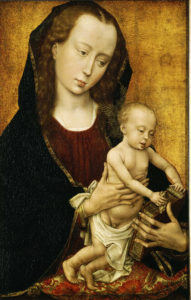
“Virgin and Child,” by Rogier van der Weyden, 1399-1464, Netherlandish. (Courtesy of the Huntington Art Museum)

This discussion makes “The Holy Family at Home,” a rich exhibition at the Getty Center and on display through Jan. 10, 2027, especially timely.

Organized to celebrate the acquisition of “The Holy Family,” a masterpiece by the Dutch painter Gerard David, the exhibition features Northern European paintings and illuminated manuscripts from about 1400 to 1530, drawn from the Getty Museum and local lenders.

The works selected set the newly acquired painting within the wider context of late-medieval and early Renaissance art, highlighting the renewed importance of Joseph after the Middle Ages.

Until the 15th century, Joseph remained largely peripheral in art. He seldom appeared even in key scenes from the life of the Holy Family. When depicted, he was usually shown as an elderly guardian rather than a husband. This was due to the influence of the apocryphal Gospels, which accentuated Joseph’s advanced age to explain his chaste marriage to Mary. Joseph was portrayed as a mere spectator in the history of salvation.

“The Holy Family at Home” exhibition captures this earlier phase in the iconography of the saint through several illuminations and paintings.

In one medieval illumination of the Adoration of the Magi, for instance, Mary is accompanied only by female attendants.

Another highlight of the exhibition, Jan Gossaert’s “Holy Family,” has Joseph as an elderly man who looks perplexed at the Virgin Mary.

The depictions of the Virgin and Child by Rogier van der Weyden and Dieric Bouts provide important precedents for David’s work. Their informal portrayals of the Virgin tenderly embracing her child bring the sacred figures closer to the viewer. In van der Weyden’s version, the curious child opens the clasp of a book of Scripture, a reminder that he will be the fulfillment of whole Scripture. Yet Joseph remains absent from these paintings.

In the early 15th century, the work of French theologian and mystic Jean Gerson played a big role in transforming the perception of Joseph, profoundly affecting later depictions of the Holy Family.

Gerson rejected the picture presented by the apocryphal Gospels and affirmed that Mary and Joseph’s marriage was a real union. Highlighting the daily life of the Holy Family, he set up Joseph as an exemplary model of a loving husband to Mary and a caring father to Jesus.

In the Getty exhibit, this new attention to the role of Joseph is reflected in a series of 15th-century illuminations depicting the Flight to Egypt. Joseph now participates in the redemptive work of his son by protecting him and Mary.

As Leo noted last December, “Being obedient to the voice of the Lord by taking his Bride and child to safety, the gesture of Joseph is revealed in all its redemptive significance. In Egypt, the flame of domestic love, to which the Lord has entrusted his presence in the world, grows and gains strength in order to bring light to the whole world.”

The domestic love within the Holy Family is the hidden presence of God in the world. Stronger than armies and political power, unheeded by the powerful and the wise.

As the great novelist J.R.R. Tolkien put it, “the wheels of the world are often turned (…) but by the seemingly unknown and weak — owing to the secret life in creation, and the part unknowable to all wisdom but One.”

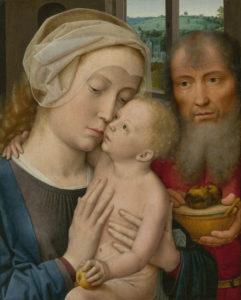
“The Holy Family,” by Gerard David, 1455-1523, Netherlandish. (J. Paul Getty Museum)

David’s painting reflects these theological developments. The Virgin and Child affectionately embrace, while nearby Joseph holds a wooden bowl with baby food (a milk soup and two cooked apples).

The artist brings the Holy Family into the foreground, creating the impression that they share the room with the viewers. The realistic details present them as a real family immersed in the simple, practical concerns of daily life.

The Virgin is dressed in contemporary clothes, and the buildings in the background are from the painter’s time, details which express that the Incarnation is still happening today.

Jesus holds an apple, a reminder that he is no ordinary child: he is destined to reconcile humanity with God after the fall of Adam. He is the new Adam, the firstborn of a new humanity.

By blending the ordinary with the supernatural, the painting captures the theological shock of the Incarnation: God became an ordinary child, in turn giving a supernatural dimension to the most menial tasks of parenting.

“In every child, in every husband or wife,” Leo said in a speech last September, “God entrusts us with His Son, with His Mother, just as He did with Saint Joseph.” He does so, Leo adds, “so that together with them, we may be a foundation, leaven, and witness of God’s love among humanity.”

Families participate in the history of salvation through their dreary everyday routines. Renaissance painters like Gerard David made this reflection visible in their work, and the Getty exhibit provides an unprecedented journey to appreciate their innovative approach.

The post The unique depictions of the Holy Family featured in new Getty Center exhibit first appeared on Angelus News.

Angelus News
JE
Angelus News
Junno Arocho Esteves3 days ago

Pope Leo XIV to undergo surgery to remove lung nodule weeks before South America trip

(OSV News) -- Pope Leo XIV announced that he will undergo surgery after doctors discovered a nodule, or lump, in his lungs.

Speaking to pilgrims gathered in St. Peter's Square Oct. 11, during his Sunday Angelus address, the pope said the nodule was "detected at a very early stage" during a medical checkup and it is "well-contained."

"The doctors believe intervention is advisable, so, following their advice, I have decided to undergo surgery to have it removed. The procedure is already scheduled for the coming days," he said.

Concluding his address, the pope thanked the crowds in the square for their "spiritual closeness" and entrusted himself to their prayers.

Responding to questions from journalists, Vatican spokesman Matteo Bruni confirmed that the surgery is scheduled within "the first few days" of this week and that "the expected post-operative hospital stay is about one week."

The Vatican also confirmed that the pope will undergo the medical procedure at Rome's Gemelli Hospital.

The surprise announcement comes less than a month before his longest international trip to date, a 12-day apostolic visit to Latin America that includes stops in Uruguay, Argentina and Peru.

Nevertheless, during his address to pilgrims, the pope greeted members of the Hermandad del Señor de los Milagros, or the Brotherhood of the Lord of Miracles, a Peruvian religious association that spreads devotion to a revered image of Christ crucified, and said he was moving forward with his visit.

"Thank you for your prayers for the pastoral visit I will fulfill in Peru," the pope said before announcing his surgery.

Shortly after the announcement, Archbishop Paul S. Coakley of Oklahoma City, president of the U.S. Conference of Catholic Bishops, swiftly promised prayers for the U.S.-born Pope Leo.

"The bishops of the United States join with the faithful and all people of good will in praying for his good health," Archbishop Coakley said in a statement provided to OSV News. "May the hand of Pope Leo's surgeons be guided by the divine physician Jesus Christ."

The archbishop added, "Please find a moment today, as I will, to offer a prayer for Pope Leo and his care team."

"We believe strongly in the power of prayerful petitions," Father Joseph Farrell, prior general of the Augustinian Order of which Pope Leo is a member, told OSV News by email.

He added, "The Augustinian brothers and sisters across the globe are praying for our brother Pope Leo XIV. We are praying also for the doctors and entire medical staff who will be assisting him in surgery in the coming days."

Villanova University, Pope Leo's alma mater, said in an Oct. 11 X post that it "joins the global Church in prayer for Pope Leo as he prepares to undergo surgery."

"May God grant the Holy Father strength, healing and a full recovery in the days ahead," said the university.

Villanova University joins the global Church in prayer for Pope Leo XIV as he prepares to undergo surgery. May God grant the Holy Father strength, healing and a full recovery in the days ahead. https://t.co/GTADYlK8yZ

— Villanova University (@VillanovaU) October 11, 2026

The pope's surgery is the first major surgical intervention he has publicly disclosed during his pontificate. A pontiff rarely makes medical announcements, which are often handled by the Vatican press office.

On July 12, 1992, St. John Paul II told pilgrims: "I would now like to share something personal with you," and announced that he would be visiting Gemelli "for some diagnostic tests," which resulted in him undergoing surgery to remove a large tumor from his colon.

Pope Francis' visits to Gemelli for checkups or medical procedures, including his 2021 colon surgery and his 2023 abdominal surgery, were disclosed by the press office.

The post Pope Leo XIV to undergo surgery to remove lung nodule weeks before South America trip first appeared on Angelus News.

Angelus News
AS
Angelus News
Angelus Staff4 days ago

Saint of the day: Pope John XXIII

Pope St. John XXIII was born Angelo Giuseppe Roncalli, in Italy, on Nov. 25, 1881. He was the fourth child of 14, and his parents instilled great faith and love for God. He entered the seminary at the age of 11, became a Secular Franciscan four years later, and in 1901, he entered the Pontifical Roman Seminary. He was ordained in 1904, and was made secretary to the bishop of Bergamo. He also taught in the seminary. 

John was great friends with St. Charles Borromeo and St. Francis de Sales when he was a young priest. He served as a military chaplain during World War I, as a spiritual director of a seminary, and as the Italian president of the Society for the Propagation of the Faith. 

In 1925, Pope Pius XI appointed him a bishop and sent him to Bulgaria as the Apostolic Visitator. John chose “Obedientia et Pax” (Obedience and Peace) as his episcopal motto. Ten years later, he was sent to Turkey and Greece to care for their Catholic populations. During World War II, St. John used his diplomatic status to rescue as many Jews as he could. 

In 1953, he was made a cardinal and Patriarch of Venice. When Pope Pius XII died, he was elected pope. He was a pastoral pope, a good shepherd who cared for his sheep, as illustrated by his social encyclicals. 

On Oct. 11, 1962, John convened the Second Vatican Council, his greatest act as pope. He was affectionately known as “Good Pope John,” for his humility, simplicity, and profound goodness. He was canonized by Pope Francis on April 27, 2014, alongside Pope St. John Paul II, who beatified him. 

The post Saint of the day: Pope John XXIII first appeared on Angelus News.

Angelus News
AS
Angelus News
Angelus Staff5 days ago

Saint of the day: Francis Borgia

St. Francis Borgia was born on Oct. 28, 1510, in Spain. He was the son of the Duke of Gandia, the great grandson of Pope Alexander VI, on his father’s side, and of King Ferdinand of Aragon on his mother’s side. 

Francis’ grandmother and mother lived with a convent of Poor Clares, and led the court of the Borgia in piety, restoring some of the scandalous lineage of the Borgia family. Francis grew in faith, and became a favorite at the court of Charles V. One day, Francis was traveling through Alcala, when he saw a man being escorted to prison by the Inquisition. That man was St. Ignatius of Loyola, who would have a profound impact on Francis’ life. 

In 1539, Francis was made the Viceroy of Catalonia, and then became Duke of Gandia after his father’s death four years later. He built a university, became a Doctor in theology, and invited the Jesuits to his duchy. 

After his wife died in 1546, Francis entered the Society of Jesus, but the pope ordered him to stay in the world, until he had taken care of his 10 children and his duchy. Two years later, Francis left Gandia and joined the Jesuits in Rome. He convinced Ignatius to found the Roman College, and then went to Spain, where he was known for his preaching and his holy example. 

In 1565, Francis was elected as general, and initiated many projects with great zeal even though he was in ill health. He is known for so many reforms and projects with the Jesuit society that he has been considered its second founder. 

St. Francis died on Sept. 30, 1572, and was canonized by Pope Clement X in 1670. 

The post Saint of the day: Francis Borgia first appeared on Angelus News.

Angelus News
CM
Angelus News
Courtney Mares5 days ago

Cardinal Tagle elected dean of College of Cardinals, succeeding Cardinal Re

The Vatican announced Oct. 9 that Cardinal Luis Antonio Tagle has been elected as the new dean of the College of Cardinals upon the retirement of 92-year-old Cardinal Giovanni Battista Re.

Cardinal Tagle was elected in a vote of the most senior cardinals of the Catholic Church, holding the rank of cardinal bishops and who number about a dozen. At age 69, Cardinal Tagle was the youngest cardinal among them with nearly all of the non-patriarch cardinal bishops being over the age of 80 with the exception of 71-year-old Cardinal Pietro Parolin.

Pope Leo XIV approved the cardinal bishops' election on Oct. 8 and gave Cardinal Tagle the traditional title of the suburbicarian church of Ostia, which he will hold while retaining his prior titular suburbicarian see of Albano.

As the dean of the College of Cardinals, Cardinal Tagle will have the responsibility of presiding over a conclave in the event of the death or resignation of the pope. In addition to summoning the cardinals to Rome and leading the general congregations, or daily meetings of cardinals, leading up to and during the conclave, the dean is the one who asks the pope-elect if he accepts the election and what his papal name shall be.

Cardinal Tagle currently serves as pro-prefect of the Dicastery for Evangelization in the Section for First Evangelization and the New Particular Churches, a role he retains with his new responsibility as dean. The Filipino cardinal was considered a "papabile," or papal contender, in the conclaves of 2013 and 2025. Pope Francis promoted him to the highest rank of cardinal bishop in 2020. Cardinal Tagle recently presided over the beatification of Blessed Fulton J. Sheen in St. Louis in September.

Cardinal Re had served as dean of the College of Cardinals since January 2020. He presided over the general congregations leading up to the conclave that elected Pope Leo XIV in May 2025, but because he was over 80, Cardinal Parolin took his place in presiding over the conclave itself as the senior voting cardinal bishop in the Sistine Chapel.

As dean, Cardinal Re officiated at the funeral Mass of Pope Francis and presided over, along with Pope Francis, the funeral of Pope Benedict XVI. Cardinal Re also stood in for Pope Francis as the main celebrant at the altar of many papal Masses during the last years of his pontificate when Pope Francis was suffering from health problems. The cardinal will turn 93 in January.

Upon Pope Leo's acceptance of his resignation, Cardinal Re now has the title of dean emeritus of the College of Cardinals and retains the titular see of the Suburbicarian Church of Sabina-Poggio Mirteto.

The post Cardinal Tagle elected dean of College of Cardinals, succeeding Cardinal Re first appeared on Angelus News.

Angelus News
AS
Angelus News
Angelus Staff6 days ago

Saint of the day: John Henry Newman

St. John Henry Newman was born in London, England, on February 21, 1801. He was the oldest of six children. After studying at Trinity College in Oxford, John was made a fellow of Oriel College, vice principal of Alban Hall, and then vicar of the university church St. Mary the Virgin. 

John became a High Churchman, and when the Oxford movement began, he was its organizer and intellectual leader. The Oxford movement stressed the Catholic elements in the English religious tradition. Newman contributed 24 tracts and several influential books. 

After much historical research, John began to suspect that the Roman Catholic Church was closest in continuity with the Church that Jesus established. In 1845, he converted and was received into full communion as a Catholic. Two years later, he was ordained a priest. He joined the Congregation of the Oratory, founded three centuries earlier, by St. Philip Neri. 

In England, John opened Oratory houses in Birmingham and London. For seven years, he served as the rector of the Catholic University of Ireland. 

John wrote 40 books and 21,000 letters that survive today. Before him, Catholic theology tended to draw deductions from first principles, but John’s work brought forth a key part of theological reflection and writing: the experience of believers. 

In 1879, John was named a cardinal. He took as his motto “Cor ad cor loquitur” (“heart speaks to heart”). He was cardinal for 11 years, dying in 1890. He was buried at Rednal. 

John Newman’s grave was exhumed in 2008, and a new tomb was prepared for him at the Oratory church in Birmingham. 

Three years after his death, a Newman Club for Catholic students was started at the University of Pennsylvania in Philadelphia. Now, ministry centers with his name operate at private and public colleges across the United States. 

John Henry Newman was beatified in 2010, and canonized by Pope Francis in October 2019. 

The post Saint of the day: John Henry Newman first appeared on Angelus News.

Angelus News
HK
Angelus News
Heather King6 days ago

Only with Christ can we ‘take nothing for the journey’

Recently I stayed in Dublin with a friend who, during the course of our visit, told me how she’d once been seated during a transatlantic flight beside a nun from a Catholic religious order called The Little Sisters of the Lamb. When the sisters are out evangelizing, they walk from place to place and beg for food and lodging. They carry no money.

When the meal came, the sister ate a reasonable amount, then pushed her tray away. Noticing an uneaten roll, my friend urged her to take it. “You’ll be hungry later!” she remonstrated. “Pack that up and put it in your pocket.”

But the nun just smiled. “Thanks, but it’s okay. I’m not hungry now.”

The story was intriguing enough that my friend still remembered it years later — and I, too, was fascinated. My own way around food while traveling is the polar opposite. I save not only the bread, but the butter, the extra creamer, sugar, and Splenda packets, the crackers, the fake cheese in a tiny plastic tub, the recyclable utensils, the bottle of water, and the napkins.

“Regard the lilies of the field,” said Jesus, and, “take nothing for the journey, neither walking stick, nor sack, nor food, nor money, and let no one take a second tunic.”

I admire such trust. But I come from a working-class family of eight children and have never been able to shake the hard-wired impulse to stockpile, the fear that there won’t be enough, no one will have your back, you’re on your own, and if there’s not enough, you’ll die.

Then again, I’ve read way too many Holocaust memoirs. In “Cold Crematorium” (St. Martin’s Press, $11.50), József Debreczeni describes lying on his fetid bunk at Auschwitz, hearing a weird crackling noise, and realizing that his cellmate, all but dead, was eating the lice off his own body. So to throw away a roll just seems wrong.

Or so I tell myself.

People often think religion is a choice, a philosophy, a set of rules. But religion isn’t a formula. 

That’s why what’s waste for one person won’t necessarily be waste for another. What’s pathological for one person will be sacrificial martyrdom for another. St. Maximilian Kolbe offered himself up to die in the starvation bunker at Auschwitz in place of a fellow prisoner, a husband and father. The anorexic and Kolbe both willingly starve to death, but their motives are totally different.

Religion is a relationship with Christ, a love for Christ. Without Christ, nailed to the cross, we couldn’t sleep at night, knowing of all the people who are hungry, being trafficked, raped, tortured, killed at any given moment. Without Christ, resurrected, we would never dare to feel joy.

Recently I heard an interview with a woman who’d escaped a religious cult and was, understandably, profoundly traumatized. “Hell is a fiction!” she spat. “And if there is a hell, why aren’t all the so-called religious people praying for the people there? Why don’t they pray all day for the poor people who’ve been consigned to it!”

Oh but we do, we Catholics, I thought. That’s exactly what we do. My friend’s house was across from a convent of contemplative nuns who dedicate their whole lives to praying, among other things, for the salvation of souls. Every late afternoon they had adoration, then evening prayer, then 5:45 Mass.

I’d hosted a writing workshop the previous week, and not having to talk to anyone much now was a relief. I spent a lot of my time in Dublin at the National Botanic Gardens, one of my favorite places on earth. Silence, surrounded by living things. A heron standing stock-still on the path. Magpies. Flowers in shades of butternut gold, violet, russet, bronze. A touch of autumn.

On the first leg of the return trip, a 10-hour flight, I had an aisle seat next to an enormous guy who couldn’t help taking up half my space. Why if you were that big, I wondered, would you sandwich yourself between two people? I guess if you were on the aisle you’d spill out, and if by the window you’d be trapped on one side, I decided — or maybe the dear man had just nabbed the last available space.

I helped him with his seat belt. He offered me some candy from a bag of fruit jellies (I took two reds). When our meals were delivered, I gave him my dessert (a piece of chemical frosted cake wrapped in cellophane), carefully stowing the crackers and water for later.

We smiled at each other.

Then I leaned back and reflected that there are different ways of not bringing an extra tunic. We suffer our ongoing compulsions, bewailing our weirdness and weakness even as we try to offer up our entire selves, like Kolbe. Perennially on the outskirts, we trust there will be enough companionship along the way, enough friends. Along with The Little Sisters of the Lamb, we know that Jesus is our deepest family, our deepest home.

In “The Joy of Believing” (Sophia Institute Press, $19.95), French laywoman and lover of the poor Madeleine Delbrêl wrote:

“In each person there is something that will never be understood by anybody. This thing is the precise cause of our solitude, of this solitude which is intrinsic to us. Our first task is to accept this ‘primordial’ solitude.”

The post Only with Christ can we ‘take nothing for the journey’ first appeared on Angelus News.

Angelus News
SH
Angelus News
Scott Hahn6 days ago

28th Sunday in Ordinary Time: Dressing for the feast

Is. 25:6–10 / Ps. 23:1–6 / Phil. 4:12–14, 19–20 / Mt. 22:1–14

Our Lord’s parable in this week’s Gospel is again a fairly straightforward outline of salvation history.

God is the king (see Matthew 5:35), Jesus the bridegroom (see Matthew 9:15), the feast is the salvation and eternal life that Isaiah prophesies in Sunday’s First Reading. The Israelites are those first invited to the feast by God’s servants, the prophets (see Isaiah 7:25). For refusing repeated invitations and even killing his prophets, Israel has been punished, its city conquered by foreign armies.

Now, Jesus makes clear, God was sending new servants, his apostles, to call not only Israelites, but all people — good and bad alike — to the feast of his kingdom. This is an image of the Church, which Jesus elsewhere compares to a field sown with both wheat and weeds, and a fishing net that catches good fish and bad (see Matthew 13:24–43, 47–50).

We have all been called to this great feast of love in the Church where, as Isaiah foretold, the veil that once separated the nations from the covenants of Israel has been destroyed, where the dividing wall of enmity has been torn down by the blood of Christ (see Ephesians 2:11–14).

As we sing in the Psalm this week, the Lord has led us to this feast, refreshing our souls in the waters of baptism, spreading the table before us in the Eucharist. As Paul tells us in the Epistle, in the glorious riches of Christ, we will find supplied whatever we need.

And in the rich food of his body, and the choice wine of his blood, we have a foretaste of the eternal banquet in the heavenly Jerusalem, when God will destroy death forever (see Hebrews 12:22–24).

But are we dressed for the feast, clothed in the garment of righteousness (see Revelation 19:8)? Not all who have been called will be chosen for eternal life, Jesus warns. Let us be sure that we’re living in a manner worthy of the invitation we’ve received (see Ephesians 4:1).

The post 28th Sunday in Ordinary Time: Dressing for the feast first appeared on Angelus News.

Angelus News
TA
Angelus News
Tyler Arnold7 days ago

Detroit Archbishop Weisenburger backs poll chaplains to guard voting rights

As the 2026 midterm elections approach, people of various faiths are training to serve their communities as poll chaplains — an unofficial role that seeks to offer a peaceful presence at voting locations to ease tensions and ensure every person’s voting rights are respected.

Poll chaplains, sometimes called peacekeepers, volunteer outside of polling locations to help provide nonpartisan election information to voters, seek to mediate tensions that arise, and peacefully intervene and document attempts to intimidate voters or infringe on voting rights.

Even though a poll chaplain is not an official Church or government position, Detroit Archbishop Edward Weisenburger said during a virtual conference in late September that Catholics should be proactive in the democratic process, which includes the protection of voting rights with the help of nonpartisan poll watchers and poll chaplains.

“We are in an especially fraught and significant moment in our nation’s history, with active, and, at times, successful attempts to gerrymander the vote or suppress turnout in areas that might not be favorable to a preferred candidate,” Weisenburger said.

“The Church is well within its theological mandate to be an instrument of activity, seeking out voters and registering them to vote, especially in areas that are being targeted for voter suppression or where tactics of intimidation might be used to discourage voting,” Weisenburger said at the Participation, Dignity, and Elections conference on Sept. 16.

“Inviting and training people to be nonpartisan poll watchers or poll chaplains, and to stand firm in the face of intimidation [is also part of that mandate],” the archbishop said.

The conference, organized by Catholics in Communion, included panels about voter support, electoral participation, political polarization, and the Church’s relationship to democracy, along with other subjects related to elections.

“Democracy can be a vehicle for Godʼs care for the human family, but it requires a state that understands its limitations and is not overreaching in its responsibility to create public good order,” Weisenburger said.

“It requires citizens and freely created associations and groups to recognize the responsibilities and duties that flow from freedom,” he said. “It requires a Church that is willing to boldly proclaim the Gospel and apply that Gospel to the task of building a just and thriving society.”

“May we all embrace that responsibility so that our Democratic Republic of the United States can be such an instrument of Godʼs care for us all,” the archbishop said.

Poll chaplains train for midterms

Various organizations have been recruiting and training people to serve as poll chaplains for the 2026 midterm elections. It is a role that has developed within faith communities in the past few election cycles.

The Rev. Jim Wallis, an evangelical preacher who directs Georgetown University’s Center on Faith and Justice, told EWTN News that the center has trained more than 1,000 of numerous faith backgrounds to serve as poll chaplains for the November elections through the coalition Faiths United to Save Democracy. The last scheduled training is on Oct. 15.

“This isn’t political or partisan for us,” he said. “It’s really theological.”

Wallis, who works to articulate the moral and theological framing for why poll chaplains go to voting locations, said the mission is rooted in Genesis 1:26, when God says, “Let us make human beings in our image, after our likeness,” which expresses the inviolable dignity of every person.

“This foundational biblical teaching about the dignity of every human being made in the image of God is fundamental to all of our human rights, civil rights, and voting rights,” he said. “... To suppress a vote is to assault the image of God.”

Wallis said the center trains people of all faiths and participants include Catholics, Protestants, Muslims, Jews, and Buddhists. He said they have trained a “good mix” of laypeople and clergy, which include Catholic priests. Clergy are encouraged to wear religious garb.

Apart from the usual de-escalation training, Wallis expressed concerns about what he called “threats” from President Donald Trump’s administration to deploy Immigration and Customs Enforcement (ICE) agents and the National Guard to polling locations.

“Polling places have lots of people,” he said. “There’s partisan actors, there’s poll workers. The administration has suggested there be people monitoring elections. … [The chaplains are] a calming presence, they’re often a trusted presence and they’re there to intervene if necessary if intimidation occurs.”

One of the Catholic activist groups involved in recruiting poll chaplains is the Franciscan Action Network (FAN), which alone has recruited 321 volunteers, which include friars, sisters, and lay Franciscans, along with other lay Catholics and Christians.

Robert Christian, director of strategy for FAN, told EWTN News that poll chaplaincy is “deeply compatible with our mission and Franciscan values,” noting that the order is “known for their commitment to peace.”

“Free, fair, peaceful elections allow for the peaceful resolution of differences,” Christian said.

He said “every single person has dignity” and a “right to participate economically, socially, and politically.” Within FAN’s network, he said there’s strong care for “the integrity of elections” and volunteers “want to do their part to make sure everyone feels comfortable showing up on Election Day and [don’t] have to worry about their vote being counted or being turned away.”

Christian said the training focuses mostly on partisan tensions boiling over into the voting line or conflicts between poll workers and a voter. He also said talks about federal intervention, such as ICE agents stationed near voting locations, have caused people to be “nervous.”

“There have been growing concerns around democratic norms and people accepting the outcome of elections,” Christian said. “... It’s a pretty tense atmosphere in the lead-up to the elections.”

The 2026 midterm elections are less than one month away on Nov. 3. Every member of the House of Representatives is up for reelection and there are 35 Senate elections. Many states have local elections and ballot referendums, and there are 36 gubernatorial elections.

The post Detroit Archbishop Weisenburger backs poll chaplains to guard voting rights first appeared on Angelus News.

Angelus News
AS
Angelus News
Angelus Staff7 days ago

Saint of the day: Pelagia the Penitent

St. Pelagia lived in Antioch and worked as a prostitute. One day, she passed a church while dressed in her elegant and provocative clothes. Bishop Nossus of Edessa was celebrating Mass, and although many of the parishioners turned away from Pelagia, the bishop noticed her outer beauty and her spiritual greatness. He prayed for her later that day, and felt that he and his fellow priests should work to adorn their wretched souls as the prostitute worked to make her body beautiful. 

Pelagia went to hear Bishop Nonnus preach the next day. She was so moved by his words that she repented, and asked Bishop Nonnus to baptize her. He agreed, seeing that she was sincere. The night of her baptism, the devil appeared to Pelagia, trying to tempt her to return to her former life of sin. She prayed, and made the Sign of the Cross, and the devil vanished. 

After her conversion, Pelagia gave her wealth to Bishop Nonnus so he could give the proceeds to the poor. She then went to the Mount of Olives in Jerusalem and lived as a hermit, disguised as the monk Pelagius. She performed penances and attained many spiritual gifts. When she died, her gender was discovered, and she was buried in her cell. 

The post Saint of the day: Pelagia the Penitent first appeared on Angelus News.

Angelus News
VC
Angelus News
Victoria Cardiel7 days ago

Pope Leo warns of 'watering down' Christianity, oppression of the weak

Pope Leo XIV on Wednesday called on Christians to be capable of “viewing the world in a positive light,” while urging them to be actively committed to transforming society according to the spirit of the Gospel, without watering down the Christian message.

“It is certainly not by watering down the content or softening the demands that Christianity can be made attractive,” he recalled on Wednesday, citing the address he delivered to the plenary assembly of the Dicastery for Evangelization, Section on Fundamental Questions Regarding Evangelization in the World, on May 28.

During the general audience held in St. Peter’s Square on Oct. 7, the pontiff resumed his catechetical series dedicated to the texts of the Second Vatican Council, following last week’s pause, when he reflected on his apostolic journey to France.

Leo thus continued his catechesis on the conciliar constitution Gaudium et Spes. In particular, he focused his reflection on Chapter 4 of the first part of the document, which is devoted to the Church’s mission in the contemporary world.

“It is the task of the whole people of God, especially pastors and theologians, to discern what in the cultures of our time is worthy of consideration, always taking the word of God and the tradition of the Church as the supreme criteria for discernment. This requires a balanced mind, free from cultural trends, capable of viewing the world in a positive light whilst remaining steadfast in preserving and presenting the Gospel message in its entirety,” he said.

We ‘cannot accept the oppression of the weak’

Before thousands of pilgrims gathered in St. Peter’s Square, Leo XIV reflected on the vocation of the lay faithful in the world and recalled that Vatican II fostered a new awareness of the responsibility of all the baptized in the Church’s mission.

Referring to the concrete demands of the Christian faith, Leo XIV said that, by worshipping Christ, “the believer cannot accept the oppression of the weak and the poor, nor the unjust structures that perpetuate conditions of dependence and injustice.”

“The social doctrine of the Church guides the actions of Christians, who collaborate with all people of goodwill in promoting the common good,” he added.

The principal settings for this evangelizing mission, the Holy Father recalled, are the family and the workplace, though it extends to every sphere of life.

The Church’s purpose is not political

The pontiff also made clear that the Church’s purpose is not political in nature but consists rather in bearing witness to faith and charity.

“The council fathers remind us that the Church’s mission is fulfilled also in contributing to the construction of the earthly city. However, her methods and aims are not primarily of a political order; rather, they consist in bearing witness to faith and charity, together with commitment for justice, peace, and fraternity,” he said.

The Church’s ‘first mission’

Leo XIV further explained that the Second Vatican Council reminds us that the Church is neither “above” nor “beside” the world but is, as it were, grafted into it.

In this sense, he emphasized that the Church “journeys through history in the midst of peoples and cultures,” though its “first mission” remains “to help people be attentive to the profound questions of life: those concerning our origin and our destiny, as well as those concerning the meaning of love and suffering.”

“The logic of profit at all costs and the manipulation of information risk exerting undue pressure on people to conform to a lifestyle centered on the consumption of material goods, but our hearts are made to look upwards,” he said.

Consistency between the ‘faith we profess and our lives’

Leo then recalled that proclaiming the Gospel requires consistency of life on the part of believers. To carry out the Church’s evangelizing mission effectively, the pontiff said, “it is necessary for every baptized person to commit to cooperating with the grace of the Holy Spirit, so that their faith may be living and expressed in consistent behavior.”

In this context, he recalled that the council fathers stated that the discrepancy between professed faith and daily life “deserves to be counted among the more serious errors of our age.”

The importance of the rosary

During his greetings to Italian-speaking faithful after the catechesis, the pope recalled the Oct. 7 liturgical memorial of Our Lady of the Rosary and emphasized the importance of this traditional Marian prayer, noting that it is “greatly cherished in the Church’s tradition.”

The Holy Father stressed that Mary is a “sure refuge amid the difficulties of life.” The memorial of Our Lady of the Rosary, celebrated each year on Oct. 7, recalls the special protection of the Virgin Mary over the Church and encourages devotion to the holy rosary as a path of contemplation, conversion, and the strengthening of faith.

The post Pope Leo warns of 'watering down' Christianity, oppression of the weak first appeared on Angelus News.

Angelus News
KS
Angelus News
Kate Scanlon7 days ago

St. Louis archdiocese sues ICE over Communion, confessions for detainees

The Archdiocese of St. Louis filed a lawsuit against the federal government Oct. 5 over a policy it said prohibits priests from distributing Communion and hearing confessions to U.S. Immigration and Customs Enforcement detainees.

The lawsuit, filed in the U.S. District Court for the Eastern District of Missouri, said the Ste. Genevieve County Detention Center — a detention center ICE uses for migrants awaiting deportation proceedings — has refused to accommodate clergy seeking to provide sacraments to migrants held there, due to its no-contact policy that prevents priests from meeting detainees face-to-face. The policy has left clergy unable to provide sacraments to detainees.

In a statement, the Archdiocese of St. Louis said it "steadfastly supports the right of all Catholics and the priests who serve them to practice their Catholic faith."

"The Ste. Genevieve Detention Center currently prohibits Catholic priests from offering, and Catholic detainees from receiving, the sacraments of confession and communion," the statement said. "Priests are also not permitted to say Mass. Offering and receiving these sacraments is a central tenet of our faith. Catholics receive the real presence of Christ in the Eucharist, and the deprivation of these sacraments imposes real and immediate harm on Catholic detainees and priests."

"As a result of this policy, Catholic priests cannot fulfill the mission to which Matthew 25:36 calls them, namely, to welcome the stranger, clothe the naked, care for the sick, and visit the imprisoned. This ministry is central to our Catholic calling and necessary to care for the souls of detained Catholics," it continued.

A spokesperson for the Department of Homeland Security denied the allegations in a written statement Oct. 6.

"These allegations are FALSE," the statement said. "This is a non-contact county jail, not an ICE facility. Detainees are given the opportunity to practice their religions. All religious items are permitted as soon as detainees make the request. DHS ensures detainees are accommodated with religious services, including access to Catholic priests, the Sacrament of the Eucharist, and the Sacrament of Penance as requested."

"Let's be clear: county restrictions on physical contact do not mean religious services are denied," it added. "DHS has done its due diligence. The media should do theirs before turning a facility security protocol into another misleading headline."

In the complaint, which named local and federal officials including DHS Secretary Markwayne Mullin, the archdiocese argued that the policy barring visitation from clergy violates the First Amendment's free exercise clause and the Religious Land Use and Institutionalized Persons Act, as well as the Missouri Religious Freedom Restoration Act.

The complaint stressed that denying pastoral access to detainees not only violated their religious rights, but also the religious rights of Catholic priests who are "obligated to say Mass and administer the sacraments of the Eucharist (commonly called communion) and Reconciliation (commonly called confession)."

In its statement, the archdiocese said, "Our Catholic priests regularly visit and provide the sacraments to criminal detainees in other jails, but are unable to do so at the Ste. Genevieve Detention Center."

"The lawsuit asks the federal court to halt these policies and restore the religious liberty rights of priests and the detained," it said.

Kevin Appleby, senior fellow for policy and communications at the Center for Migration Studies of New York and the former director of migration policy for the U.S. Conference of Catholic Bishops, told OSV News, "I would think that wherever one stands on the immigration issue overall, a reasonable person would agree that detained immigrants should have the ability to practice their faith, and, in the Catholic tradition, access to the sacraments. It is a fundamental freedom enshrined in our Constitution to which all persons are entitled."

"Immigrants being held in detention and facing deportation are most in need of pastoral support and the affirmation of their God-given human dignity and worth," Appleby said Oct. 6. "To deny that to them is both unnecessary and a violation of human rights."

A failure to provide pastoral access to immigrants in detention "is a growing issue around the country," he said.

"DHS could address this issue simply by issuing a directive requiring their detention centers to allow clergy full access to minister to their people," Appleby said. "For an administration that likes to tout their commitment to religious freedom, this should be a no-brainer.”

In its statement, the archdiocese said, "We have faith that the judicial system will vindicate the God-given right to religious freedom that ensures Catholics — and all the faithful — may practice their faith, even while imprisoned."

The post St. Louis archdiocese sues ICE over Communion, confessions for detainees first appeared on Angelus News.

Angelus News
AS
Angelus News
Angelus Staff8 days ago

Feast of Our Lady of the Rosary

October 7 is the Feast of Our Lady of the Rosary. Known for several centuries as the feast of “Our Lady of Victory,” today’s feast celebrates a 16th century naval victory that protected Europe from Turkish invasion. 

Troops from the Turkish Ottoman Empire had invaded and occupied the Byzantine empire by 1453, bringing a large portion of the Christian population under a version of Islamic law. Over the next hundred years, the Turks expanded their empire westward, conquering and asserting their power. 

In 1571, three Catholic powers — Genoa, Spain, and the Papal States — formed an alliance called the Holy League, to defend their Christian people against the Turks. The Holy League’s fleets sailed to confront the Turks near the west coast of Greece on October 7, 1571. 

In preparation for battle, crews on more than 200 ships prayed the rosary, and Christians throughout Europe joined them in prayer, gathering in churches to invoke Mary’s protection. 

Some accounts say that Pope Pius V was granted a miraculous vision of the Holy League’s stunning victory. All but 13 of the nearly 300 Turkish ships were captured or sunk, and the pope attributed the navy’s victory to the intercession of Our Lady, instituting the feast we celebrate today. 

The post Feast of Our Lady of the Rosary first appeared on Angelus News.

Angelus News
AG
Angelus News
Archbishop José H. Gomez8 days ago

Why Vatican II still matters today

At the start of the year, Pope Leo XIV launched a series of general audience talks on the Second Vatican Council. He plans to talk about each of the 16 documents the Council issued.

He is doing that for a reason. It has been 60 years since the Council, and that generation is passing. Here in America, about 70% of all Catholics were born after Vatican II. 

For most Catholics, Vatican II is all they have ever known. But it is probably also true that most Catholics today do not know very much about Vatican II. 

That is why Leo says we need to rediscover the Council, “to get to know it again,” not by listening to what others say about it but by reading the documents again ourselves.

In the background is the continuing debate over the changes in the liturgy made after the Council. Some Catholics continue to prefer the earlier, pre-Vatican II form of the liturgy. 

But all the popes since the Council agree that the Council was “great grace,” and a work of the Holy Spirit. 

St. Pope John Paul said, “the Council has made the Spirit newly ‘present’ in our difficult age,” and that its documents “need to be read correctly, to be widely known and taken to heart as important and normative texts of the Magisterium.” 

The popes also agree that Vatican II’s liturgical reforms are an authentic development that has grown organically from the Church’s living tradition. 

That does not mean that all these reforms were always carried out with proper care. We need to continue the work of purifying the liturgy. But as Catholics, we can never be tempted to think that Vatican II is somehow not legitimate or that we can choose what we want to believe or how we want to worship. 

I love the Mass that we have been given, especially since the new English translation of the Missal we began using in 2011. What a gift to be able to pray in a language that we know and understand. I find that the words of the liturgy go with me during the day — the prefaces, the collects, the Eucharistic prayers. I realize the truth that what we pray becomes how we live. 

A few weeks back, the Prayer after Communion was this: “May the working of this heavenly gift, O Lord, we pray, take possession of our minds and bodies, so that its effects, and not our own desires, may always prevail in us.”

This is an example of the power and beauty in our liturgy, the noble simplicity! If we pray the words we are given, with reverence and sacred attention, we can celebrate in any of our native tongues, and these words will lift our hearts to heaven and bring Jesus into our lives here on earth. 

And we should not forget: there were strong reasons for the Council’s reforms. 

The liturgical reform movement had begun decades before the Council. There was great concern that people were like spectators at the Mass and did not understand the worship they were offering. The old rite could be profound and beautiful, but the reality was often that the priest was doing one thing at the altar and the faithful were disconnected. 

Pope Benedict XVI said that in the old rite, it often seemed as if “there were two parallel liturgies: the priest with the altar-servers, who celebrated Mass according to the missal, and the laity, who prayed during Mass using their own prayer books.” 

The Mass belongs to the Lord and not to us. 

We need to always be rediscovering the beauty and the mystery of the liturgy, in which the heavens are opened and our worship here on earth participates in the liturgy that goes on around the throne of God. 

In our worship, the Word becomes flesh once again at the altar, the living God comes to be our food and drink, to dwell within us and make our lives his own, and to give us courage and light for our journey. 

What the liturgy demands is our reverence, our submission, our service to the sacred mysteries we celebrate. The words we say, the gestures that we make, are holy and filled with sacred power. 

This is Vatican II’s vision for the liturgy. 

Leo recently devoted eight public audiences to the Council’s “Constitution on the Sacred Liturgy.” I recommend reading what the Holy Father has to say and also reading the document, too. If you have not read it, I think it will surprise you.

Pray for me and I will pray for you. 

And let us ask holy Mary, Mother of the Church, to help us keep being renewed in our own reception of Vatican II. 

The post Why Vatican II still matters today first appeared on Angelus News.

Angelus News
RB
Angelus News
Robert Brennan8 days ago

Keep it simple, stupid: A Catholic lunch lesson for life

I came upon a classic example of “clickbait” online the other day, which says a lot about the state of our fractured society and my own algorithms. It was a “choose one of these options” proposition: are you a “Charlie Kirk” Christian or are you a “Dolly Parton” Christian?

I had no intention of joining the fray, but I did read a half-dozen of the hundreds of comments. Returning quickly to the real world, this made me think about the fractures, fissures, and the internecine skirmishes within our own Church.

It also took me back to a time and place where I was presented with a similar either/or pronouncement. I was attending a roundtable lunch in a Catholic setting with a discussion on a wide variety of Catholic topics. I was out over my skis in this group. They were all well-educated members of the Thomistic wing of the Catholic faith. It was quite clear that as the outsider in the circle, they wanted to know if I was an “us” or a “them.”

When they spoke of themselves as, and I quote, “disciples” of St. Thomas Aquinas, I cringed a little on the inside. To me, that was a descriptor reserved only for followers of the Second Person of the Holy Trinity. At best, a “disciple” of a “disciple” sounded redundant.

These people were a lot smarter than me, and I thought that even if I did voice an objection, I would be shot down with some arcane reference from the Fourth Council of Constantinople, so I kept it to myself. As lunch progressed, though, they dug deeper and hinted strongly that a devotion to St. Thomas Aquinas was an essential component of the true Catholic faith and went even further, suggesting that without such commitment, a person’s salvation could be in jeopardy.

As I am wont to do, I allowed my mouth to get ahead of my brain and responded, “You know, people had been getting to heaven for over a thousand years before St. Thomas Aquinas was even born.” If there was a candle in this room, it would have gone out for lack of oxygen. Visions of my lunch companions sharpening their salad forks to go after the heretic in the room filled my head and left only because they were being squeezed out of my brain space by a sense of panic.

My years as a television writer and all the pitching I did in production offices came to my rescue as I mumbled a backpedal pronouncement that even though my chronology of the great saint was correct, that did not discount his wisdom and power that had been helping people reach their final destination for more than 750 years since his death. It worked — the torches and pitchforks were put away — and lunch continued, but I could tell my lunchmates were no longer sure of my doctrinal orthodoxy.

In the following years, I got a better grasp of the Thomistic approach and the more recent Ressourcement theological paradigm. But I remain a rank amateur in both disciplines. So, if St. Thomas Aquinas was once called the “dumb ox,” what does someone like me do when I am actually the dumbest ox in the room?

There is an answer, and it is KISS — not the band, the acronym: Keep It Simple, Stupid. That plan of attack with deep theological or even plain old everyday dilemmas is usually foolproof, with emphasis on “fool.” There is so much in both the Old and New Testament that is easy to digest, and they are usually the most important things. God saw his creation as “good.” Jesus said there were only “two” great commandments, and if we just followed those two, how different this world would be. The faith should not be as complicated as a 4,763-piece Lego model of the Mona Lisa, and it is not. Jesus left behind a Church to see to that.

I used to use identifying terminology like “Roman Catholic.” I try not to do that anymore, as the Latin Rite is just one of several expressions of the one true Faith, all under the umbrella being held by the pope. Plain old Catholic should be good enough for all of us with no need for a hyphen.

And for all those theologians who are grinding axes on the internet about whether someone is a “Charlie Kirk” or “Dolly Parton” Christian, I would suggest they say they are a Jesus Christ Christian.

Remember … KISS.

The post Keep it simple, stupid: A Catholic lunch lesson for life first appeared on Angelus News.

Angelus News
EN
Angelus News
EWTN News8 days ago

Ahead of Pope Leo's visit, 2.7 million walk to Our Lady of Luján shrine

The rain did not stop the record-breaking number of faithful who made their way on a pilgrimage to Luján, Argentina, this past weekend. According to figures provided by the Buenos Aires Province Ministry of Security, the 52nd Youth Pilgrimage to Luján drew 2.7 million people.

The image of the Virgin set out at 10 a.m. on Saturday, Oct. 3, from the San Cayetano Sanctuary in the Liniers sector of Buenos Aires, carried and escorted by a delegation from the Diocese of Lomas de Zamora.

Buenos Aires Archbishop Jorge García Cuerva, accompanied by La Plata Archbishop Gustavo Carrara, also set out from Liniers.

Reflecting on the pilgrimageʼs motto — “Mother, in your embrace we recognize each other as brothers and sisters” — García Cuerva observed: “To be brothers and sisters, the first step is discovering that Mary is the mother of all, and that she unites us. I believe we need to lower the intolerance and contempt we have on occasion for others; we must stop emphasizing what divides us and instead focus on what unites us.”

A pilgrim is trapped with an image of Pope Leo XIV is seen outside the Basilica of Lujan in Argentina on the outskirts of Buenos Aires, Oct. 4 2026, as they take part in the annual procession in honor of Our Lady of Luján before Pope Leo's trip to the country. In November, Pope Leo will travel to Argentina, Peru, and Uruguay. It will be the first papal visit to Latin America of Pope Leo's pontificate and his longest international journey to date. (OSV News photo/Antonio Becerra Pegoraro, Reuters)

In the rain, wearing store-bought or makeshift raincoats, the crowd began the journey of more than 37 miles separating Liniers from the Basilica and National Shrine of Our Lady of Luján, where anticipation is already building for the visit of Pope Leo XIV, who is scheduled to arrive in Argentina on Nov. 8.

Along the way, there was no shortage of prayers and songs, nor of the ever-present support stations where volunteers from parishes, movements, and organizations offered refreshments, assistance to pilgrims, and “free hugs.”

By early afternoon on Saturday, the rain had passed, and the sun even came out. The first pilgrims began to arrive in Luján, which gradually filled with the faithful coming to the feet of the Mother — some walking with great difficulty, others supported by their companions, and most visibly moved.

Upon arrival in Luján at nightfall, the journey became difficult due to the sheer number of people — far greater than in previous years, according to regular pilgrims. Some reported taking over an hour just to cover the final few blocks to the basilica.

Once in Luján, the prayers, expressions of gratitude, hugs, and tears bore witness to the faith of a people who — regardless of age, social class, or political views — had come to receive the embrace of the Virgin of Luján.

Marcos, from Our Lady of Fatima Parish, said he particularly valued the act of making the pilgrimage “not because it is mandatory, but because it allows for a deeper connection with the Virgin, with God, with oneself, and even with oneʼs own family.”

Mariana, a “free hugs” volunteer, described her role as providing that “little push” needed for the final 10.5 miles to Luján “to meet the Virgin.”

“That embrace is not just for the person I give it to, but also for the one I receive; because I, too, receive so much affection and love — it is a caress for the soul.”

Going on pilgrimage, she affirmed, “means following in Jesus' footsteps, going to meet Mother, just as Jesus walked with Mother. I imagine Mary teaching Jesus to walk, waiting for him in a little spot, ready to steady him so he wouldnʼt fall. That is how Mary is with us: waiting for us, steadying us so we can reach our destination,” she reflected.

García Cuerva celebrated the pilgrimageʼs main Mass early Sunday morning in Plaza Belgrano, facing the basilica.

Pilgrims pray inside the Basilica of Lujan in Argentina on the outskirts of Buenos Aires, Oct. 4 2026, as they take part in the annual procession in honor of Our Lady of Luján before Pope Leo XIV's trip to the country. In November, Pope Leo will travel to Argentina, Peru, and Uruguay. It will be the first papal visit to Latin America of Pope Leo's pontificate and his longest international journey to date. (OSV News photo/Antonio Becerra Pegoraro, Reuters)

In his homily, García Cuerva noted that “there are no ideological rifts or exclusions on the pilgrimage.”

“The journey leveled the playing field for us all; as we walked, we all wore out our shoes, we all grew tired, and we all longed to reach Mary’s home. What a profound lesson we learned! When we realize we are fellow travelers belonging to the same people, there is no room for individualism or hate speech,” he declared.

Reflecting on the state of the nation, he also observed that “our country has many embraces yet to be shared: embraces of forgiveness in the face of so much disparagement and insult; embraces of solidarity amid such indifference; embraces of reconnection amid such lostness; deep embraces — not merely formal gestures — but embraces from the soul.”

Along these lines, he also spoke of “wounds of disparagement, intolerance, and physical and verbal violence" — wounds that "are already festering, and it seems the heart of the Argentine people is becoming infected."

He therefore urged: “It is time for us to unite. If the Virgin of Luján embraces us all, it is impossible to look upon each other with contempt, for the other is my brother.”

Addressing the faithful, he invited them to be “artisans of fraternity” and to bring Mary’s embrace “to those at their breaking point, to the elderly, to those who think differently, to people with disabilities and their families, to the unemployed, to those sleeping on the streets, to adolescents and young people struggling with drug addiction, and to the poorest among us.”

Finally, looking ahead to the upcoming visit of Pope Leo XIV, he encouraged everyone to make this pilgrimage a "school of fraternity for our country, one where "Mary teaches us to respect and forgive one another and to engage in dialogue with everyone; where we stop disparaging our brothers and sisters, stop being indifferent to those who suffer, and stop giving way to hatred among ourselves; because here in Luján, we have experienced that, within her maternal embrace, we recognize one another as brothers and sisters."

The post Ahead of Pope Leo's visit, 2.7 million walk to Our Lady of Luján shrine first appeared on Angelus News.

Angelus News
ME
Angelus News
Madalaine Elhabbal8 days ago

Colorado Christian leaders issue joint letter on immigrants for Cabrini feast day

Catholic bishops and other Christian leaders in Colorado issued a letter on immigrants and refugees in observance of St. Frances Xavier Cabrini’s feast day during the 250th anniversary of U.S. independence.

“This anniversary invites us to remember not only the founding of our nation but also the generations who have helped bring its ideals to life,” the letter, released on Oct. 5, Cabrini’s feast day, said, highlighting that “America’s immigrant heritage is an essential part of, and inseparable from, our national identity.”

Cabrini is the patron saint of immigrants and is the first American to be canonized.

The message, titled “A Pilgrim People, A Shared Hope,” is signed by Archbishop James Golka and Auxiliary Bishop Jorge Rodriguez of Denver, Bishop Stephen Berg of Pueblo, and Father Kyle Ingels, the diocesan administrator of Colorado Springs, as well as several other Christian leaders across denominations. The letter comes as the Trump administration’s deportation efforts across the country continue to stir controversy among Catholics, including in the Archdiocese of St. Louis, which filed a lawsuit Oct. 5 against local and federal officials for barring priests from ministering to Catholic immigrant detainees.

“We remember with respect the Indigenous peoples who inhabited this land long before the nation’s founding, as well as those brought here through slavery and denied the freedom our nation proclaimed,” the letter said. “We also give thanks for generations of immigrants and refugees who arrived carrying their faith, cultures, hopes, and gifts.”

The letter underscored the contributions of immigrants across agriculture, business, science, medicine, technology, and more. “Here in Colorado, immigrants have worked in our mines and fields, taught in our schools, opened businesses, served in our hospitals, raised families and enriched our civic and religious life,” the letter said.

Addressing concerns about national sovereignty and border security, the Christian leaders affirmed “both a nation’s responsibility to protect its people and maintain an orderly immigration system and its duty to treat every person with justice and mercy.”

“Laws should serve the common good while respecting human dignity, protecting the vulnerable, preserving family unity and providing fair legal processes,” the letter said, concluding: “On this anniversary, we invite the faithful to remember the immigrant and refugee stories that have shaped their families and communities; to pray for those displaced from their homes; to support ministries that accompany newcomers; and to build friendships across differences of language, culture and nationality.”

The post Colorado Christian leaders issue joint letter on immigrants for Cabrini feast day first appeared on Angelus News.

Angelus News
GC
Angelus News
Gina Christian8 days ago

Portland's Archbishop Sample calls for 'mission renewal' in pastoral letter

An Oregon archbishop is calling for "mission renewal" across his archdiocese, urging personal holiness, a recommitted clergy, a focus on Catholic education and the efforts of lay faithful to foster a "culture of evangelization."

On Oct. 1, Archbishop Alexander K. Sample of Portland, Oregon, released his pastoral letter "Go therefore and make disciples of all nations."

The publication of the 37-page text, available on the archdiocese's website in English, Spanish and Vietnamese, coincided with the feast of St. Thérèse of Lisieux, devotion to whom Archbishop Sample recommended, especially for archdiocesan priests.

In his pastoral letter, Archbishop Sample pointed to what he called a "watershed moment" in the Church, particularly in western Oregon.

"In the last few years, we have seen ever-increasing numbers of people coming into the Church," he said, adding that such growth was "quite stunning" since "Oregon is considered a very secular and 'unchurched' state."

The archbishop said he was especially encouraged by "the number of young people coming to the Church," while stressing that "the Church in Western Oregon must be ready for this moment."

That task first requires being both "very clear and focused on what that mission is in the first place" and "renewed in our own discipleship," he said.

"We must together contemplate once again the Face of Christ," said Archbishop Sample, referencing his episcopal motto, "Vultum Christi Contemplari" ("To Contemplate the Face of Christ"). "We must let the face of Jesus Christ shine forth from us to the people of our time here in this part of God’s vineyard."

Renewal starts with priests

Such a renewal "will be ineffective if it does not start with" priests, the archbishop said.

Quoting the Trappist abbot and author Jean-Baptiste Chautard, the archbishop said, "If the priest is a saint, the people will be fervent; if the priest is fervent, the people will be pious; if the priest is pious, the people will at least be decent; if the priest is only decent, the people will be godless."

Archbishop Sample specified three areas of clergy renewal: personal holiness in priestly life and ministry; fraternity and communion; and "complete unity in the mission before us in our time."

He invited clergy to develop an interior life based on "deep prayer," including daily Holy Hours before the Blessed Sacrament, spiritual direction, annual retreats and the faithful observance of the Liturgy of the Hours, the daylong cycle of prayer that priests are bound to practice under canon law.

Describing daily celebration of the Eucharist as "essential" to priestly ministry, Archbishop Sample directed priests to follow the archdiocese's liturgical handbook and to reflect their inner devotion to the Mass in their outer performance of its rites.

Regular reception of the sacrament of reconciliation by priests is also crucial, said the archbishop, since "the best confessors are first the best penitents."

He exhorted priests to cultivate devotion to Mary, whom he described as "no better advocate and helper" for their ministry, as well as St. Thérèse, a "special friend and intercessor" whom Archbishop Sample regards as his "'big sister' in the faith."

Pointing to Jesus' prayer for unity at the Last Supper (Jn. 17), the archbishop urged archdiocesan priests "to embrace a true commitment to deeper fraternity, communion, unity, and genuine love for one another," despite differences, time constraints and past hurts.

While noting some priests have been "deeply wounded in their relationships with one another and with me or with former archbishops," Archbishop Sample said, "We must work hard to seek reconciliation and peace with our brothers."

The archbishop asked the lay faithful to pray for their priests, adding, "Support them. Assist them. Encourage them. And forgive us when we make mistakes along the way."

'Mission passionate' Catholic education

Along with clergy rooted in Christ, the Church's evangelizing mission encompasses Catholic education, which strives to "form the hearts and minds of children and young people to know, love, and serve God" in hope of eternal life with him, said Archbishop Sample.

In addition to "social media, the internet, and now the significant challenges of artificial intelligence," he identified "new threats to Catholic faith and moral teaching in public education" that derive from "pervasive philosophical ideologies" -- which have "also crept into Catholic schools."

Among those are secularism, which elevates human reason over "the necessary integration of faith and reason in education" and which "has served as a breeding ground for relativism and the denial of truth," he said.

Pragmatism and utilitarianism have led to education being valued only in terms of "useful outcomes" such as "college and career," the archbishop added.

Moreover, he said, "conflict and critical theories have led to seeing education primarily as a task of raising a new generation of socially conscious activists who can dismantle systems of oppression and become 'agents of change' in the world."

Such thought "must be challenged and replaced with a Christian anthropology," Archbishop Sample said.

While ensuring academic excellence, Catholic schools must "stay focused on what ultimately matters most: bringing the young people entrusted to our care to encounter Jesus Christ and to be transformed by him through their spiritual, religious, intellectual, and human formation," said the archbishop.

To ensure the holistic development of students -- including non-Catholic children and youth enrolled in archdiocesan schools -- he emphasized a "mission passionate" approach to Catholic education and, eventually, to parish faith formation programs.

Catholic school teachers, staff and administrators must themselves be witnesses and examples to the faith, particularly "in the moral realm," Archbishop Sample said.

He admitted that the affordability of Catholic education, in particular for students with special needs, remains a challenge that requires a whole-of-archdiocese response to ensure families can cover tuition.

Catholic schools must not be separated from parish life, he said, and pastors must serve as "the leader and spiritual father of the school community."

According to Church teaching, parents are "the primary educators of their children, especially in the ways of faith," and should exercise that role by creating "a truly Catholic culture in the home," also known as the "domestic Church," he said.

Creating a culture of evangelization

Archbishop Sample said that the "ultimate goal" of his mission renewal vision for the Archdiocese of Portland is "to create a true 'culture of evangelization' within the Church in Western Oregon."

Lay faithful are essential participants in that mission, he said, inviting "every Catholic in Western Oregon" to read sections 30-38 of "Lumen Gentium," the Second Vatican Council's Dogmatic Constitution on the Church, in which the council addressed the laity's role in the Church's life and mission.

Everyday interactions provide numerous opportunities to live out that call, he said.

"We don’t need to be expert theologians or masters of the catechism," Archbishop Sample said. "We must be simply willing to share our faith and relationship with Jesus."

He added that his "dream" would be to see the day "when every Catholic in this Archdiocese wakes up every morning wondering how they can witness to Jesus Christ today and help bring others to him."

The post Portland's Archbishop Sample calls for 'mission renewal' in pastoral letter first appeared on Angelus News.


Angelus News
KH
Angelus News
Kimberley Heatherington8 days ago

Walking 'El Camino Real': Pilgrims seek faith and history on mission trail

Long before the era of winding asphalt roads and cruising American cars, California's longest highway, U.S. Route 101, had another name: "El Camino Real" -- The Royal Road -- christened to honor the Spanish monarchs who financed expeditions to the region as they sought to expand their impressive empire.

The 21 Catholic mission churches Spain planted from San Diego to Sonoma, beginning in 1769 and ending in 1823, are all located on or near Route 101 -- and collectively, they represent one of the largest impacts of St. Francis of Assisi and his religious order upon the United States.

So during the Jubilee Year of St. Francis proclaimed by Pope Leo XIV -- concluding Jan. 10, 2027 -- California's Historic Mission Trail holds obvious spiritual significance. But those who devotedly trek, study and preserve it also want potential pilgrims to know this: The invitation to visit has no expiration date.

Christian Clifford, author of "Pilgrimage: In Search of the Real California Missions," recently conducted a small sample survey to determine just why people walk California's El Camino Real.

"I found that those who did the survey did it for religious and spiritual reasons, number one," he said.

That was followed by those seeking greater appreciation of California history and for an athletic challenge.

"I didn't ask for religious beliefs," explained Clifford, "but I think it's safe to assume plenty of people are doing it to search for more -- something beyond themselves."

He also discovered "not many people" have actually walked the full 800-plus mile route -- which he has.

"It was way harder than I anticipated," he admitted of his 2020 trek. "So I got a lot of blisters and sunburns, and I ran out of water a few times. But I learned along the way."

Author and historian Christian Clifford Iis pictured in a file photo at Mission Santa Clara de Asís in California. Clifford, author of "Pilgrimage: In Search of the Real California Missions," recently conducted a small sample survey to determine just why people walk California's El Camino Real. (OSV News photo/courtesy Christian Clifford)

He credits his success in part to members of the California Mission Walkers -- a group of historians, hikers, religious pilgrims and enthusiasts who either walk or plan to walk the El Camino Real.

Founded in 2013, the organization has over 2,800 members and supports more than 150 people currently walking the trail.

"They gave recommendations on different things to do," Clifford said. "I wasn't prepared -- but I ended up doing the entire, roughly 800 miles, from Mission San Diego to Mission Sonoma, over a 45-day period."

"I did bits and pieces -- because I'm married and we have a child," he added.

That piecemeal approach nonetheless confirms there's no one way to walk the Camino -- it just starts with a step.

As the Mission Walkers' website notes, "This 800 mile pilgrimage can be walked in one continuous thru-hike (which takes 55-60 days), or it can be walked in segments for a week (or a weekend) at a time over a year or more."

Naomi Torres, former National Park Service superintendent of the Juan Bautista de Anza National Historic Trail and keynote speaker for the Mission Walkers' 2026 Conference, said that however hikers choose to approach their walk, they will encounter both beauty and connections.

"The mission walkers are walking on city streets (and) along highways, where cars are zooming by -- but they're also walking in some of the most beautiful places," she told OSV News. "This act of walking is connecting with the land, in a world where there's so much technology and so much coming at us."

And, Torres emphasized, they are literally following in the historical footsteps of others.

"Humans have been doing these paths of pilgrimage -- paths of understanding -- for, I'm sure, millennia, all over the world," Torres said.

Anyone who accepts the El Camino Real challenge may want to adopt the motto of St. Junípero Serra (1713-1784), a Spanish Franciscan friar and missionary often referred to as the "Apostle of California" who is credited with establishing eight of the eventual 21 missions.

St. Junípero, it is said, embraced the credo "siempre adelante!" -- always forward! -- as he planted churches and converted the native population. His legacy has encountered controversy owing to modern assessments of Spanish colonialism's impact upon indigenous peoples; activists have toppled St. Junípero statues and also objected to his 2015 canonization by Pope Francis.

"The historical record really shows that he was a good, holy man," Clifford asserts.

While dramatic or contested history dots the trail of St. Junípero for some seekers, others -- such as Edie Littlefield Sundby, author of the 2024 book "The Mission Walker" published by Thomas Nelson press -- speak of its healing properties.

The subtitle of Sundby's book reveals why: "I was given three months to live."

People walk past Mission Dolores Basilica in San Francisco May 18, 2024. In January 2026, Pope Leo opened the Jubilee Year of St. Francis of Assisi. One of St. Francis' biggest impact on the U.S. came through the 21 Californian missions established by St. Junipero Serra and his fellow Franciscans. (OSV News photo/Bob Roller)

A triggering moment came in 2007 after she received a Stage 4 gallbladder cancer diagnosis, with widespread metastasis.

"When they first discovered the cancer, they told me I was filled with it -- and you know, it's kind of a shock," she said.

Leaving a clinic, she pulled her car into the shade of a tree. "I wanted to catch my breath and say a short prayer," Sundby recalled. "And I remember, I just noticed in the weeds this old California bell marker."

The El Camino Real bells -- actual bells attached to a pole resembling a lamppost -- mark the mission trail route. Installed as early as 1906, they are today maintained by the California Department of Transportation.

The solitary bell struck a chord with Sundby.

"It was so beautiful. Life is so beautiful and intense when you confront it -- when your mortality hits you in the face," she said.

She was determined to respond. By 2013 -- after 79 rounds of chemo, four major surgeries and losing her right lung -- Sundby was on the trail, walking 1,600 miles from Loreto, Mexico, to Sonoma, California.

Ron "Butch" Briery, author of the 2012 guidebook, "California Mission Walk: The Hiker's Guide to California's 21 Spanish Missions Along El Camino Real," was a literal and metaphorical guide; his volume inspired hundreds of people to walk the Mission Trail and form the California Mission Walkers community.

"I connected with him," explained Sundby, "and said, 'I want to do this. I want to walk. I'm determined to do this.'"

Sundby was accompanied by a strong mixture of fortitude and intentionality.

"Every step I took, I would think, I'd exhale cancer out … and 1,000 steps became 1,000 prayers," she recalled. "Basically, when I got to Sonoma, I had 80% normal lung capacity -- as if I'd never had a lung removed. That's what walking -- and prayer and pilgrimage -- can do for us."

Of walking the full route, Sundby said, "Regardless of what your issues are -- what your problems are -- you can get out there."

That holistic outlook, she is convinced, is a true life-saver -- and indeed, she's still walking.

"Life breaks every single one of us -- emotionally, physically, spiritually. We're all broken, and walking heals us," she said. "That's why a pilgrimage is not a one-time event. Pilgrimage needs to be a part of our life. So don't make it just a one-time thing."

The post Walking 'El Camino Real': Pilgrims seek faith and history on mission trail first appeared on Angelus News.
Angelus News
AS
Angelus News
Angelus Staff9 days ago

Saint of the day: Bruno of Cologne

St. Bruno of Cologne was born in 1030, and is said to have been a member of a prominent family in Cologne. Not much is known about his early life, but he studied theology in Reims before returning to his homeland, where he was likely ordained a priest in 1055. 

The next year, he became head of the school he had attended, after its director left for consecrated life. Bruno led the school for nearly 20 years, and earned a reputation as a brilliant philosopher and theologian. In 1075, he was named chancellor of the local diocese. 

At the time, there was an uproar about the behavior of the new bishop, Manasses de Gournai. After he was suspended by a local council, de Gournai appealed to Rome, while attacking and robbing the houses of the council members. Bruno left the diocese during this uproar, although he was considered a possible successor to de Gournai after he was finally deposed in 1080. 

Bruno was not interested in leading the diocese, having resolved to renounce his worldly goods and enter religious life. He was inspired by a dream to seek guidance from Bishop and later Saint Hugh of Grenoble. In 1084, Bruno settled in the Chartreuse Mountains with a small group of scholars who intended to become monks. 

In 1088, one of Bruno’s former students was elected Pope Urban II. Six years into Bruno’s life of monasticism, he was called to help the pope against the hostile Holy Roman Emperor Henry IV and a rival papal claimant. Bruno helped Urban during this critical time of reform, eventually obtaining permission to return to monastic life, but continuing to help the pope periodically. 

In the 1090s, Bruno befriended Count Roger of Sicily and Calabria. Roger granted land to Bruno’s monks, enabling the founding of a major monastery in 1095. Bruno and his Carthusian monks were known for their strict asceticism, poverty, and prayer, and for their unique organization form — combining the solitary life of hermits with the collective life of conventional monks. 

St. Bruno died on October 6, 1101. His Carthusian Order was the subject of a 2006 documentary film “Into Great Silence.” 

The post Saint of the day: Bruno of Cologne first appeared on Angelus News.
Angelus News
KC
Angelus News
Kimmy Chacón9 days ago

How Habitat for Humanity’s ‘Catholic Coalition’ is helping Palisades rebuild

Nearly two years since a historic wildfire leveled most of Pacific Palisades, signs of a comeback are on the horizon.

Several restaurants and stores are open for business, an estimated 10% of homes have been rebuilt, and friends are playing bocce ball at the park again. 

But ordinary residents still face steep challenges.

About three in four Palisades Fire survivors remain displaced. While some have been able to rebuild, the typical homeowner in the Pacific Palisades and Malibu faces a “gap” — the amount between the cost of rebuilding and what insurance covers — of more than $1 million.  

Now, Habitat for Humanity is working to fill it.

Volunteers cleared undergrowth from residential lots in the Palisades where burned down homes will be rebuilt by Habitat for Humanity. (Mike Goulding)

The week of Sept. 22-25, some 500 volunteers from across LA pitched in at a four-day community build event organized by Habitat to benefit wildfire survivors who want to return home but lack the resources to rebuild on their own. Many were from Habitat for Humanity LA’s “Catholic Coalition,” which includes members of 16 Catholic parishes, local Knights of Columbus councils, and Loyola High School.

“We just felt it would be great for LA to have a space to rally together to support the ongoing wildfire relief efforts,” said Chris Untiet, faith relations director for Habitat LA. “So, we decided to do something big for this fall.”

Untiet said the Catholic Coalition played a “big part” in making the build possible.

“It’s still kind of soaking in,” Untiet said of the number of people who showed up to help, many of them parishioners of Corpus Christi Church, which was destroyed in the Palisades Fire, and St. Monica Church in nearby Santa Monica.

As temperatures rose throughout the week, camaraderie at the build sites was on full display. Volunteers powered through, clearing overgrowth at the sites of now empty lots so that foundations can be laid. Others helped serve food. More than 100 people framed walls in the parking lot of Pacific Palisades Presbyterian Church, which was lost in the fire.

Msgr. Torgerson’s parish, Saint Monica in Santa Monica, rallied dozens of parishioners to help with the community build. (Mike Goulding)

The morning of Saturday, Sept. 25, a few celebrities, including members of the Clippers and Rams, were on hand to help. Msgr. Lloyd Torgerson, pastor of St. Monica, led more than 100 volunteers in a group blessing.

Carmen Kahlberg, a parishioner at Corpus Christi, said Torgerson’s presence on Saturday — and that of her pastor, Msgr. Liam Kidney, for a similar blessing on Tuesday — gave the volunteers “a lot of hope.”

While helping volunteers park at Will Rogers Beach, Kahlberg met a 70-year-old woman who worked for the city and wanted to participate in the effort.

By the end of the day, Kahlberg ran into the woman again on the shuttle back to the parking lot.

“I’ve never done anything like this before. Everybody was so nice to me,” the woman told Kahlberg, who has been a member of the Catholic Coalition since 2017 and participated in the Palisades event for all four days.

Habitat LA currently has 160 Pacific Palisades and Malibu households approved for rebuilds, with another 167 “in the pipeline” that meet eligibility criteria, according to Barry Smith, who belongs to the Catholic Coalition. Several homes being rebuilt by Habitat LA since the wildfire are already nearing completion.

Residents who will benefit from the new homes include “longtime residents, seniors, renters, and households with modest or fixed incomes who face significant barriers to returning home.”

Funding for the new homes comes from private donors, among them Palisades residents, and a long list of corporate sponsors that includes Airbnb, the American Red Cross, Samsung, and NBC. 

The blue angel structure that stood next to Corpus Christi and survived the Palisades Fire watches over volunteers near a worksite. (Mike Goulding)

Smith said the project is not just about rebuilding homes.

“Recovery is about restoring stability, community, and hope,” said Smith, a parishioner of American Martyrs Church in Manhattan Beach.

In the Palisades, Habitat has already completed work on Casa Gateway, an affordable housing development with condos for seniors and qualifying families. 

“There was some damage from the fires at one of those apartments that we were able to help with some basic repairs,” explained Untiet.

Kidney believes the kinship at the building projects is helping bring the scattered community back together.

“They are literally trying to create a humanity that lives in the same home, and that is we take care of each other,” said Kidney, whose church was destroyed in the fire. “We love each other. We respect each other, and we’re there for each other. And Habitat for Humanity has succeeded in doing this.”

As volunteers gathered at the site of Corpus Christi, they drew inspiration from a physical symbol of hope that was hard to miss: a blue angel sculpture — one of several from a citywide public art installation in 2000 — that had been decorated by parish school students. It had once faced the crosswalk where kids walked on their way to school, and was one of the few objects from the church that survived the fire.

Carol Sanborn, longtime co-chair of the Catholic Coalition and also Corpus Christi’s director of pastoral ministry, remembers the day a landscaper called her over to point out the word “hope,” which was written on the angel’s lips. On the wing was a painted image of longtime former Corpus Christi Principal Sister Patricia McGann, whose funeral was held just days before the Habitat build.

“We just all felt like we had a guardian angel who was looking over us,” said Sanborn, who lost her family’s home of 40-plus years in the fire. “That word, hope … we felt that that was very much a theme of these last four days.”

The post How Habitat for Humanity’s ‘Catholic Coalition’ is helping Palisades rebuild first appeared on Angelus News.
Angelus News
CM
Angelus News
Courtney Mares9 days ago

Bishop Tylka presents Pope Leo with relic of Blessed Fulton Sheen at Vatican

Bishop Louis Tylka of Peoria, Illinois, presented Pope Leo XIV with a relic of the recently beatified Blessed Fulton Sheen during a private audience at the Vatican Oct. 5.

Bishop Tylka was one of four U.S. bishops who met the pope on Monday. The pope also received 75-year-old Archbishop Thomas G. Wenski of Miami for an individual private audience, as well as the leadership of the U.S. Conference of Catholic Bishops.

For the bishop of Peoria, the opportunity to give the Chicago-born pope the relic was "a profound joy and privilege," especially because of Pope Leo's personal interest in Blessed Fulton Sheen, who was beatified in St. Louis on Sept. 24 with about 50,000 people in attendance.

"To place a relic of this son of the Diocese of Peoria into the hands of the first American pope, both of whom are from Illinois, was an especially moving moment," Bishop Tylka said in a statement following the papal audience.

"The Holy Father's own interest in Archbishop Sheen reminds us that his witness continues to speak to the Church today and challenges all of us to proclaim the Gospel with the same conviction and joy," the archbishop added.

Msgr. Jason Gray, the executive director of the Peoria-based Archbishop Fulton J. Sheen Foundation, also took part in the papal audience.

"I felt that Archbishop Sheen was with us in spirit when greeting Pope Leo," Msgr. Gray said. "I am grateful that Pope Leo spoke so fondly of Archbishop Sheen, whom he remembered watching when he was young."

Pope Leo has previously praised Blessed Fulton Sheen as "a light of faith, hope and love that shone through the radio and television media for decades," as his broadcasts brought the Gospel to millions of Americans.

In comments to OSV News on the papal flight to Paris, France, the American pope recalled spending time with his family as a child watching Archbishop Sheen on television and remarked that he would have liked to attend the beatification.

The pope's first private audience of the day was with the U.S. bishops' conference president and vice president, Archbishop Paul S. Coakley of Oklahoma City and Bishop Daniel E. Flores of Brownsville, Texas, respectively. The bishops were joined by Msgr. Michael J.K. Fuller, the USCCB general secretary, and Father Paul B.R. Hartmann, associate general secretary.

The papal audience is part of the annual visit made by the leadership of the U.S. bishops' conference to Rome to meet with offices in the Roman Curia.

Chieko Noguchi, USCCB spokesperson, told OSV News that the meeting was an opportunity to update Pope Leo on the Church in the United States.

"The USCCB is grateful for the opportunities that our bishops have to spend time with our Holy Father and assure him of our support and prayers," she said.

While in Rome, Archbishop Coakley will participate in the Oct. 7-14 meeting on marriage and family convened by Pope Leo, who called the heads of national bishops' conferences worldwide as well as the heads of Eastern Catholic Churches to the event, titled "Ten Years After 'Amoris Laetitia': Proclaiming the Gospel With Families Today."

Last week, Pope Leo had private audiences with two other U.S. bishops. The pope met one-on-one on Oct. 1 with Archbishop Paul D. Etienne of Seattle and with Bishop Robert E. Barron of Winona-Rochester, Minnesota, who presided over the diaconate ordination of 18 American seminarians from the Pontifical North American College during an evening Mass in St. Peter's Basilica.

The post Bishop Tylka presents Pope Leo with relic of Blessed Fulton Sheen at Vatican first appeared on Angelus News.