
On Sunday, Pope Leo XIV surprised the world by announcing he will undergo surgery this week.
“Dear friends, during some recent medical examinations, the doctors found a small, localized nodule in my lung,” he said after reciting the Angelus in the Vatican.
“It was detected at a very early stage and is well-localized. The doctors believe that it is best to intervene, so, following their advice, I have decided to undergo surgery to remove it,” Leo explained. “The operation is already scheduled to take place in the coming days. I thank you for your spiritual closeness and entrust myself to your prayers.”
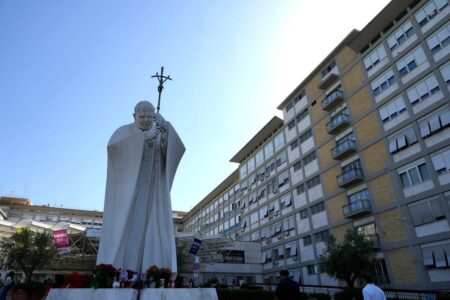
Holy See Press Office spokesperson Matteo Bruni told journalists the surgery will be performed at the Gemelli Hospital in Rome, and Pope Leo’s recovery period should be about a week.
RELATED: Pope Leo XIV will undergo surgery to remove a nodule on his lung
The last time a pontiff personally announced he was visiting a hospital was over 30 years ago. Pope St. John Paul II made a brief announcement at his Angelus on July 12, 1992.
“I would now like to confide something to you. This evening I will go to the Gemelli Hospital to undergo some diagnostic tests,” he told the crowd. John Paul made the announcement in Polish, which meant most journalists couldn’t translate it immediately. (They did soon receive an Italian copy of the transcript.)
What happened on Sunday was truly a revolution in papal transparency.
John Paul II went to the hospital several times – he often referred to the Gemelli Hospital as part of the Vatican – making his first visit after he was shot in 1981.
However, what happened at the hospitals was often not fully reported and was always downplayed, even into his final year. Holy See Press Officer Joaquín Navarro-Valls was criticized for this, especially when he said the pope was eating biscuits immediately after having an “elective tracheotomy” in the year of his life.
By the era of Pope Francis, the Vatican had become more open about reporting a pope’s medical care.
However, the Vatican only announced his 2021 visit to the Gemelli on the day he was admitted. In 2025, he spent 38 days in the hospital, and the Vatican did say his condition was “critical.” However, it later came out how close he came to dying: His surgeon, Dr. Sergio Alfieri, said in an interview after the discharge that the medical team had considered stopping treatment so he could die in peace.
Reporters are frustrated by this history of not getting information about papal health, and they often say it illustrates the problems of Vatican secrecy in general.
Yet the announcement on Sunday also highlights the costs of this greater transparency.
Pope Leo made another major announcement on Sunday.
“The war in tormented Ukraine continues to cause suffering far beyond its borders, especially in the poorest countries, where so many people depend on grain imports,” he said shortly before he spoke about his upcoming surgery.
“I make a heartfelt appeal to the parties to the conflict to allow for the safe transport of grain through the Black Sea. The daily bread of millions of people cannot be held hostage by the war,” Leo declared.
This barely made the news.
Since last week, the heads of the bishops’ conferences around the world have been discussing Pope Francis’s Amoris Laetitia. Monday’s session was scheduled to focus on divorce and families “in difficulty.” Will this make the headlines, or will interviews with thoracic surgeons about what kind of operation Pope Leo will receive?
Pope Leo is scheduled to attend the 40th annual interreligious meeting for peace on Oct. 27. That’s just over two weeks away: If he doesn’t go, his non-appearance will be the news; if he does attend, the media will focus on how he looks.
Next month, Pope Leo is scheduled to visit several cities across Uruguay, Argentina, and Peru. Will he go? If so, will doctors accompany him? How will he handle the stress and strain of a long journey?
Leo’s openness about his health does have a price: Everything else the Vatican does this week. That is also understandable, since a pope’s medical condition is a bigger story for most people than a decade-old papal document. Secrecy has its costs, too. In 1978, rumors filled the information vacuum after John Paul I died, and they still haven’t gone away.
That affects all of us, even at Crux Now: I had planned to write today about the Church’s contradictions on youth sexuality and promoting young marriage. Then Pope Leo spoke at the Angelus.
Follow Charles Collins on X: @CharlesinRome
Comments (0)