
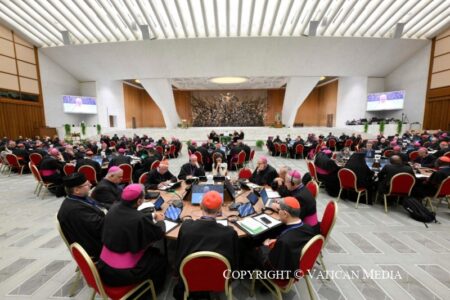
Participants in the 10th anniversary gathering of senior Church leaders, experts, families and facilitators to discuss and assess reception of Pope Francis’s seminal – and highly controversial – exhortation, Amoris Laetitia, continued in Rome as the week opened.
“Life’s difficulties: accompanying and supporting” was the specific theme of the day on Monday, one of five themes chosen for the working days of the weeklong series of sessions that began last Wednesday with a public session and has proceeded behind closed doors.
Heading into the meeting, the president of the bishops’ conference of Indonesia shared with Crux Now some of the challenges facing Catholics in his country.
Familiar challenges
“In Indonesia,” Bishop Antonius Subianto of Bandung said, “families face divorce, migration, interfaith marriages, single-parent households, economic insecurity, and changing attitudes among young people.”
“We have begun developing a more welcoming pastoral approach,” he said, “but we still have a long way to go.”
Subianto told Crux Now of one urgent challenge facing the bishops: Helping “young people to rediscover the beauty of Christian marriage as God’s call to love and holiness.”
“Many desire authentic love but hesitate to make lifelong commitments because they have witnessed broken marriages, domestic violence, infidelity, or unhappy families,” he said.
Pope Leo XIV spoke to the concern in his opening remarks to participants on Wednesday of last week.
“In many contexts,” Leo said, “a growing distance has emerged between the ways in which sex and intimacy are lived and the Christian vision of marriage.”
RELATED: All Vatican eyes are on Amoris Laetitia, but what will Pope Leo show them?
“Young people continue to long for love, fidelity and belonging,” he said, “yet many find it difficult to embrace how such a vision of love can take shape in their own lives or to believe that a lifelong commitment is the condition for reaching what they desire.”
The pontiff explicitly cited economic insecurity, migration, violence, loneliness, “and other forms of emotional fragility also shape the choices people make and the possibilities they can imagine for their future.”
“These realities,” Leo said on Wednesday, “raise a number of questions that we must face with courage.”
Inside and out: Converging views of challenges
Speaking to Crux Now ahead of the gathering at the Vatican, Subianto agreed.
“They need to discover that human fragility does not diminish the beauty of marriage,” he said, “God’s grace can transform our weaknesses into opportunities to grow in love and holiness.”
Crux Now also reached Cardinal Ignatius Suharyo of Jakarta, who confirmed Subianto’s view of things.
“Reality in general, and family life in particular, is becoming increasingly complex as Christian values are progressively eroded by the currents of the times,” Suharyo said.
“Family issues can no longer be addressed in black-and-white terms,” he said.
“The lens of Misericordiae vultus needs to be worn,” he said, recalling the title of the papal bull with which Pope Francis proclaimed the 2016 Extraordinary Jubilee Year of Mercy, “to read and find ways out for family problems.”
Suharyo is not participating in the Amoris meeting – apart from organizers and a few invited guests, the bishops taking part in the gathering are conference heads – but offered his reflections as archbishop of Indonesia’s capital see.
Points of contact with the Gospel
Among the participants is Bishop Stephen Fernandes, auxiliary of Mumbai, who was invited as an expert.
In remarks dated Friday, Oct. 9 and obtained by Crux Now, Fernandes told participants the lived realities of young people in his country, across Asia, and throughout the world do indeed present challenges, but also “point[s] of contact with the Gospel.”
Friday’s reflections were scheduled to focus on “young people and discovering the vocation to marriage.”
Young people, Fernandes said in his prepared remarks, “are unwilling to accept relationships marked by domination, manipulation or inequality. They increasingly expect mutual respect and the equal dignity of women and men.”
“They rightly reject violence and every form of abuse within relationships,” Fernandes said.
“This is not a difficulty to presenting the Christian vision of marriage,” he said, but a set of facts that “can become a point of contact with the Gospel.”
“Christian marriage is a covenant of mutual self-gift. The dignity of each person is safeguarded because husband and wife receive one another as persons and as gifts, rather than as possessions,” Fernandes also said.
The bishop-expert noted how this dimension has particular significance in India.
Young people in India face “not only changing cultural understandings of marriage, but also the concrete realities of caste, economic inequality, gender discrimination, migration, dowry expectations and, in some situations, violence against women,” he said.
“The Christian presentation of marriage cannot be separated from these lived realities,” Fernandes said. “The Christian family,” he said, “must become a place where dignity, equality, reconciliation and non-violence are experienced concretely.”
Comments (0)