

In a culture marked by rising rates of anxiety and a loss of meaning, a growing number of Catholics are seeking ways to promote human flourishing by integrating the best in psychological science with the personalist philosophy of St. John Paul II.
Catholics gathered at the CatholicPsych Institute’s Summit of Integration from Oct. 20–23 in Dallas. Its founder, Greg Bottaro, whose work centers on the integration of St. John Paul II’s teachings on the meaning and purpose of the body with the practice of psychology, told attendees that “St. John Paul II has written more for psychologists than any other psychologist in the last 150 years.”
“John Paul II didn’t use the language of psychology in his theology of the body, but everything he talked about was relatable to the field,” Bottaro told EWTN News. “Faith, reason, and science all come together in his work.”
The theology of the body teaches that the human person is a unity of body and soul, created male and female in the image of God and called to communion through the sincere gift of self. The body has a “nuptial” or spousal meaning: It expresses the person and is ordered toward loving self-gift, which is fully realized either in the permanent, exclusive, and life-giving union of marriage or in the celibate gift of self for the kingdom.
Speakers at the conference, which was timed to coincide with St. John Paul II’s feast day on Oct. 22, tied the saint’s writings to their own work and personal lives.
A love that is ‘stronger than death’
Christopher West, a Catholic author and educator who specializes in the theology of the body, gave an address called “My Interior Journey with St. John Paul II.”
West said the saint’s writings helped him make sense of a yearning that began when he was a child, a yearning that he explained was for a love that would never end.
He described this yearning as beginning with an innocent crush on a girl in his third grade class, but as he grew up, it led him to a disordered view of sexuality and the body: “I wanted a beauty; I wanted a joy; I wanted happiness that lasts forever, that does not die.”
“The Church calls this yearning eros,” the Greek word for romantic love, he said. “Eros cries out for a love that is ‘stronger than death,’” he continued, quoting the Song of Songs in the Old Testament.
“Christianity is an invitation to a wedding feast that corresponds to that cry of the heart,” he said.
St. John Paul II taught that “Christianity is not redemption from the body and sexuality. It is the redemption of the body and sexuality. Christ came into the world, not to condemn those whose eros is distorted, but to untwist it.”
“The most disastrous mistake of Christians is to view sexuality as trash and throw it away rather than redeem it,” he continued. “We have three choices with eros: Repress it, aim it at finite pleasure, or, by the grace of God, learn how to aim our desire for the infinite toward the infinite.”
He said he sees St. John Paul II not primarily as a theologian but as a spiritual father whose writings helped him confront his own fear of death.
“This boundless demand of eros expresses the basic problem of human existence: The heart demands infinity but cannot grant it. It claims eternity but is bound by death,” West continued. “Our deepest fear is staring into our own death.”
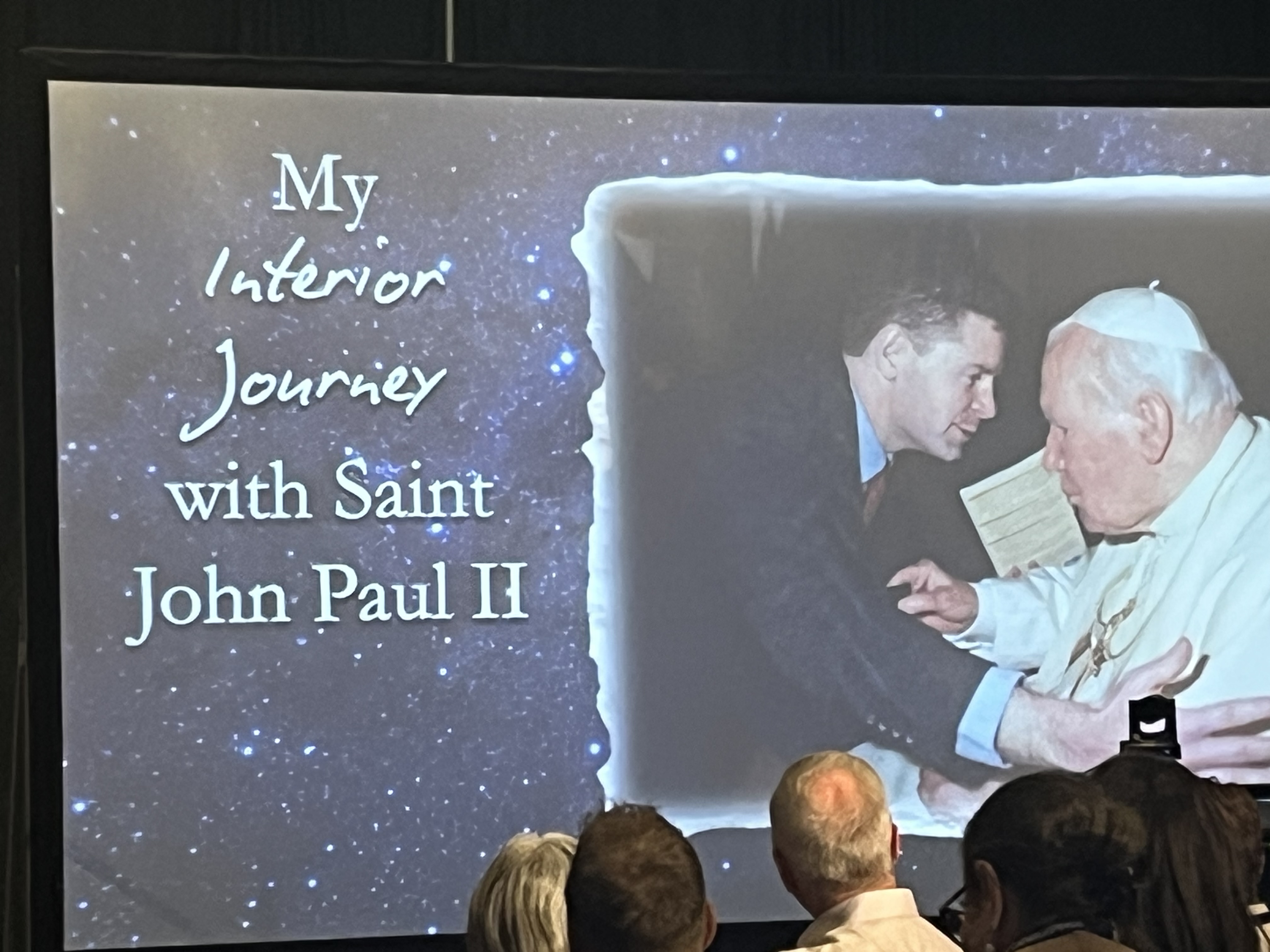
“John Paul II truly fathered me,” West said. “This is the gift of this man in my life: He has helped me face my deepest fear and gave me courage.”
West said he needed that courage to confront difficulties that fear caused in his 31-year marriage to his wife, Wendy, who sat in the front row as he spoke.
He said he had discovered “deep, unconscious wounds of rejection” he’d received from his brother during his childhood but that ultimately came from a fear of death that led him to “rejecting the true heart of my wife.”
“When I have caused you so much sorrow and suffering, it’s because I wanted you to do something you couldnʼt possibly do for me, which is to take away my fear of death,” he said. “I wanted you to take that existential threat away.”
“And weʼre aging, haven’t you noticed?” he asked her, laughing. “Weʼre in our late 50s, and all the gray hair is a reminder that weʼre dying; weʼre all on this conveyor belt, and weʼre all gonna fall off.”
An ‘inheritance to life’
In his keynote, Bottaro repeatedly returned to the idea that Christians receive an “inheritance to life” from God rather than an inheritance of fear and death.
“The inheritance of life, the legacy of life, of the Resurrection is the answer to the deepest fear in the human heart: death,” he said, pointing to St. John Paul II’s admonition to “‘Be not afraid!’”
Bottaro also described the saint as a spiritual father who shaped his life.
He spoke of a visit to Poland during a time he was struggling with discouragement in his work. He was sitting at the kitchen table where a young Karol Wojtyla (John Paul II) had discovered his father dead. As Bottaro sat, he said he felt “John Paul II just put his arms around me,” after which he was able to return to his professional efforts with a renewed purpose.
He spent the next five years writing “The Personalist Cure,” a book that integrates the saint’s theological teachings with psychology. It was released during the conference, on St. John Paul II’s feast day.
Bottaro said the book is a manual for how to understand healing and mental health through a Catholic lens and is intended for anybody studying mental health or human formation.
Michelle Gardiner, a mother of four who attended the conference, told EWTN News the summit “surrounded me with the reality John Paul II gave his life to: Authentic healing begins with reverencing and protecting the inviolable gift of myself and every other human person.”
“We inadvertently turn away from God, the supreme lover who created us for delight, when we reject the gift because of interpersonal wounding,” she said. “John Paul II knew this: Authentic human flourishing requires receiving and protecting the inviolable gift of the human person.”
Comments (0)