By CBCP News
November 16, 2026
MANILA — The Diocese of Kalookan has published a two-volume book documenting how its grassroots mission stations accompany families facing poverty, violence and other social hardships.
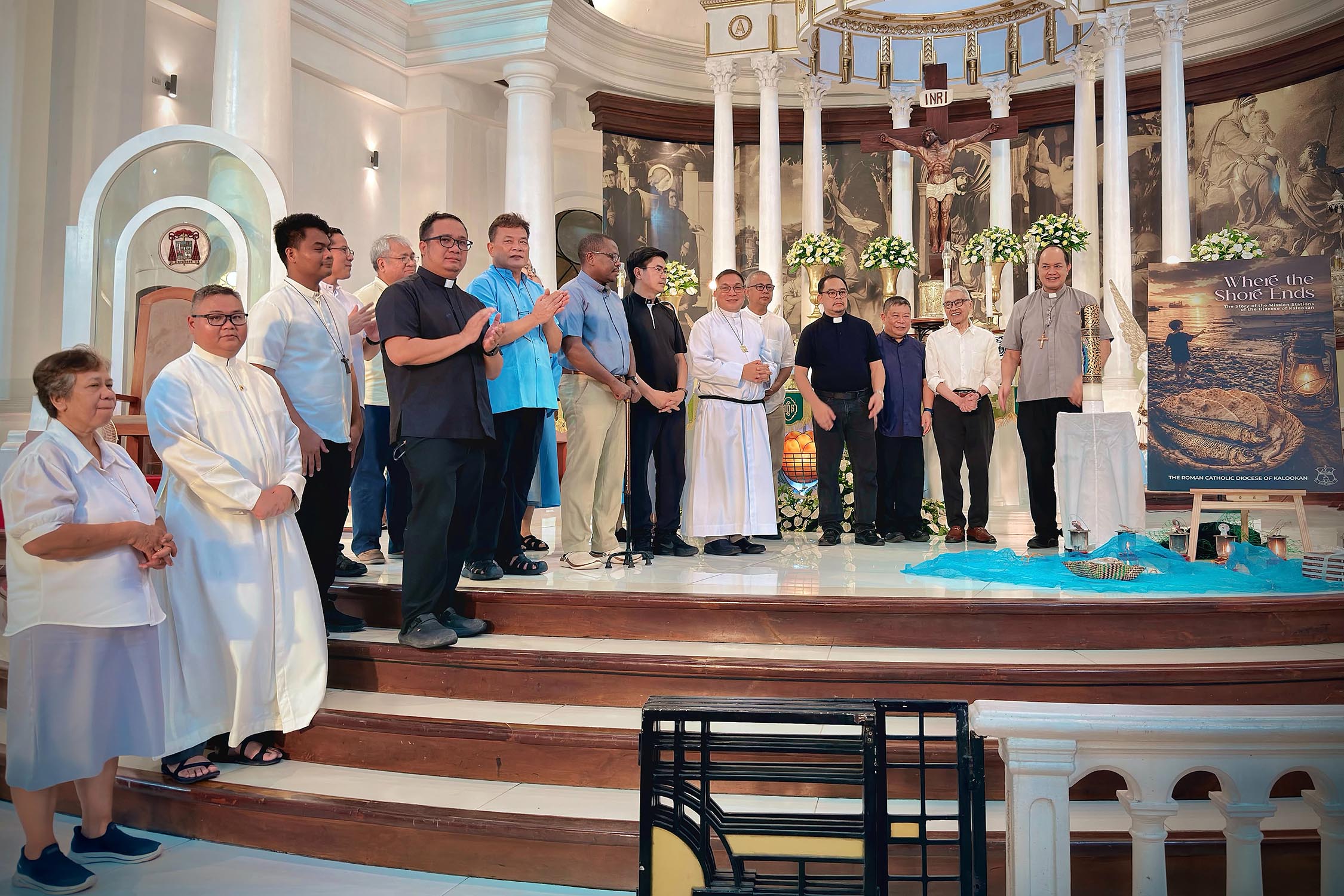
Titled “Where the Shore Ends: The Story of the Mission Stations of the Diocese of Kalookan,” the book was launched Nov. 14 at San Roque Cathedral before more than 500 clergy, religious and lay leaders.
The launch followed Cardinal Pablo Virgilio David’s presentation of the diocese’s experience at a Vatican gathering marking the 10th anniversary of Amoris laetitia, the Church’s document on family life.
The two volumes bring together missionary testimonies and field research from 18 mission stations and two quasi-parishes serving coastal communities and informal settlements in South Caloocan, Malabon and Navotas.
The diocese established its first two mission stations in Tangos and Baesa in 2017 to accompany families grieving loved ones killed during the Duterte administration’s war on drugs.
Speaking at the Vatican on Oct. 12, David said the stations grew out of home visits to families affected by drug-related violence, flooding, poverty, insecure employment and environmental degradation.
“This experience helped shape our mission stations,” David said. “I would say today that the mission stations changed our diocese more than our diocese changed the mission stations.”
“We began to ask, ‘Will the Church go to them?’ That question changed us,” he added. “Accompaniment, then, is not merely what a priest or pastoral worker does for a family. It is what the Christian community gradually learns to become around that family.”
At the book launch, lay leader Liberty “Libay” Gaspi recounted her experience of feeding and teaching children in informal settlements in Malabon.
“You can sacrifice for other people without love, but you cannot sacrifice without love for your neighbor,” Gaspi said in Filipino.
The book was reviewed by theologian Estela Padilla, Father Andrew Recepción, a professor of missiology at the Pontifical Gregorian and Urbaniana universities, and sociologist Randolf David.
Recepción described the publication as a model for urban mission in Asia, emphasizing its focus on presence, listening and communion.
“This book offers the Church in Asia a credible new model of urban mission and a timely witness to what synodality looks like when it walks with the least, the last, and the lost, from the perspective of a Church of the Poor,” he said.
“In this vision, presence comes before programs, listening before proclamation, and communion before structures,” he added.
Prof. David called the publication “a thoughtful documentation of the rich experience of the mission stations,” while Padilla urged readers to approach it with “a mind ready to be disrupted and a heart spacious enough to follow God beyond the shores of our certainties.”
The launch concluded with a candle-lighting ceremony led by David, who commissioned representatives of the mission stations under the diocesan motto Duc in altum (“Put out into the deep”), from Luke 5:4.