New film puts spotlight on unresolved disappearance of Filipino priest
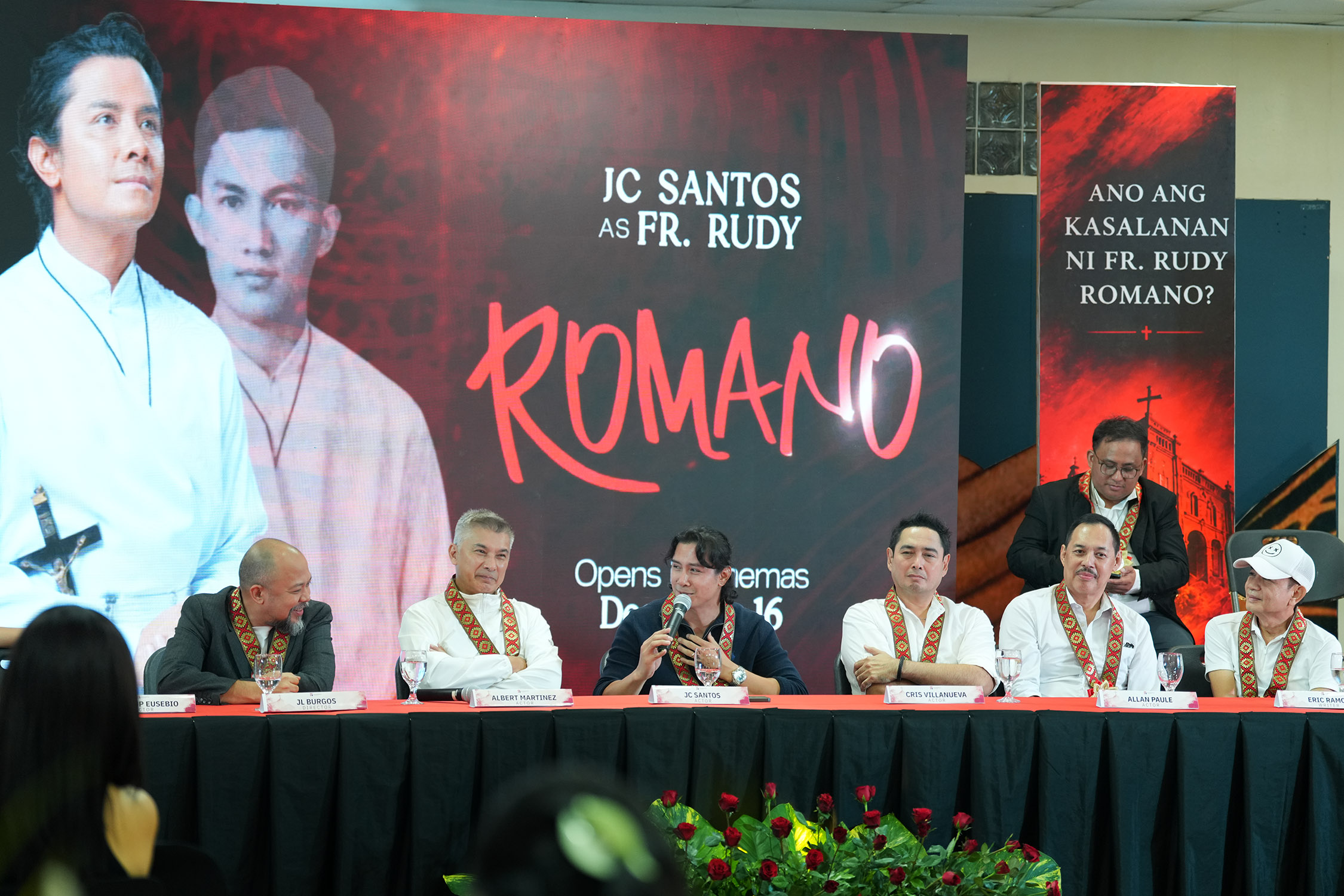
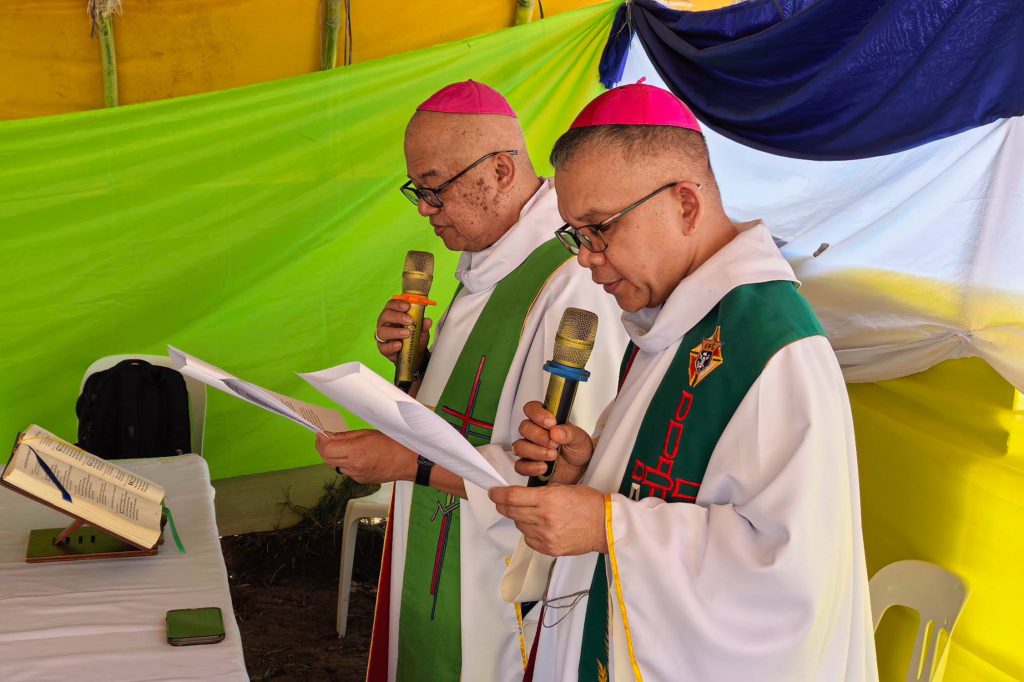
The cast of “Romano,” led by JC Santos, discusses the upcoming biopic about abducted Redemptorist priest Fr. Rudy Romano during a press conference on Nov. 18, 2026. VATICAN MEDIA
By Alexandra Gabrielle C. Mansineros November 19, 2026
MANILA — A new film about a Filipino missionary priest abducted during martial law seeks to revive questions about enforced disappearances and accountability, 41 years after he went missing.
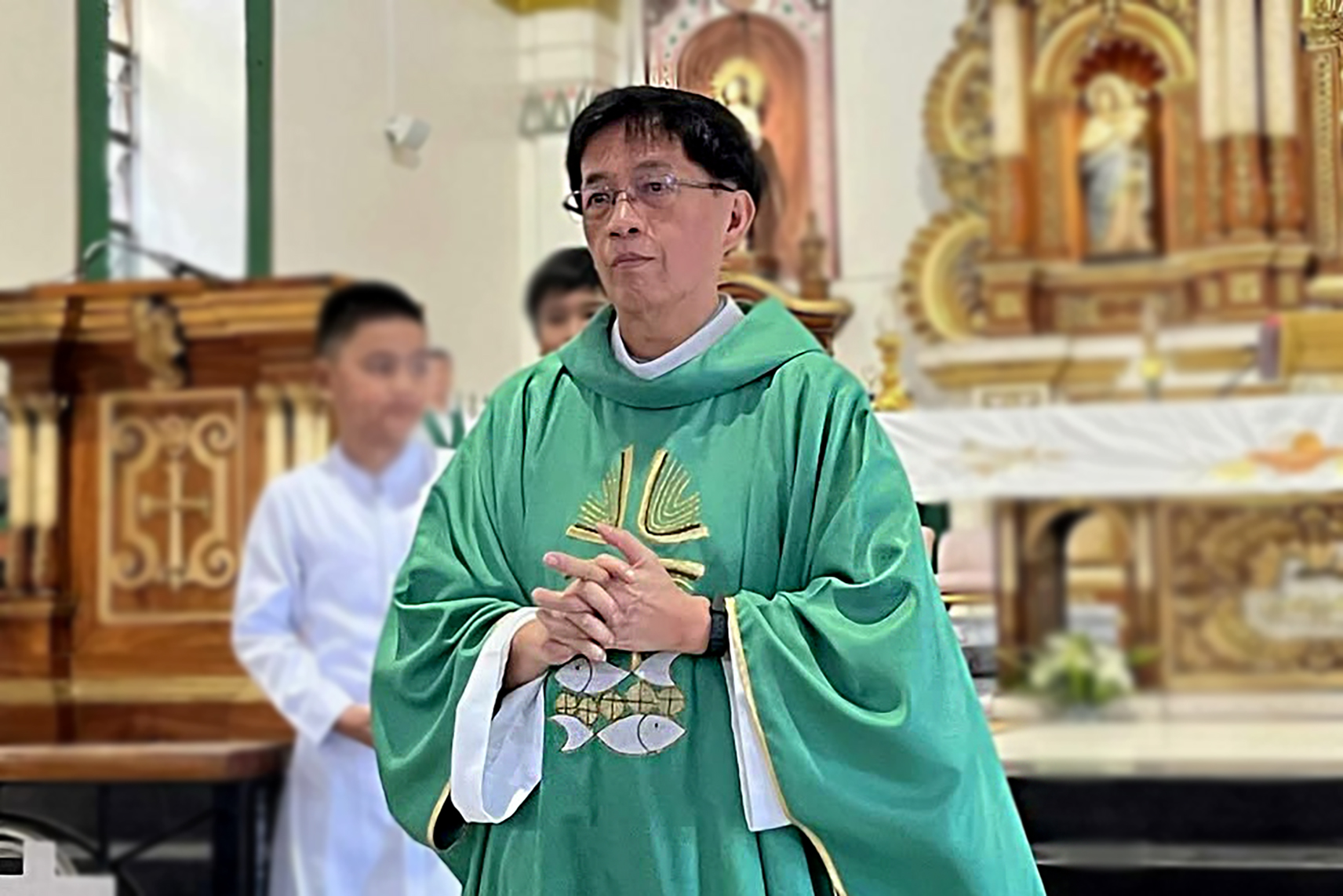
Titled “Romano,” the biopic tells the story of Redemptorist priest Fr. Rudy Romano, who was abducted in Cebu City on July 11, 1985. His fate remains unknown.
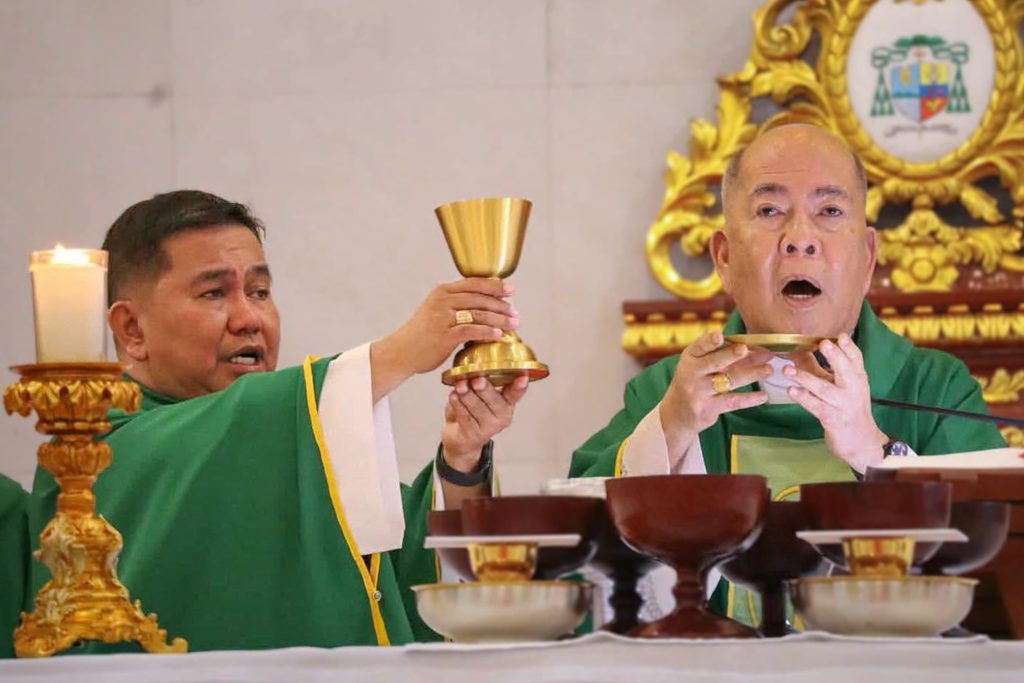
At a Mass launching the film at Baclaran Church on Nov. 18, Redemptorist Fr. Edilberto Cepe said Romano’s life reflected a priesthood rooted in the struggles of ordinary people, particularly the poor and marginalized.
Romano understood proclaiming the Gospel as listening to unheard voices and standing with people whose dignity was threatened, Cepe said.
His disappearance remains an “unresolved wound” in the history of the Redemptorists in the Philippines, he added.
Cepe said the film seeks to recover the congregation’s historical memory and challenge younger generations to carry on its mission.
“Faith is not something we preserve by hiding. It is something we make fruitful by giving it away,” he said.
Director JL Burgos said the film also seeks to draw attention to enforced disappearances and the uncertainty endured by families searching for missing loved ones.
Burgos, whose brother Jonas was also a victim of enforced disappearance, said cases involving alleged state forces are particularly difficult because missing persons rarely resurface.
“When they do, there are usually a few circumstances,” he said, citing cases in which victims face what he described as fabricated charges, are coerced into cooperating with their captors or have already been killed.
Burgos expressed hope that Romano might still be alive, despite the uncertainty surrounding his fate.
Redemptorist Fr. Raymond Urriza said Romano’s story continues to challenge the Church to stand with people who are marginalized and abandoned.
“Especially with the advent of fake news, we’re always standing with the people, especially those who are on the margins,” Urriza said.
The film stars theater and film actor JC Santos as Romano, alongside Albert Martinez, Cris Villanueva, Allan Paule, Joel Saracho, Raul Montesa and Rolando Innocencio.
“Romano” is scheduled to open in cinemas nationwide on Dec. 16, coinciding with the start of the traditional nine-day Simbang Gabi celebrations before Christmas. Its premiere night is set for Dec. 10, International Human Rights Day.
For Cepe, the film should inspire more than admiration for the priest’s courage. It should encourage compassion, solidarity with the poor and greater commitment to defending human dignity.
“A movie can preserve a memory but only a community committed to the Gospel can continue a mission,” he said.
Study: Only 29% of U.S. Catholics believe Christ is present in Eucharist despite bishops’ efforts
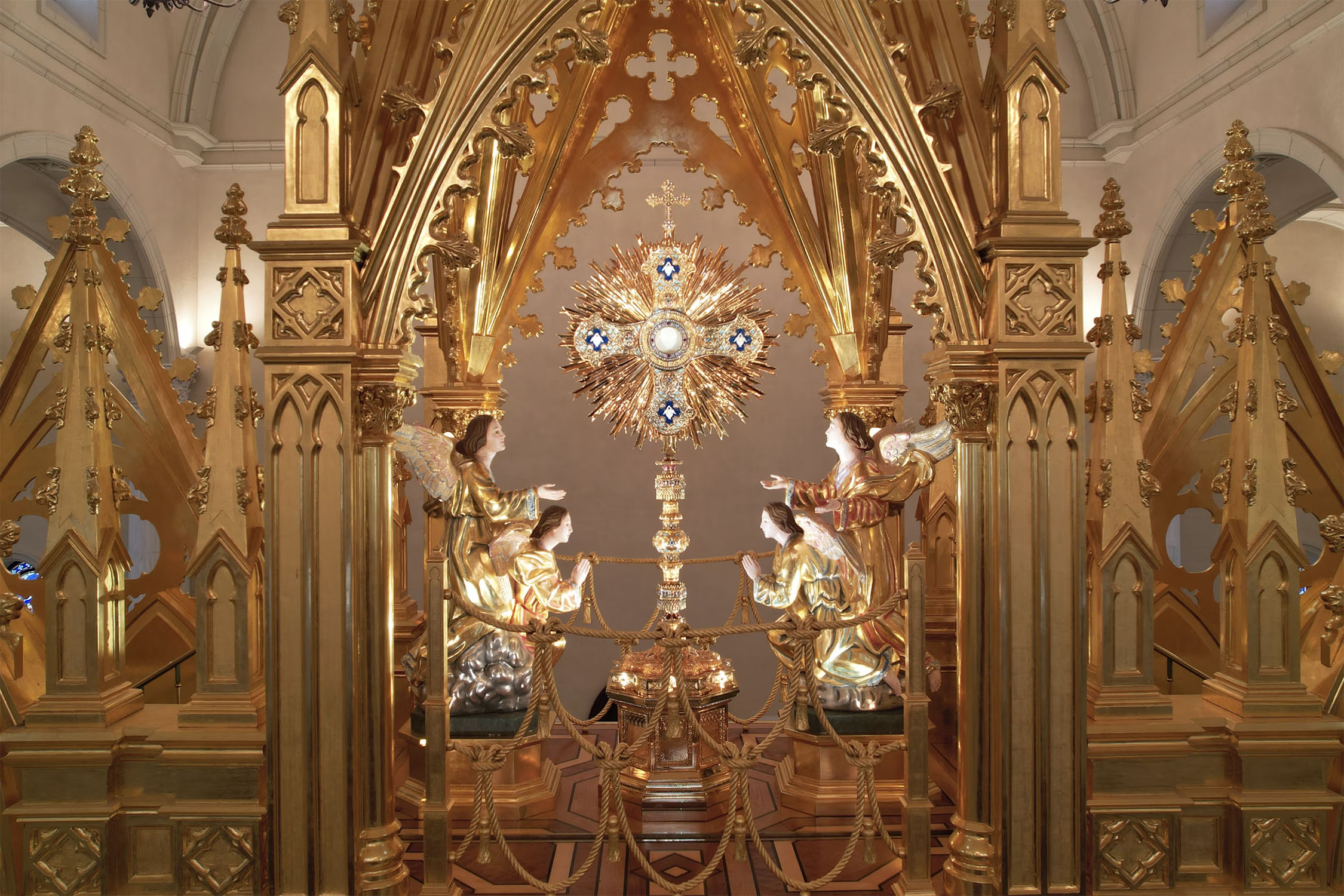
The monstrance housing the Blessed Sacrament is above the main altar at the Shrine of the Most Blessed Sacrament. COURTESY OF THE SHRINE OF THE MOST BLESSED SACRAMENT VIA EWTN NEWS
By Tyler Arnold EWTN News November 18, 2026
A new study has found that less than one-third of American Catholics believe Jesus Christ is truly present in the Eucharist, despite the Eucharistic revival initiative launched by the bishops more than four years ago.
The study, published in the academic journal Sociological Inquiry, found that American Catholic belief in the Real Presence has remained stagnant in recent years. Most Catholics, researchers found, continue to view the Blessed Sacrament as merely a symbol.
Researchers asked 1,049 Catholics whether they believe the Eucharist actually becomes “the Body and Blood of Christ” during consecration or whether they believe “the bread and wine are symbols of his body and blood.”
Only 28.8% answered that “the bread and wine truly become the Body and Blood of Christ” and about 58.8% expressed belief that “they are just symbols,” with approximately 12.4% saying “I’m not sure what happens.”
As one of the study’s authors Mark Regnerus pointed out in a blog post, their research found no statistically significant change from a 2019 Pew Research Center poll that found just 31% of Catholics believe in the Real Presence or from a 1992 Gallup poll that found only 30% of the faithful hold the belief.
Weekly Mass-goers were much more likely than other Catholics to believe in the Real Presence, at about 60%. Among those who attend Mass more frequently, slightly less than 70% believed in the Real Presence. Among those who self-identify as “very religious,” about 40% believed in the Real Presence.
“In a world wherein Catholics are saturated with information — and hence competitors to orthodox belief — it is incumbent on priests to remind parishioners what the Church holds to be true theologically (and socially, etc.),” Regnerus, who is Catholic, wrote in his blog post.
“Unfortunately, the study’s analyses also reveal that those who most need it aren’t likely to be present and listening,” he wrote.
The Eucharistic revival
To respond to the ongoing issue, in June 2022 the U.S. Conference of Catholic Bishops (USCCB) launched what it called a National Eucharistic Revival initiative designed to emphasize the real presence of Christ in the Eucharist.
With a goal of deepening devotion to the Eucharist, the nation’s bishops worked with priests to encourage adoration of the Blessed Sacrament and coordinated Eucharistic processions throughout the country. In 2024 a National Eucharistic Congress was held, attended by about 60,000 people.
“This study highlights that Catholic belief in the Real Presence has been a problem for many years, and it is going to take a while to correct,” David Spesia, the executive director for the USCCB’s Secretariat of Evangelization and Catechesis, told EWTN News.
“The message is clear that Catholics need to encounter Christ in the Eucharist regularly and live as though they have encountered him,” he said. “When we begin to do this, the natural next step is to prayerfully accompany friends or family members to a deeper relationship with the Lord — to ‘Walk with One’ person in our daily life, wherever they might be on their faith journey.”
Spesia said one issue the Church faces is the “secularization” of individuals and communities, and another is an “impoverished understanding of signs and symbols” and “an emptying of a sacramental worldview in favor of a materialistic worldview.”
“The Catholic faithful need to recover a deeper understanding and lived experience of what really happens when we celebrate the sacraments, and this requires lifelong formation and conversion of heart,” he said.
Spesia said the long-term goal of the revival is to reach everyone, “and there is still much work to be done.” Yet, he urged people not to dismiss “short-term fruit among those who engaged with the Eucharistic revival,” which deepened “the belief and practice of those Catholics who are actively practicing their faith so they would be better prepared to take on the mission of the Church to evangelize.”
As the revival initiative continues, Spesia said the bishops received “great feedback” from small-group studies held by parishes during the Eucharistic revival and there is an ongoing strategy “to invite people to hear and respond to the good news in conversation with fellow pilgrims on the journey.”
‘This is my body’
The Council of Trent proclaims that at the moment of consecration, the “substance” of the bread and the wine do not remain. Rather, it is transubstantiated into the true body, blood, soul, and divinity of Jesus Christ even though it maintains the outward appearance and chemical structure of bread and wine.
Affirmation of the Real Presence dates back to Christ himself at the Last Supper, declaring “this is my body” and “this is my blood.” St. Justin Martyr, a bishop and philosopher, explained in the A.D. 150s what the Eucharist meant to Christians: “The food which is blessed by the prayer of His word, and from which our blood and flesh by transmutation are nourished, is the flesh and blood of that Jesus who was made flesh.”
St. Ignatius of Antioch discussed this even earlier, writing in about A.D. 110, warning against the early Docetist heresy, which rejected that Christ had a physical body and also rejected the real presence of Christ in the Eucharist on that basis.
“They refrain from the Eucharist and from prayer because they do not confess that the Eucharist is the flesh of our Saviour Jesus Christ, which suffered for our sins, and which the Father of His goodness raised up,” the bishop wrote.
Tom Nash, a staff apologist at Catholic Answers, told EWTN News that understanding the real presence of Christ in the Eucharist is important because “it sacramentally re-presents Christ’s one sacrifice of Calvary and so enables us to offer anew and partake of the Real Presence of his new covenant Passover Communion sacrifice.”
“The Eucharistic sacrifice is the source of the Christian life because in re-presenting Christ’s one sacrifice of Calvary, we come in contact with the very means by which Our Lord objectively redeemed the world and enabled us to have forgiveness of our sins and the prospect of eternal life,” he said. “Thus our Lord’s words regarding his Eucharistic body and blood, namely, that those who consume it reverently will live forever.”
Jonathan Ciraulo, a theology professor at The Catholic University of America, explained to EWTN News that belief in the real presence of Christ in the Eucharist “is not a marginal concern” for the Church.
Ciraulo said the Real Presence affirms other doctrines: “Christ’s true humanity and real body; the dignity of the human body and its future resurrection; and the interior transformation whereby Christ comes to dwell in the Christian.”
“We would do well to ask ourselves how this apparent loss has reverberations far beyond polls regarding faith in the sacraments,” he observed.
In the Gospel of John, the apostle documents that Christ himself had his own dissenters from this doctrine, who wondered: “How can this man give us his flesh to eat?”
“Amen, amen, I say to you, unless you eat the flesh of the Son of Man and drink his blood, you do not have life within you,” Christ responded. “Whoever eats my flesh and drinks my blood has eternal life, and I will raise him on the last day. For my flesh is true food, and my blood is true drink. Whoever eats my flesh and drinks my blood remains in me and I in him.”
Philippine bishop urges COP31 to give voice to poor, future generations
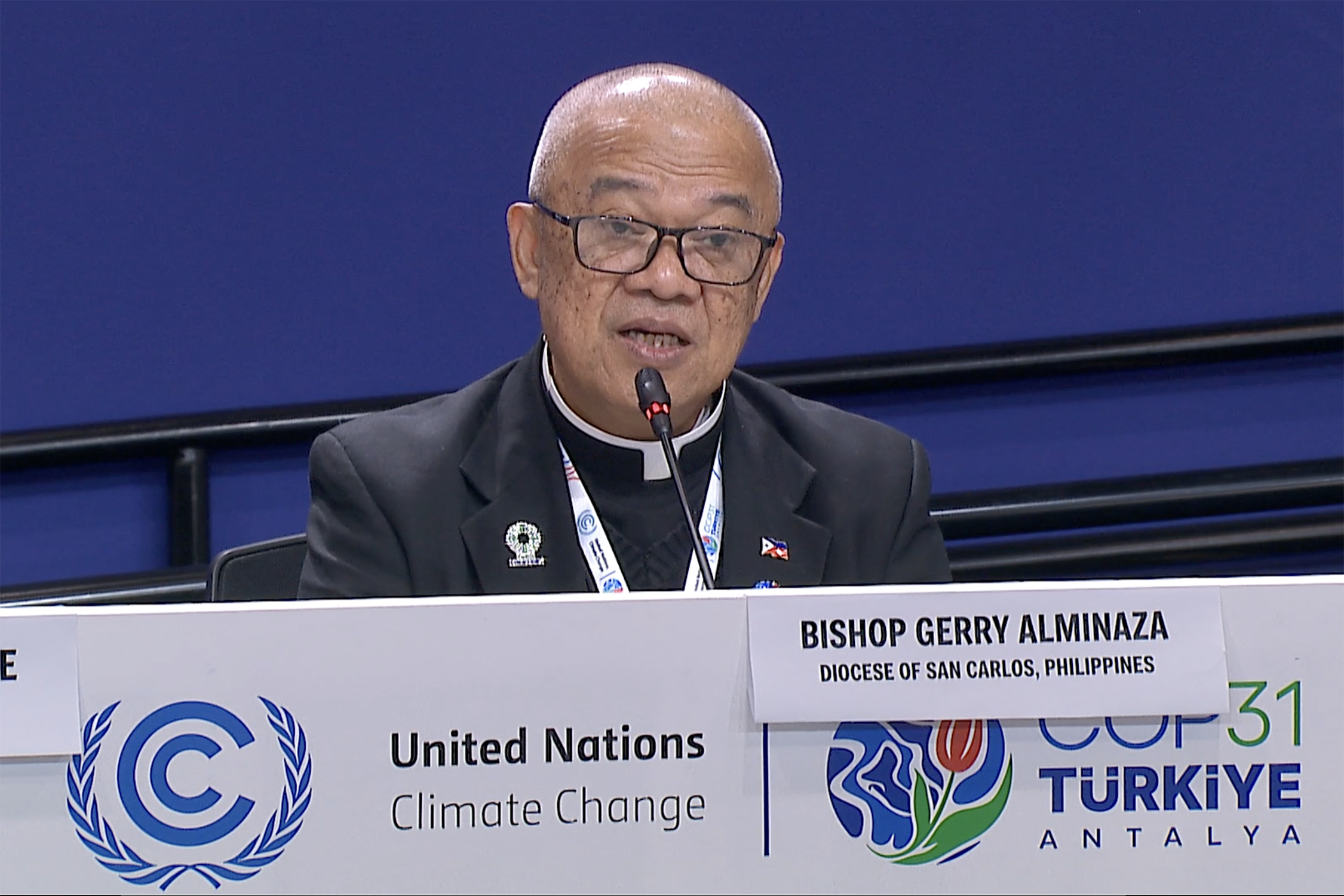
Bishop Gerardo Alminaza of San Carlos, president of Caritas Philippines, speaks at a press conference during COP31 in Antalya, Turkey, on Nov. 17, 2026. SCREEN GRAB FROM UN CLIMATE CHANGE VIDEO
By Roy Lagarde November 18, 2026
MANILA — A Philippine Catholic bishop has challenged world leaders at COP31 to make room for three often-missing voices at the negotiating table: the poor, the planet and future generations.
Bishop Gerardo Alminaza, president of Caritas Philippines, said their interests are often overlooked in climate decisions, even though they bear many of the consequences of environmental destruction.
“Let us remember the three empty chairs often absent in negotiation tables. The poor, our common home, and the future generations,” Alminaza said Tuesday during a press conference at the climate summit in Antalya, Turkey.
“Are their voices present in these negotiations? Are we protecting their future? Or sacrificing it for short-term gains?” he asked.
Alminaza urged governments to accelerate the shift away from fossil fuels and halt new oil and gas exploration in biodiversity-rich and ecologically sensitive areas.
He cited Palawan as an example of how fossil fuel development threatens communities and fragile ecosystems, questioning who benefits from resource extraction and who bears its costs.
Despite decades of gas extraction from its waters, Palawan continues to struggle with costly electricity, he said.
The bishop warned that offshore exploration and drilling threaten marine life through underwater noise, habitat destruction and the risk of spills.
“The cry of the Earth and the cry of the poor cannot be separated,” he said, citing Pope Francis’ environmental encyclical Laudato Si’.
Fishing communities and indigenous peoples depend on the sea for food and livelihoods but often bear the environmental costs of development, Alminaza said.
He called for a shift from coal, oil and gas to renewable energy that protects ecosystems, supports livelihoods and respects human dignity.
“Fossil gas must not become another excuse to prolong dependence on fossil fuels,” he said.
Alminaza warned that Palawan and the Coral Triangle must not become “sacrifice zones” for further fossil fuel development.
“We cannot save the climate while destroying biodiversity,” he said.
Marawi prelature to consecrate new pro-cathedral on Nov. 20
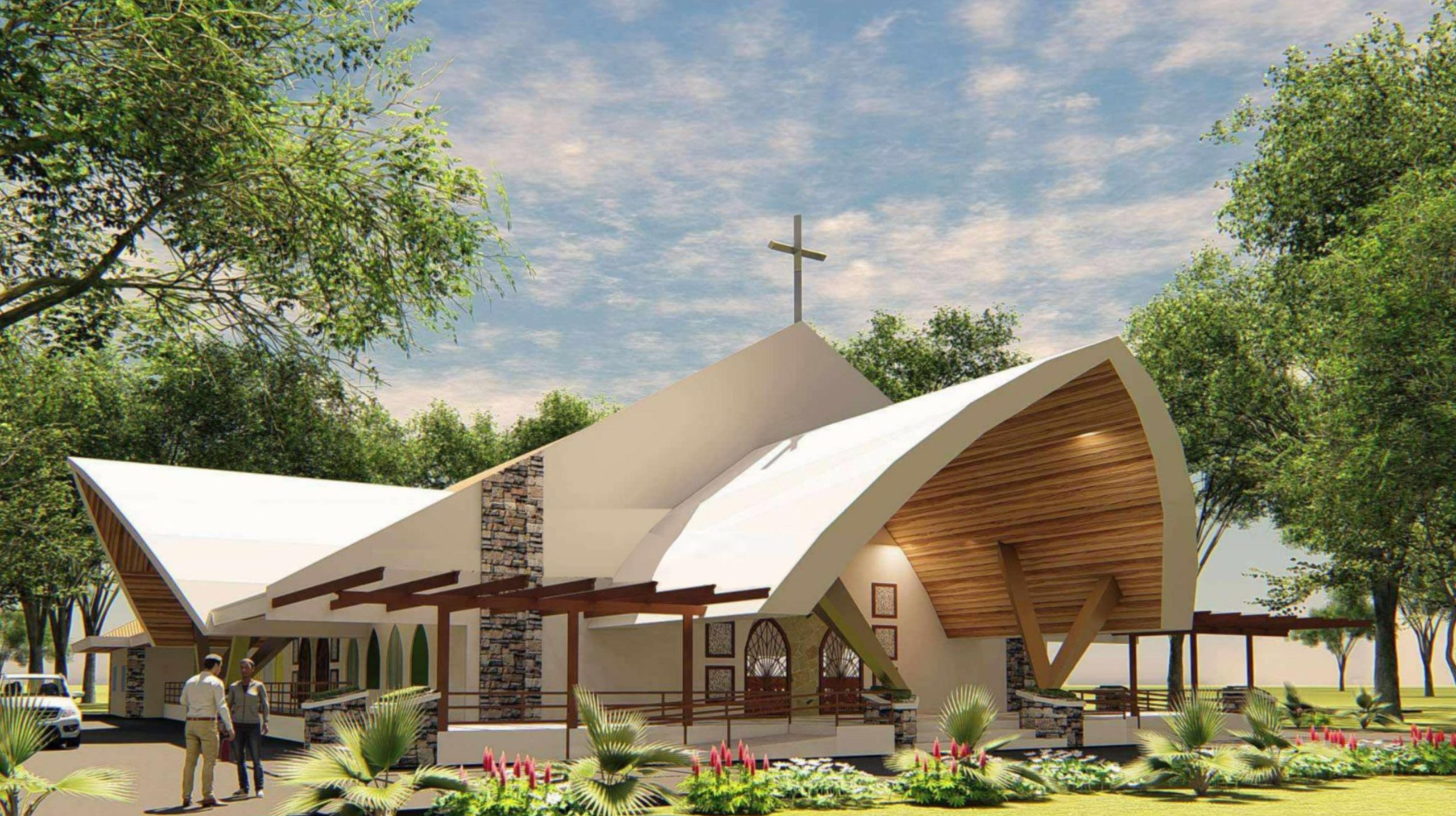
A perspective of the Marawi Pro-Cathedral. ACN
By CBCP News November 17, 2026
MANILA — A new pro-cathedral serving the Prelature of Marawi will be consecrated on Nov. 20 in Lanao del Norte, marking the local Church’s 50th anniversary and a milestone in its recovery from the 2017 siege.
The church is located in Maria Cristina, a barangay in Balo-i town, outside Marawi City in neighboring Lanao del Sur.
A pro-cathedral serves as the principal church of a diocese or prelature until a permanent cathedral is established or completed.
The consecration comes nine years after St. Mary’s Cathedral in Marawi was severely damaged during a five-month siege by Islamic State-linked Maute militants in 2017.
The militants occupied and desecrated the cathedral, damaging religious images and leaving the building structurally unsafe.
Aid to the Church in Need (ACN) Philippines raised ₱8 million for the new church through a nationwide fundraising caravan that visited nine archdioceses, four dioceses and 29 parishes, national director Max Ventura said.
ACN International provided a matching grant, effectively doubling the amount raised through the campaign, Ventura said at a gathering in Manila on Tuesday.
Cardinal Pablo Virgilio David will preside over the consecration Mass, which will also mark the return of a restored statue of Mary Help of Christians. The statue was beheaded and damaged during the siege.
Regina Lynch, president of ACN International, urged Filipino Catholics not to forget Christians persecuted for their faith.
ACN is a pontifical foundation that supports persecuted and disadvantaged Christian communities through financial assistance, prayer and awareness campaigns.
Vatican charity chief urges Filipinos not to forget persecuted Christians
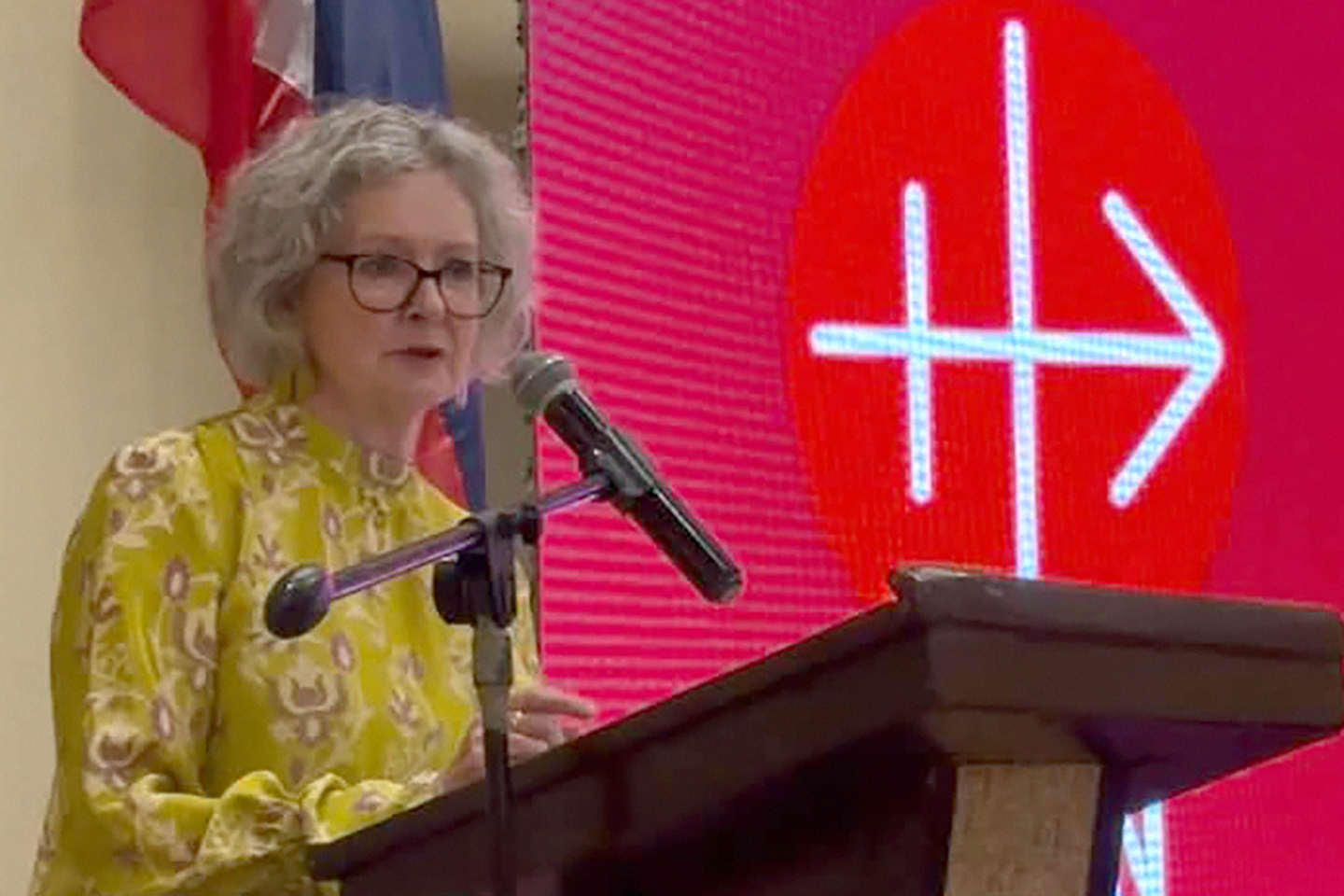
Regina Lynch, president of Aid to the Church in Need (ACN) International, speaks in Manila on Nov. 17, 2026.
By CBCP News November 17, 2026
MANILA — The head of a pontifical charity foundation has urged Filipino Catholics to stand in solidarity with Christians facing persecution in the Holy Land, warning that many are leaving their communities because of suffering and uncertainty.
Regina Lynch, president of Aid to the Church in Need (ACN) International, said prayers and support from Catholics worldwide give hope to Christians struggling to remain in their homeland.
Speaking at an ACN Philippines gathering in Manila on Tuesday, Lynch said Christians in Jerusalem and the West Bank were enduring difficult conditions.
“This is the cradle of our faith, and the Christians are leaving the country because of the suffering they have and because they find it difficult to find hope,” she said.
Lynch, who recently visited the Holy Land, said Christians were deeply moved to learn that Catholics from different parts of the world remembered and supported them.
She also noted that many Filipinos working in Israel face difficult conditions and sometimes feel forgotten.
Lynch said Filipinos could relate to the suffering of Christians abroad, recalling communities in Marawi, Jolo and Basilan where believers had suffered or died for their faith.
“Please do not abandon them. Pray for them. Spread the word,” she said, urging Catholics to keep the plight of persecuted Christians in public attention.
ACN is a pontifical foundation that supports Christians facing persecution and hardship through prayer, awareness campaigns and assistance.
ACN Philippines national director Max Ventura said the organization was expanding its local presence through dioceses and Catholic schools to strengthen support for suffering Christian communities.
The organization will hold its annual Red Wednesday observance on Nov. 25 in the Archdiocese of Cagayan de Oro to raise awareness of persecuted Christians worldwide.
Pope Leo XIV will not ease rules on married priests or the Latin Mass
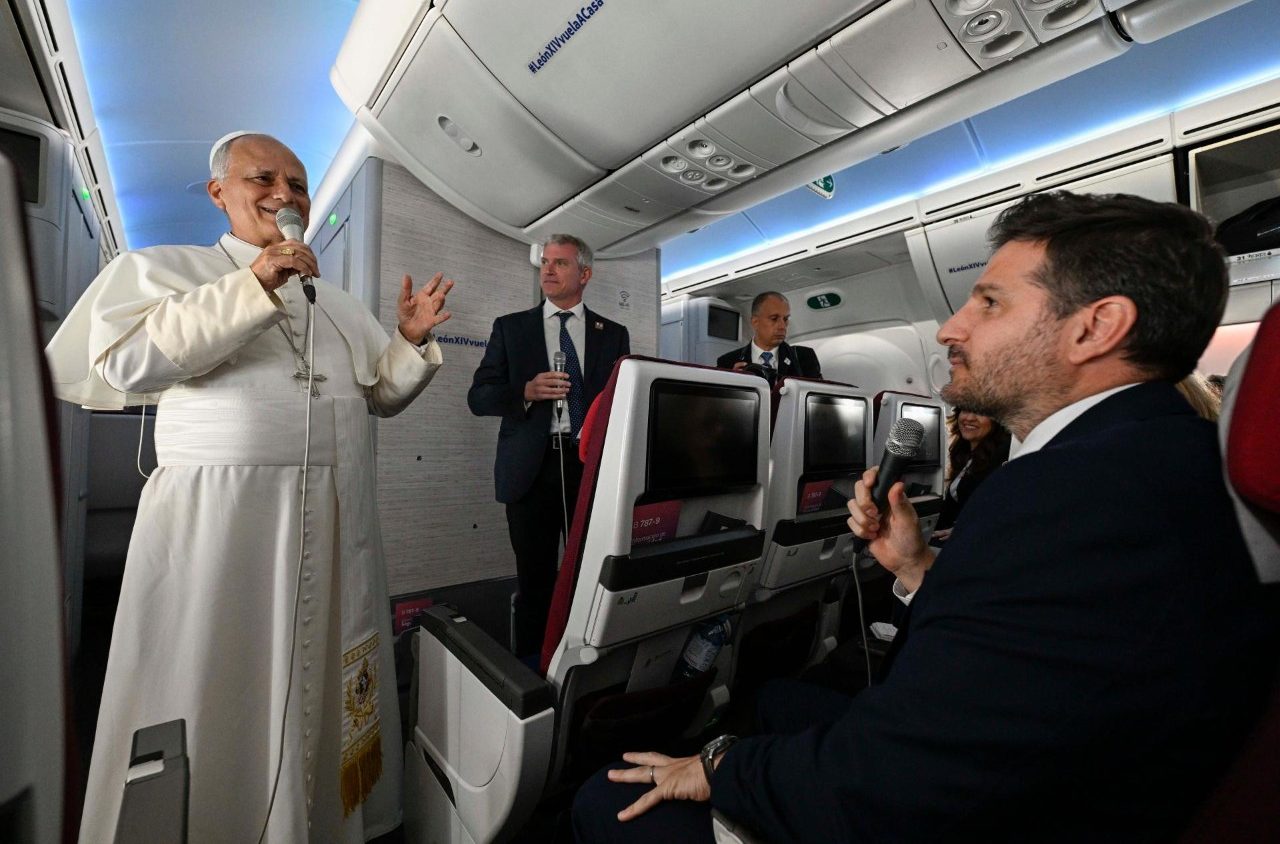
Pope Leo XIV speaks with journalists aboard the papal plane during his return flight from Lima, Peru, to Rome on Nov. 17, 2026. VATICAN MEDIA
By Francis X. Rocca EWTN News November 17, 2026
ABOARD THE PAPAL FLIGHT — Pope Leo XIV said he doesn’t intend to expand permission for the ordination of married men as priests, nor loosen restrictions on the celebration of the Traditional Latin Mass — in both cases, because he thinks such changes would undermine the unity of the Church.
The pope spoke during a 45-minute news conference on his flight to Rome Nov. 16, 2026, at the conclusion of a 12-day trip to South America.
Leo also discussed his health, his American identity, and the aftermath of midterm elections in the U.S.
The pope was asked if he was considering approving the ordination of married men to relieve the priest shortage in regions such as South America’s Amazon, as recommended at the 2019 Synod of Bishops, a question left open in the 2020 exhortation Querida Amazonia.
Leo responded that the numbers of priestly vocations in some historically underserved areas had increased notably in recent years.
Ordaining married men is “not the only solution” to the priest shortage, the pope said, “but itʼs a solution which in certain areas of the church can cause division because there is not universal, if you will, acceptance of that concept.”
Leo said he had made it clear that one of his priorities as pope was “to promote unity and communion among us as members of the Church.”
“It may be in the future that some things will change. However, for right now what I believe [is an] important part of my ministry to the Church is to heal, bring people together … to say, first letʼs come together, letʼs consider what we believe the priorities need to be, and then weʼll see how we walk forward from there,” he said.
“All these things are going to take time and we will go with that as the Lord moves us,” the pope added.
Leo gave a similar explanation for not rescinding restrictions imposed by Pope Francis, in his 2021 motu proprio Traditionis custodes, on celebrating the Traditional Latin Mass.
“Again, for the unity of the Church, the vast majority of Catholics around the world, we celebrate the rite of Vatican II, Paul VI, and we will continue to do that,” Leo said, noting that Francis’s legislation allows for granting of permission to celebrate the Latin Mass.
In response to questions about his health, following his surgery last month to remove a cancerous tumor together with part of his right lung, Leo said that he had not experienced any symptoms and that the cancer had been discovered as part of a routine annual check-up.
The force of prayer and messages of support from around the world, “along with a certain determination, which I also have,” and good medical care had allowed him to make the demanding trip to South America, he said, speaking in Spanish.
The pope said he hoped his example would encourage people to overcome their fears of cancer and obtain regular check-ups. Speaking in Spanish, he said he was “not at 100%, but quite well.”
Asked if he had drafted a letter of resignation in case he were to be incapacitated, for instance if he fell into a coma, Leo said in Spanish that he had not seen the need and that canon law already provides for such situations, but that he would eventually do so.
Leo said that his readiness to discuss his health was a trait, along with his “profound faith in democracy, democratic participation,” that reflected his U.S. origin, saying in Spanish that “in many things I am a gringo, a North American.”
The pope answered several questions from Latin American reporters, including one about his meeting last week with Argentina’s President Javier Milei, a self-described “anarcho-capitalist” whose austerity policies have drawn criticism from the country’s Catholic bishops.
Leo said the message he wanted to bring was not political, but he did speak to Milei about the neediest in the country. He said the two men had a “mutual understanding about the value of life, the value of the human being in all its stages,” apparently a reference to Milei’s opposition to abortion.
“He had an openness to hearing this message, so I think in this sense, it was very positive,” the pope said in Spanish about his dialogue with Milei.
Asked whether he expected that the results of the U.S. midterm elections earlier this month would lead to more polarization or more moderation, the pope said, in a mix of Spanish and Italian: “I would like to see more capacity for dialogue, construction of bridges, reconciliation, less polemic, less war, less division. I know that this is also a dream, but I know that it is possible.”
In a sign of the papacy’s changing communication style under the first U.S.-born pope, an Italian journalist asked Leo if they could speak Italian, something that would have been taken for granted less than two years ago. Amid laughter, the pope said yes.
Vatican diplomat who served in Philippines dies at 89
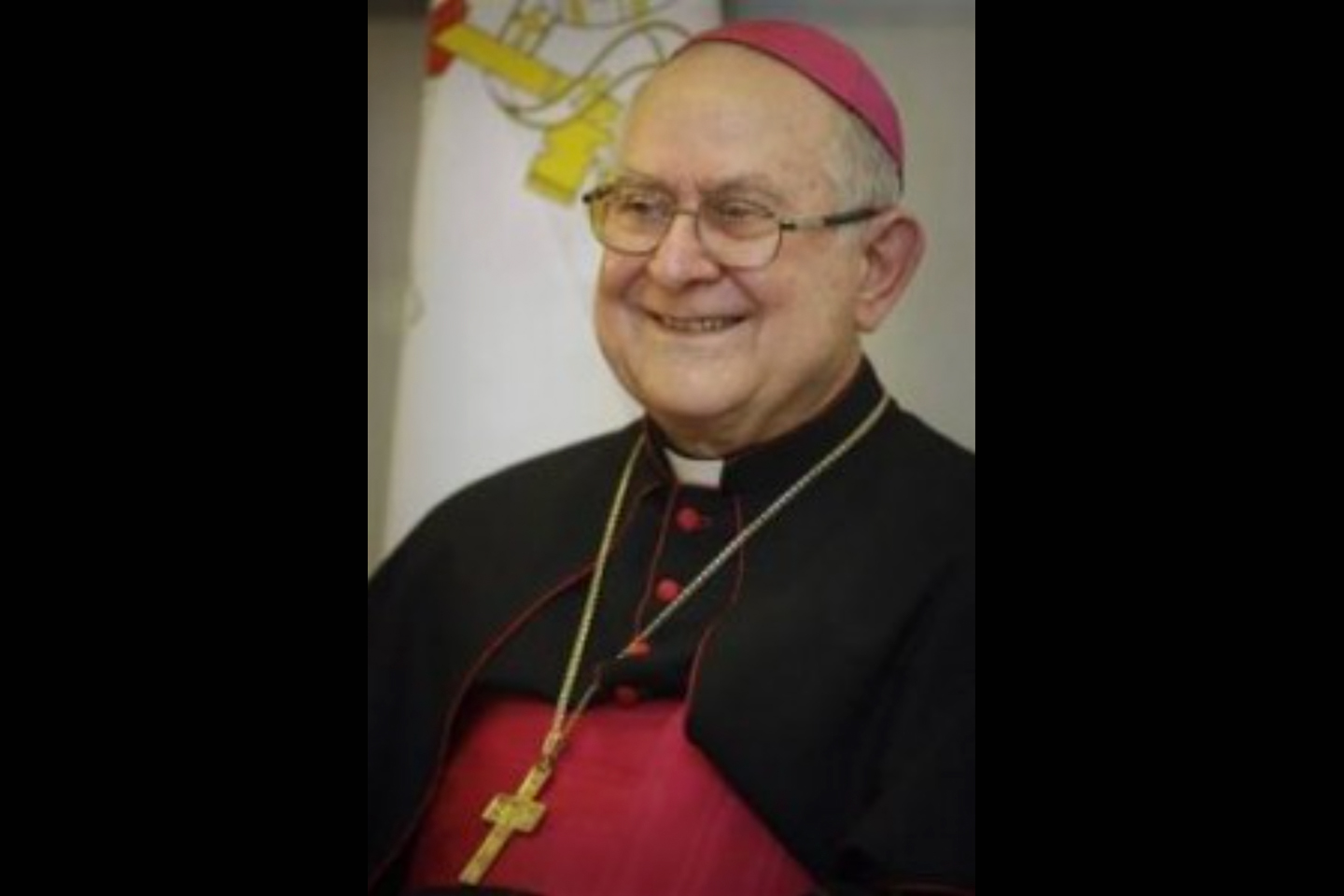
Archbishop Antonio Franco, former apostolic nuncio to the Philippines. DIOCESE OF CERRETO SANNITA-TELESE-SANT’AGATA DE’ GOTI, ITALY
By CBCP News November 17, 2026
Archbishop Antonio Franco, who served as the apostolic nuncio to the Philippines from 1999 to 2006, died in Italy on Nov. 15. He was 89.
Franco died at Rummo Hospital in Benevento, where he had been admitted a few days earlier.
Bishop Giuseppe Mazzafaro of Cerreto Sannita-Telese-Sant’Agata de’ Goti, Italy, announced Franco’s death in a statement on Monday expressing condolences to his family and those who shared his priestly and episcopal ministry.
Franco spent seven years in the Philippines as the Holy See’s diplomatic representative before being assigned to the Middle East in 2006.
His tenure coincided with the 2001 EDSA II People Power uprising and the reorganization of the Archdiocese of Manila, which resulted in the creation of new dioceses in the capital region.
Throughout his diplomatic career, Franco represented the pope in several countries, helping foster dialogue and strengthen relations between the Catholic Church and civil authorities.
Born in Puglianello, Italy, on March 24, 1937, Franco was ordained a priest for the Diocese of Cerreto Sannita-Telese-Sant’Agata de’ Goti on July 10, 1960.
He entered the Vatican diplomatic service in 1972 and served in diplomatic missions in Bolivia, Iran and France, as well as at the Holy See’s permanent mission to the United Nations in New York.
Pope John Paul II appointed him apostolic nuncio to Ukraine in 1993, making him the first Vatican representative to the country following its independence from the Soviet Union.
In January 2006, Pope Benedict XVI appointed Franco apostolic nuncio to Israel and Cyprus and apostolic delegate to Jerusalem and Palestine.
He retired from diplomatic service in August 2012 after more than four decades of service to the Holy See.
Mazzafaro described Franco as “an instrument of communion, dialogue and peace,” particularly in Jerusalem and the Holy Land, where tensions and suffering persist.
The bishop also thanked Franco for his dedication to the Church and urged the faithful to pray for the repose of his soul.
Franco’s remains arrived Nov. 16 at the Parish of St. James the Apostle in Puglianello, where a wake held.
His funeral Mass is scheduled for Tuesday at the Church of St. Alphonsus Maria de’ Liguori in Telese Terme.
Kalookan diocese documents grassroots mission in two-volume book
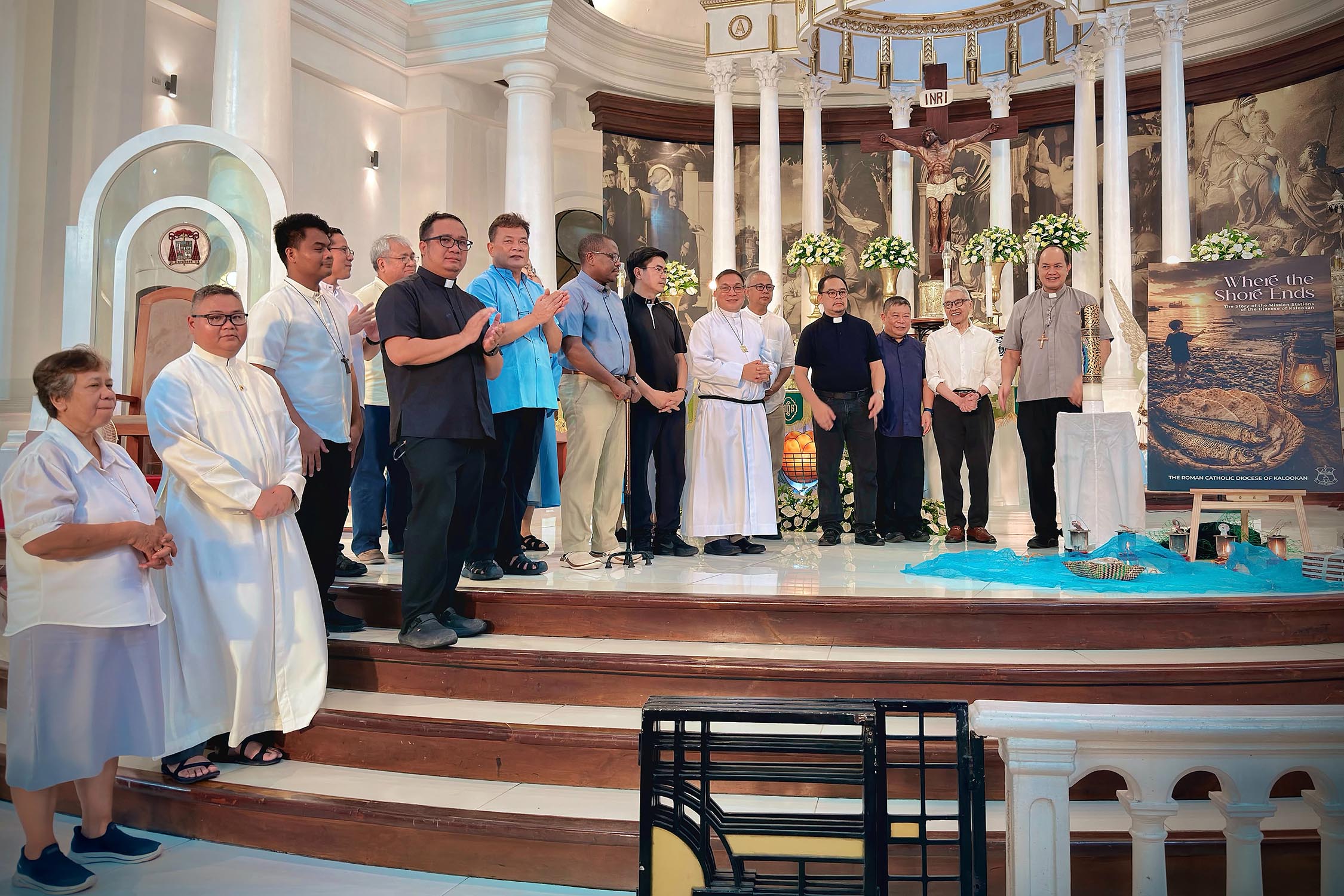
Cardinal Pablo Virgilio David leads the launch of “Where the Shore Ends: The Story of the Mission Stations of the Diocese of Kalookan,” a two-volume book documenting the diocese’s grassroots ministry to families facing poverty, violence and other hardships, at San Roque Cathedral in Caloocan City on Nov. 14, 2026. CONTRIBUTED PHOTO
By CBCP News November 16, 2026
MANILA — The Diocese of Kalookan has published a two-volume book documenting how its grassroots mission stations accompany families facing poverty, violence and other social hardships.
Titled “Where the Shore Ends: The Story of the Mission Stations of the Diocese of Kalookan,” the book was launched Nov. 14 at San Roque Cathedral before more than 500 clergy, religious and lay leaders.
The launch followed Cardinal Pablo Virgilio David’s presentation of the diocese’s experience at a Vatican gathering marking the 10th anniversary of Amoris laetitia, the Church’s document on family life.
The two volumes bring together missionary testimonies and field research from 18 mission stations and two quasi-parishes serving coastal communities and informal settlements in South Caloocan, Malabon and Navotas.
The diocese established its first two mission stations in Tangos and Baesa in 2017 to accompany families grieving loved ones killed during the Duterte administration’s war on drugs.
Speaking at the Vatican on Oct. 12, David said the stations grew out of home visits to families affected by drug-related violence, flooding, poverty, insecure employment and environmental degradation.
“This experience helped shape our mission stations,” David said. “I would say today that the mission stations changed our diocese more than our diocese changed the mission stations.”
“We began to ask, ‘Will the Church go to them?’ That question changed us,” he added. “Accompaniment, then, is not merely what a priest or pastoral worker does for a family. It is what the Christian community gradually learns to become around that family.”
At the book launch, lay leader Liberty “Libay” Gaspi recounted her experience of feeding and teaching children in informal settlements in Malabon.
“You can sacrifice for other people without love, but you cannot sacrifice without love for your neighbor,” Gaspi said in Filipino.
The book was reviewed by theologian Estela Padilla, Father Andrew Recepción, a professor of missiology at the Pontifical Gregorian and Urbaniana universities, and sociologist Randolf David.
Recepción described the publication as a model for urban mission in Asia, emphasizing its focus on presence, listening and communion.
“This book offers the Church in Asia a credible new model of urban mission and a timely witness to what synodality looks like when it walks with the least, the last, and the lost, from the perspective of a Church of the Poor,” he said.
“In this vision, presence comes before programs, listening before proclamation, and communion before structures,” he added.
Prof. David called the publication “a thoughtful documentation of the rich experience of the mission stations,” while Padilla urged readers to approach it with “a mind ready to be disrupted and a heart spacious enough to follow God beyond the shores of our certainties.”
The launch concluded with a candle-lighting ceremony led by David, who commissioned representatives of the mission stations under the diocesan motto Duc in altum (“Put out into the deep”), from Luke 5:4.
Bishop Socrates Mesiona of Puerto Princesa. AVPP PHOTO
By CBCP News November 16, 2026
A Catholic bishop in Palawan is demanding answers about the province’s mining industry, asking who benefits from its resources as environmental concerns persist more than a year after a mining moratorium was adopted.
In a pastoral letter issued Nov. 15, Bishop Socrates Mesiona of Puerto Princesa called for greater transparency about the industry’s economic contributions and the distribution of its benefits, saying the public deserves clear answers.
“How much does mining contribute to the national economy? How much does it contribute to Palawan’s economy? And above all, who truly benefits?” Mesiona said in Filipino.
He also questioned the effectiveness of a provincial ordinance halting endorsements for new mining applications, saying its impact remained unclear.
Mesiona said mining continues to alter mountains and strip forests, particularly in southern Palawan, raising concerns about the province’s environmental future.
The bishop also questioned the lack of public information about mineral deposits being extracted, including whether other valuable resources remain insufficiently assessed.
Mesiona praised local governments, religious groups, Indigenous communities and residents opposing the opening or operation of new mining sites.
He questioned whether government policies and agencies adequately protect local communities and the environment, saying existing rules appear to favor powerful interests.
The bishop urged residents, particularly young people, to speak up and demand accountability from authorities responsible for protecting the province’s natural resources.
“Ordinary citizens, especially young people who will inherit the future, must make their voices heard,” Mesiona said.
“We are not against development. But genuine development must be based on sincere concern for people and respect for creation,” he added.
He called on Palaweños to protect the province’s natural heritage for future generations, saying its resources were entrusted by God to their care.
Pope Leo XIV celebrates popular piety and Indigenous cultures in Peru
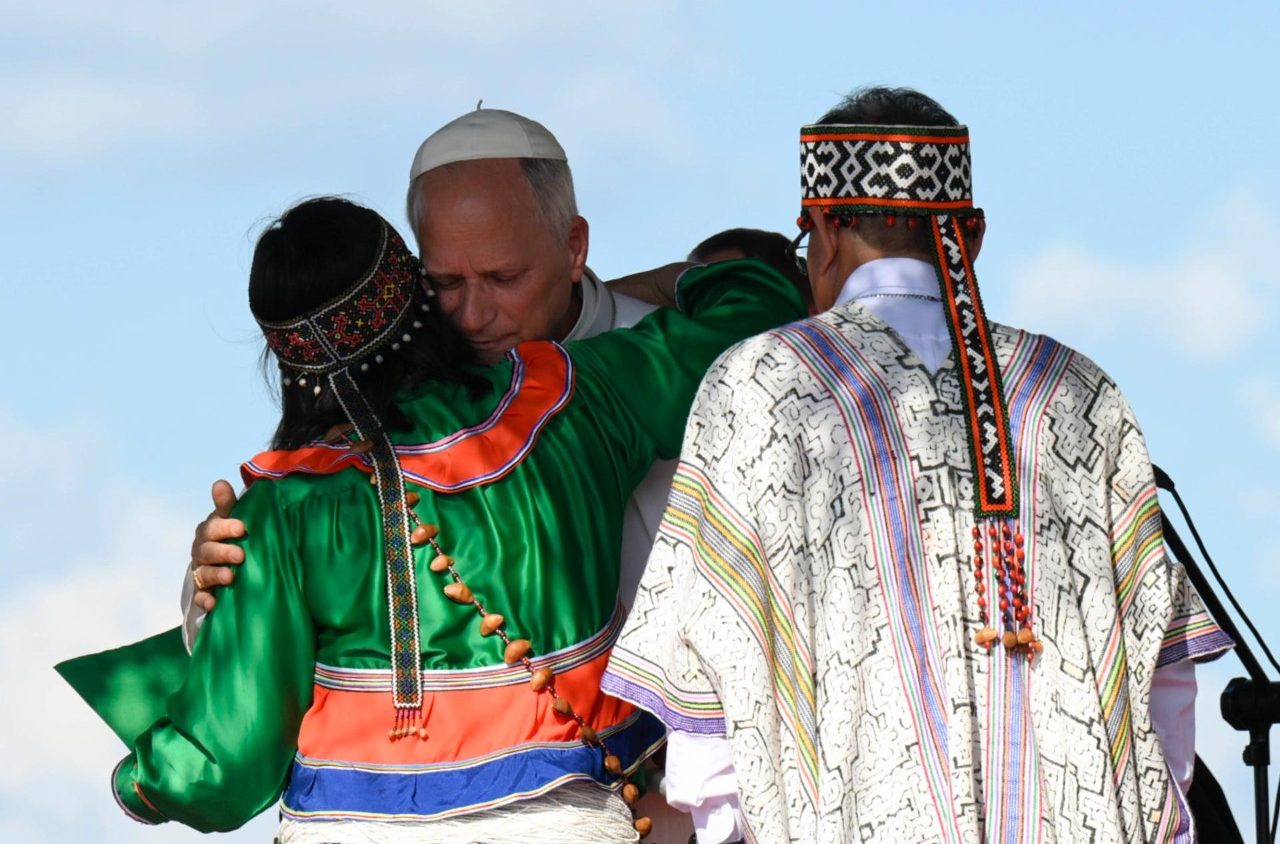
Pope Leo XIV meets with missionaries and representatives of Amazonian communities at Malecón Puerto Callao in Pucallpa, Peru, on Nov. 15, 2026. VATICAN MEDIA
By Francis X. Rocca EWTN News November 16, 2026
LIMA, Peru — Pope Leo XIV’s last full day in South America on Sunday, Nov. 15, was the most physically demanding and geographically ambitious of his three-country tour, taking in coastal desert, Andean highlands and the Amazon rainforest in a few hours.
It was an impressive show of stamina by the 71-year-old pope, only a month after he underwent surgery for lung cancer that removed part of his right lung. Leo has shown no signs of fatigue during the trip, not even on Sunday morning when he presided at a prayer service at an archaeological site over 12,000 feet above sea level.
The event was a celebration of popular piety as expressed in traditions such as festivals, pilgrimages and processions.
“I invite you to make these festivals a school of fraternity and charity, where you work, pray, and have fun together — and also care for those in need — so that everyone can be joyful and united before God,” Leo told the congregation, estimated by local authorities at about 100,000 people. An estimated half-million lined the streets to greet the pope as he rode in from the airport.
Some had made great efforts to reach the plateau overlooking the city of Cusco.
“It has been very, very hard for me, because I am elderly and I have had to climb it all myself. The kids, the young people, were going past me and I could not run. But here I am. Here I am before His Holiness, who is the pope,” said Ana María Nina Delgado of the southern Peruvian region of Arequipa.
The Saqsaywaman National Archaeological Park was once a sacred Inca ceremonial center known as the House of the Sun and is the location today of a revived Festival of the Sun.
Following the meeting, Leo led a recitation of the Angelus in the square in front of Cusco’s cathedral. He announced that he was donating a shroud to cover the Lord of the Earthquakes, an image of the crucified Jesus venerated as patron of the city and traditionally believed to have miraculously stopped an earthquake in 1650.
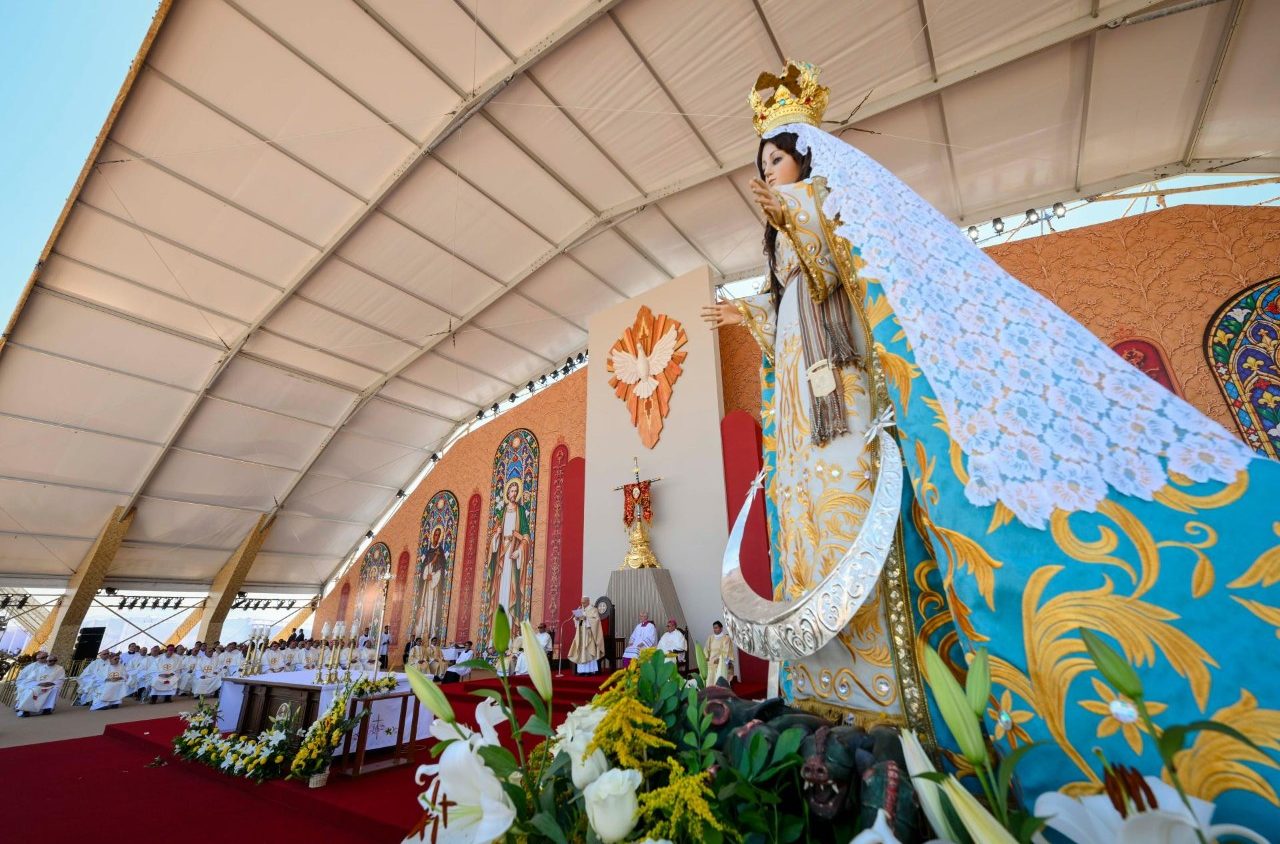
Leo spent the afternoon in a very different ecosystem, the humid Amazon lowlands, where he celebrated Mass for a congregation of about 100,000 people at a sports field in the city of Pucallpa.
In his homily, the pope connected the poverty of the region to threats to its natural resources.
“All labor exploitation is a plundering of the environment,” he said. “Violence against people is violence against the earth, and violence against the earth is violence against human beings.”
Leo’s words echoed his remarks prior to the Mass, at a meeting with representatives of the Indigenous peoples of the Amazon and some missionaries who minister to them. The pope told the meeting that defending the rainforest also means defending the rights of its inhabitants.
“The cry of the earth and the cry of the poor are inseparable, exposing patterns of exploitation and economic activity that threaten the balance of creation. Protecting the Amazon rainforest cannot be separated from concern for the people who live there,” he said.
The pope flew to Lima on Sunday evening and was scheduled to celebrate Mass there the next day before leaving for Rome in the early afternoon.
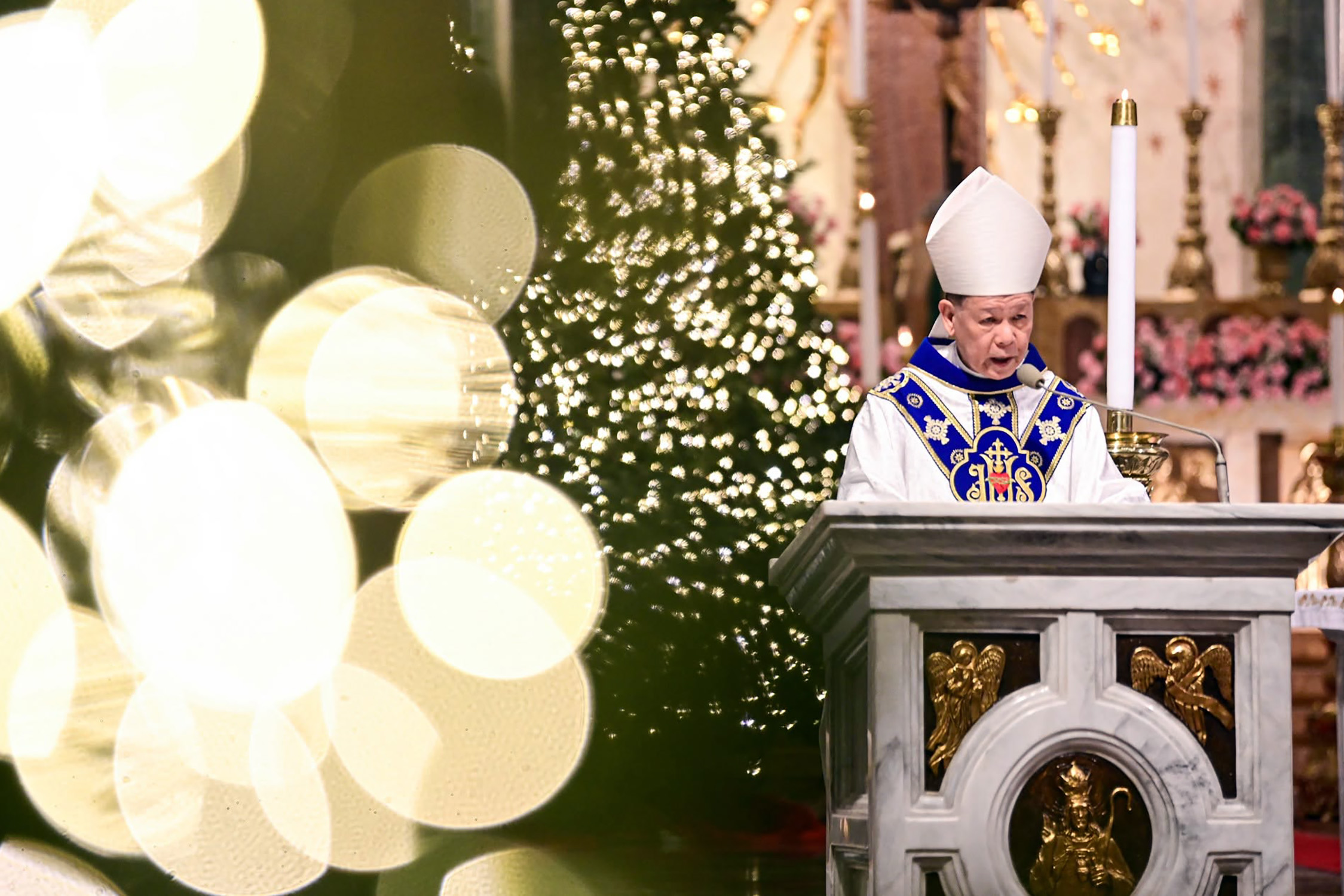
Cardinal Jose Advincula of Manila presides over the first Simbang Gabi Mass of 2025 at the Manila Cathedral on Dec. 16. MANILA CATHEDRAL FILE PHOTO
By CBCP News November 16, 2026
MANILA — Manila’s Catholic archbishop is requiring explicit approval for Simbang Gabi Masses held in venues outside recognized churches and chapels, citing the need for proper oversight of celebrations.
Cardinal Jose Advincula issued the directive in a Nov. 12 circular outlining guidelines for the Filipino tradition of nine Christmas novena Masses, also known as Misa de Aguinaldo.
The requirement covers chapels, offices and other venues outside parish churches, shrines, chaplaincies and chapels recognized by parishes where Masses are regularly celebrated.
“Explicit permission must be obtained from the Archbishop of Manila” for celebrations in such locations, Advincula said.
The circular also allows evening Simbang Gabi Masses to begin as early as 6 p.m., while dawn celebrations may start at 5:30 a.m.
Weekday evening Masses may use the readings and prayers for the following day, except when Sunday is being anticipated. Sunday evening celebrations must retain the liturgy proper to Sunday.
White vestments and the Gloria are required for all Simbang Gabi Masses, including those celebrated on Sundays. The Creed is recited or sung only on Sundays.
Regular Sunday Masses on advent outside the Simbang Gabi celebrations retain violet vestments and omit the Gloria, according to the guidelines.
Advincula said the nine-day tradition honors Mary as the expectant mother of Jesus and is celebrated “for the perseverance of the nation in the faith.”
The guidelines followed recommendations from the archdiocese’s Presbyteral Council and Liturgical Commission.
Missionary sisters seek return of sacred items stolen from chapel
By CBCP News November 16, 2026
MANILA — Catholic missionary sisters in southern Philippines are appealing for the return of a stolen tabernacle and other sacred objects including consecrated hosts.
The Missionary Sisters of Mary said the items were taken Nov. 12 from their generalate chapel in Km. 4, Baan, Butuan City, Agusan del Norte. The missing objects include a tabernacle, chalice, monstrance and ciborium.
The congregation also expressed concern over what it described as the “desecration of consecrated hosts.”
“We are not seeking to blame or accuse anyone. Our only hope is to recover these sacred items and bring them back to their rightful place,” the sisters said in a public announcement posted Nov. 15.
They appealed to anyone who may have purchased the items, even unknowingly, to return them to the community.
“These are sacred items. They are not ordinary objects, nor are they simply pieces of metal that can be sold or weighed,” the congregation said, stressing their religious significance to the chapel and the Catholic faith.
The sisters urged the public to share any information that could help recover the missing objects.
33rd Sunday in Ordinary Time, Matthew 25:14-30 November 15, 2026
By Fr. Agustin Opalalic
TODAY is the 33rd Sunday in Ordinary Time. Next week we will be celebrating the Solemnity of the Kingship of Jesus in the Universe. It is noteworthy that as we are about the end the Ordinary Season of the Liturgical year, we celebrate this Sunday Eucharist with the gospel reading with a parable on “stewardship.” The parable tells of the master who “entrusted his possessions” to his servants while he went away on a journey. Two of the servants did well, as they “traded with the talents” that he entrusted to them. The third failed, preoccupied with his own future (afraid of what the master will do to him if he loses it), he “dug a hole in the ground and buried his master’s money.”
Looking at the whole story, the parable is not much money but rather, being “good and faithful servants.” The amount one receives and the profit one makes are secondary. What mattered to the master was the servants’ faithfulness in taking responsibility over his gifts. Each one was entrusted with different amounts, but only two were given exactly the same reward for being “good and faithful” and were told, “Come, share your master’s joy.”
The parable is also about the kind of person the master was. He was extremely generous to his servants, contrary to what the third servant had thought (a demanding person, harvesting where he did not plant and gathering where he did not scatter). He was very reasonable in giving each of them “according to his ability.” The servants themselves understood that the amount was well suited to the “ability” of each one. And afterwards, He did not give just a portion of his possession to the “good and faithful”, but rather, shared everything.
As God’s servants, we are stewards of His manifold gifts. Through His Son (in whose Death and Resurrection we were baptized), He has given each of us a portion of His “possessions” (a share in His divine life). Through the Holy Spirit, He has given us, “according to our ability,” various forms of charisms and services. The kind and amount of gifts we receive do not really matter. What’s important is how we make use of them to attain the very purpose that God has for each one of us, which our old Catechism says is: to know God, to love God, to serve God, and to be with Him in heaven.”
Our First Reading and Psalm provide us with the splendid examples of people who live according to God’s purpose and thus make their lives fruitful. The “wife” (Ps. 31:10–13, 19–20, 30–31) and the “man” (Ps. 112: 1-2, 3-4, 5-6) both live in “fear of the Lord.” According to St. Paul in the Second Reading (1 Thes. 5:1-6), this means living as “children of the light.” It is not the servile “fear” of that servant in the Gospel who was spiteful and bitter towards his master, but rather a holy “fear” that enables us to be awed by the love of God who shares with us not only earthly blessings but also eternal joy with Him. Like the “wife” who receives “a reward for her labors” and the “man” who eats “the fruit of his handiwork,” we will receive the same if we fulfill our own vocations with love and energy. As we wait for the return of the Lord, let us be “alert and sober” and live daily in the manner befitting our Father’s beloved children. Being stewards of the talents we received from God is one responsibility each Christian should always consider. God has been so generous for us to be grateful to him in return, developing fully our talents and returning them to God through sharing them to the least of our brothers and sisters, especially those who are in dire need. In this way we do not only recognize and acknowledge the gifts we have received but assist others in making aware of God’s goodness and mercy through the gifts we share with them.
Bishops seek probe into alleged abuses against indigenous communities
By CBCP News
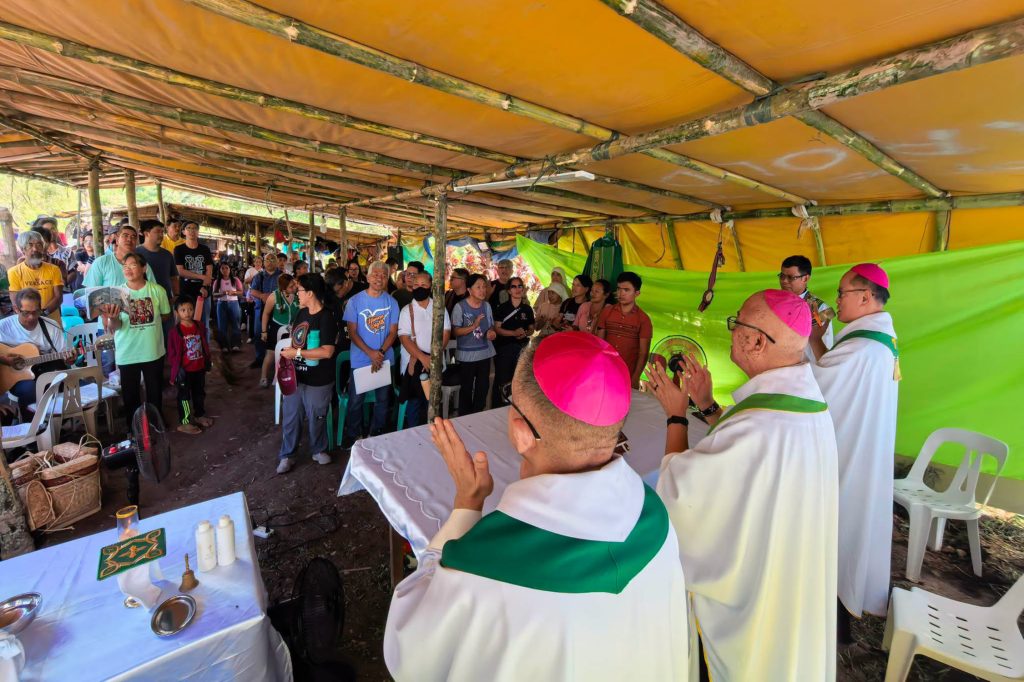
Bishops Moises Cuevas, Gerardo Alminaza and Elmer Mangalinao visit a barricade in Kasibu, Nueva Vizcaya, on Nov. 14, 2026, during a solidarity mission that included Mass and dialogue with indigenous communities opposing a proposed mining site. PHOTOS FROM CARITAS PHILIPPINES November 14, 2026
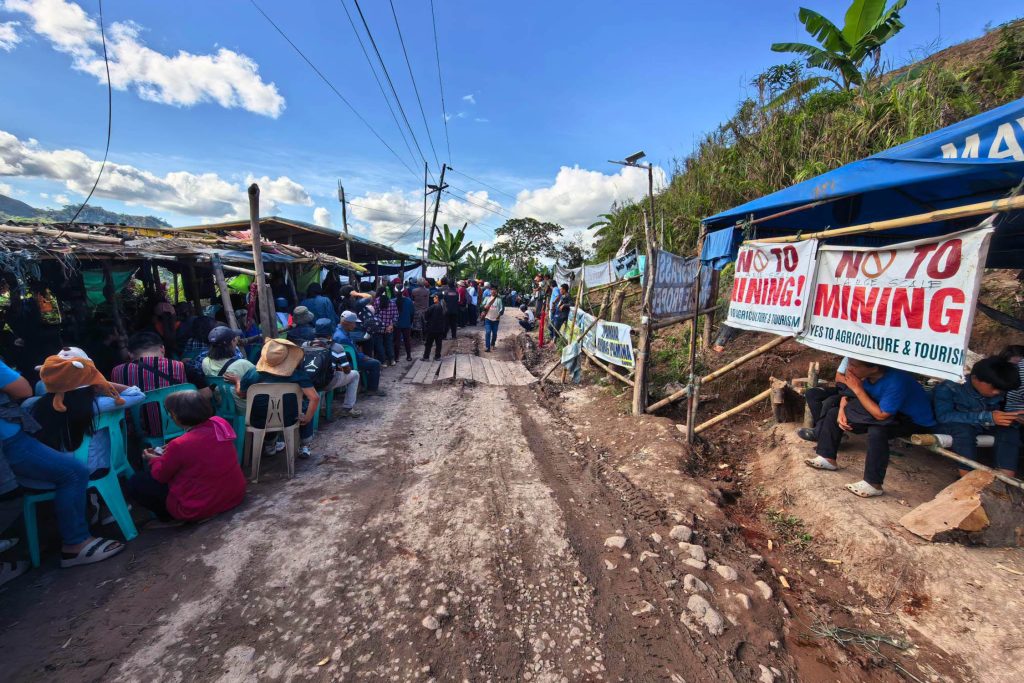
Two Catholic bishops have called for an independent investigation into alleged human rights abuses against indigenous communities defending their ancestral lands in Nueva Vizcaya and Quirino provinces.
Bishop Gerardo Alminaza of Caritas Philippines and Bishop Moises Cuevas of the Episcopal Commission on Indigenous Peoples made the appeal Saturday following a solidarity mission in Kasibu, Nueva Vizcaya.
Bishop Elmer Mangalinao of Bayombong accompanied the two bishops during the mission, which included meetings with affected indigenous communities.
In a joint statement, the bishops cited reports of intimidation, violent dispersals, red-tagging and judicial harassment involving indigenous peoples, farmers and community defenders.
“These accounts must be taken seriously and with urgency,” they said, urging the Commission on Human Rights and other authorities to investigate the allegations.
The bishops also raised concerns over mining permits, certificates of non-overlap and consent processes that they said may not adequately protect indigenous peoples’ rights.
They called on government agencies and companies to respect customary laws and the right to free, prior and informed consent (FPIC), saying projects requiring consent must not proceed without it.
The Indigenous Peoples’ Rights Act, or Republic Act 8371, recognizes ancestral-domain rights and requires safeguards for communities affected by development projects.
The bishops also urged environmental agencies and local governments to disclose mining permits and compliance records and conduct independent assessments of mining and exploration activities.
They warned that development must not threaten communities’ livelihoods, food security, watersheds and natural resources.
“Development must serve the common good and not threaten livelihoods, food security, and the well-being of future generations,” they said.
The bishops stressed that indigenous peoples must lead decisions affecting their ancestral lands, which are closely tied to their identity, culture, spirituality and community life.
“As a synodal Church, we are called to respect their collective decisions, support their initiatives, and accompany them in their continuing struggle for justice,” they said.
Pope Leo XIV returns to his former diocese of Chiclayo
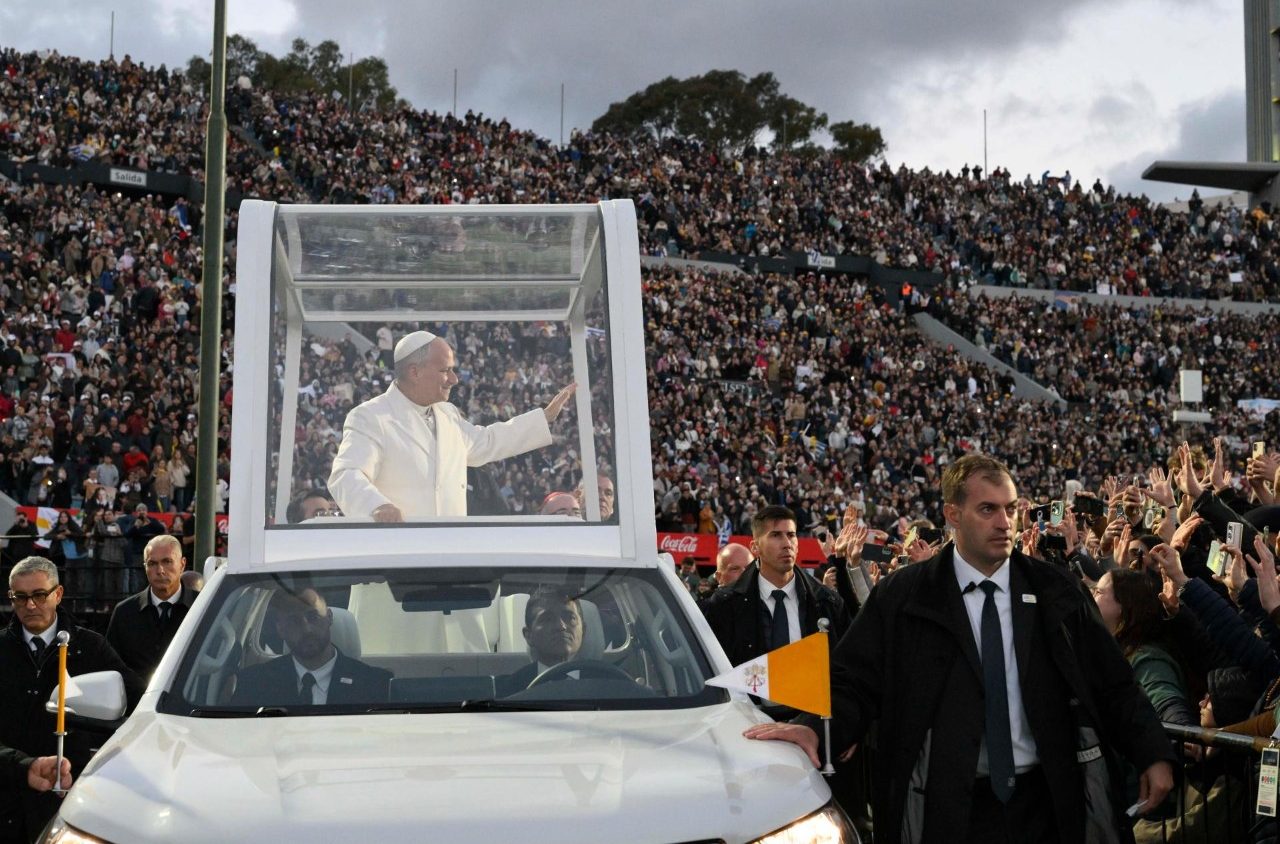
Pope Leo XIV waves to crowds upon arriving for Mass near Chiclayo, Peru, on Nov. 13, 2026. VATICAN MEDIA
By Francis X. Rocca EWTN News November 14, 2026
CHICLAYO, Peru — Pope Leo XIV returned on Friday to his former diocese, where he received an ecstatic welcome and seemed equally moved to be back.
“What a joy it is to return to Chiclayo! It is a blessing for me to be with you once again,” Leo said at the start of his homily at an open-air Mass in an arid plain outside the city.
Then he added a poignant reminder that, despite the hectic pace of his 12-day trip to South America — which has left him seemingly unfazed a week into the journey — he had cancer surgery only a month ago.
“Thank you for your affection, support, and prayers, especially for my health during this time of trial which, with God’s help, I am overcoming,” the pope said.
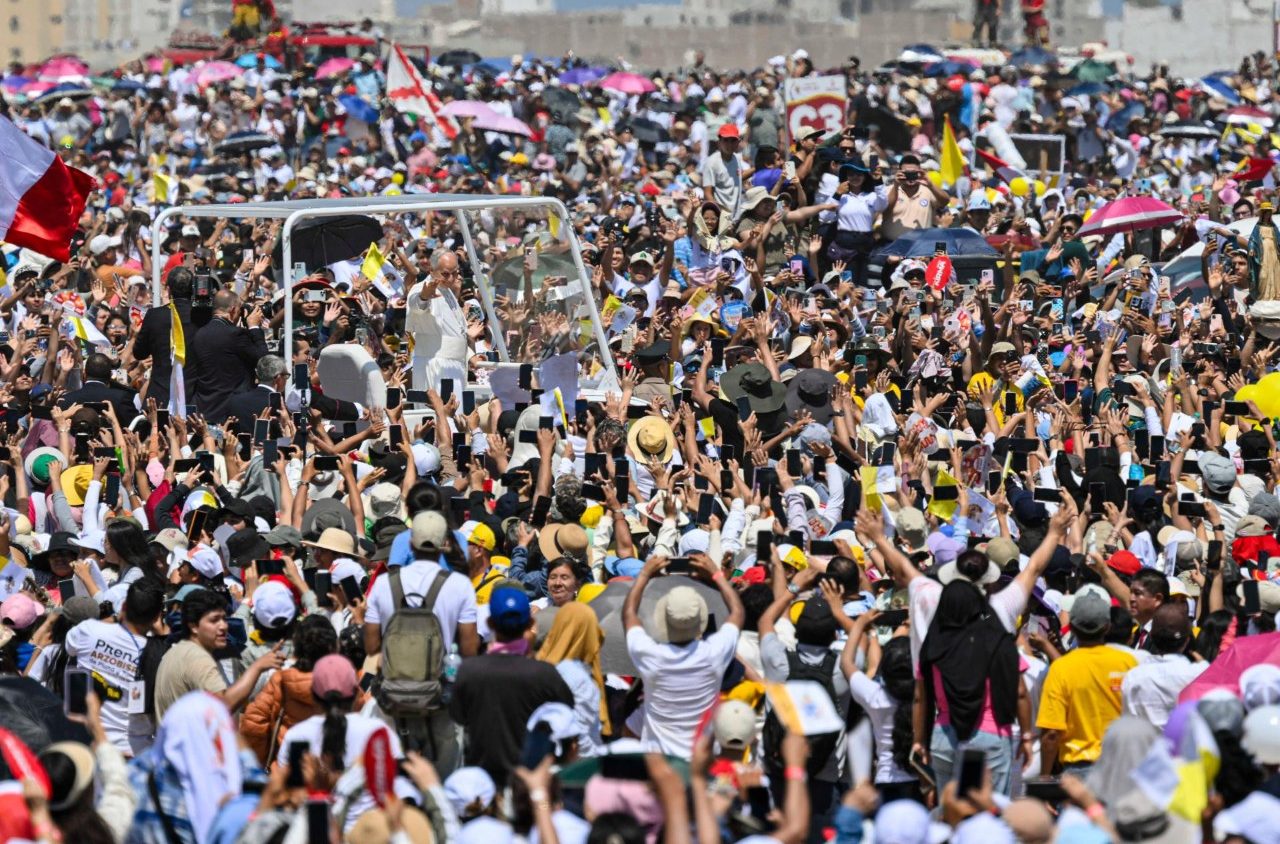
Approximately 1 million people lined the pope’s route to the Mass site on the Pampas de Pimentel, and another 500,000 attended the liturgy, according to the Vatican.
Leo served as bishop of Chiclayo for eight years out of two decades in total as a missionary in Peru. He is the first foreign missionary in at least centuries to have been elected to the papacy.
Pope Leo XIV celebrates Mass near Chiclayo, Peru, Nov. 13, 2026. VATICAN MEDIA
But in his homily, he reminded his congregation that they were all called to evangelize.
“All Christians, whether ordained ministers or lay faithful — regardless of the degree of formation we have received in the faith — are missionary disciples,” the pope said.
For most laity, he said, the task of evangelization takes the form of “the witness of an authentically Christian and coherent life.”
The pope said achieving that life “is not merely the fruit of our own will, but it is also a grace for which we must implore the Lord and with which we are called to cooperate through our personal commitment and effort.”
Leo said that good works are a necessary concomitant to evangelization, “because the proclamation of the faith is linked to charity and the care of those most in need.”
He also stressed that the welcome of the evangelist does not mean suspension of moral rigor, since Jesus “invites us to conform our lives to his in faithful obedience to his commandments.”
“Without truth, love degenerates into mere sentimentality, while truth without love becomes rigid and cold,” the pope said.
Davao archdiocese sets Jan. 14 installation of new archbishop
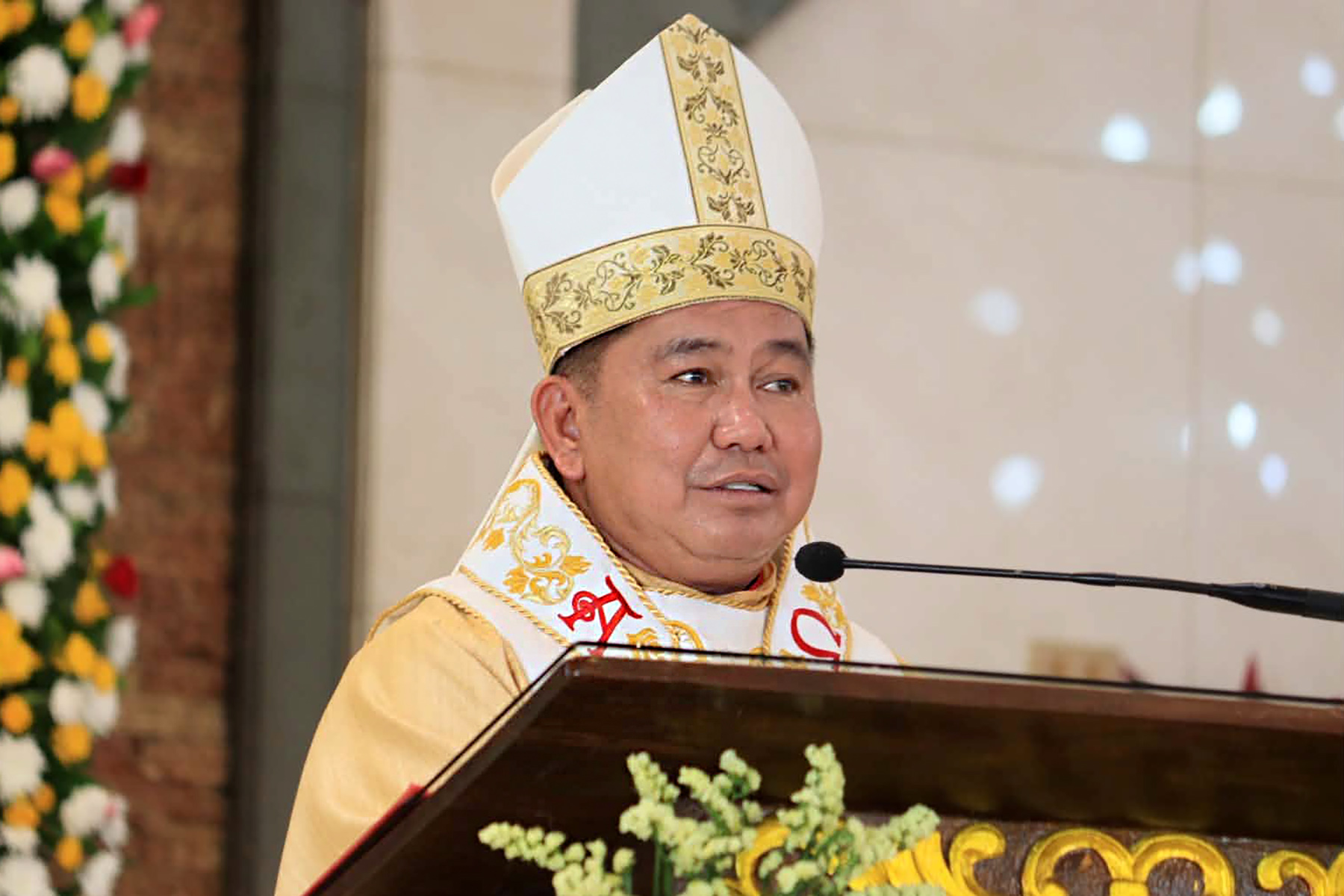
Archbishop Abel Apigo of Davao. DIOCESE OF MATI
By CBCP News November 14, 2026
MANILA — Archbishop Abel Apigo will be formally installed as the fifth archbishop of Davao during a Mass at San Pedro Metropolitan Cathedral on Jan. 14, 2027.
Apigo will officially take canonical possession of the archdiocese, succeeding Archbishop Emeritus Romulo Valles, who has led the ecclesiastical jurisdiction for around 14 years.
Valles will remain apostolic administrator of Davao until Apigo’s installation.
At 59, Apigo returns to the archdiocese where he was ordained a priest in 1994 and served for about 24 years before his appointment as bishop of Mati in 2018.
His installation in Davao will leave the Diocese of Mati vacant, making it the eighth ecclesiastical jurisdiction in the country currently without a residential bishop.
The other vacant jurisdictions are the dioceses of Bangued, Parañaque, Masbate, Kabankalan, Ilagan and Borongan, as well as the Apostolic Vicariate of Jolo.
Cardinal Tagle to lead Mass for Guadalupe pilgrimage thanksgiving in Manila
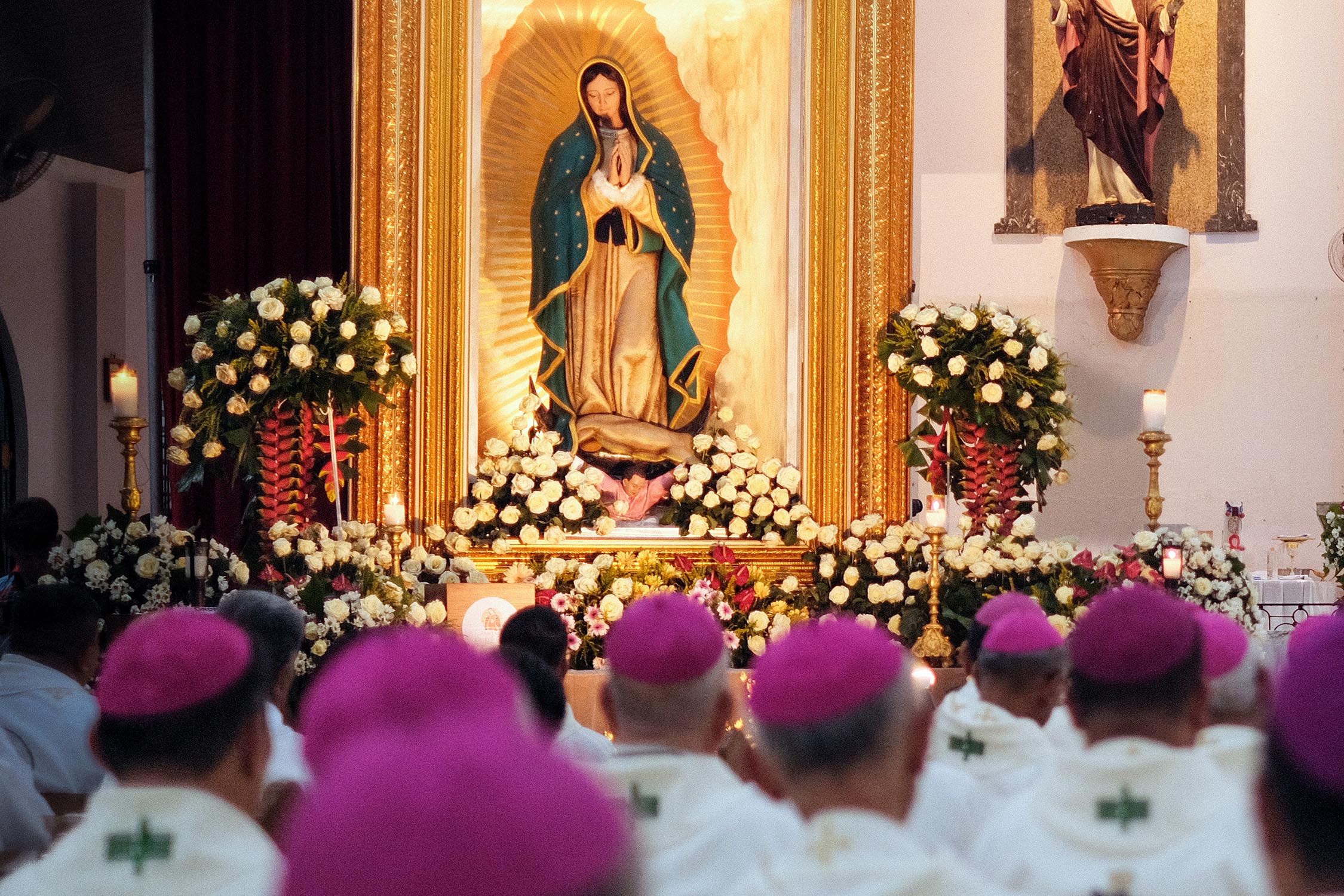
Catholic bishops celebrate Mass before the pilgrim image of Our Lady of Guadalupe at the Parish of the Holy Child in Clarin, Misamis Occidental, on July 6, 2026. CBCP NEWS
By CBCP News November 12, 2026
MANILA — The Philippine pilgrimage of the image of Our Lady of Guadalupe will culminate in a two-day thanksgiving celebration at Manila’s Quirino Grandstand on Dec. 11 and 12, following visits to dozens of churches across the country.
The Our Lady of Guadalupe Philippine Pilgrimage Committee said the gathering will bring devotees together for prayer and thanksgiving, with an overnight vigil marking the feast of the Marian image.
“Everyone is invited to take part in the celebration of the Feast of Our Lady of Guadalupe and in thanksgiving for the conclusion of her journey across the Philippines from Mexico,” the committee said in a statement.
The event aims to unite Filipino devotees in faith and devotion to the Blessed Virgin Mary, it added.
According to the schedule, the pilgrim image will arrive at the Quirino Grandstand from Manila City Hall at 6 p.m. on Dec. 11, followed by an opening Mass at 8 p.m.
An overnight Holy Rosary vigil and veneration will begin at 10:30 p.m. and continue until noon on Dec. 12.
A Marian concert is scheduled for 2 p.m. on Dec. 12, while veneration of the image will continue until 4 p.m.
Cardinal Luis Antonio Tagle, dean of the College of Cardinals and pro-prefect of the Dicastery for Evangelization, will preside over a Mass at 5 p.m.
A procession carrying the image to the Manila Cathedral in Intramuros will follow at 7 p.m.
Since June 2026, the image from Mexico has traveled across the Philippines, drawing hundreds of thousands of devotees during its visits to more than 60 churches in Luzon, Visayas and Mindanao.
Pope Leo XIV returns to Peru: ‘Much of my own story belongs to you’
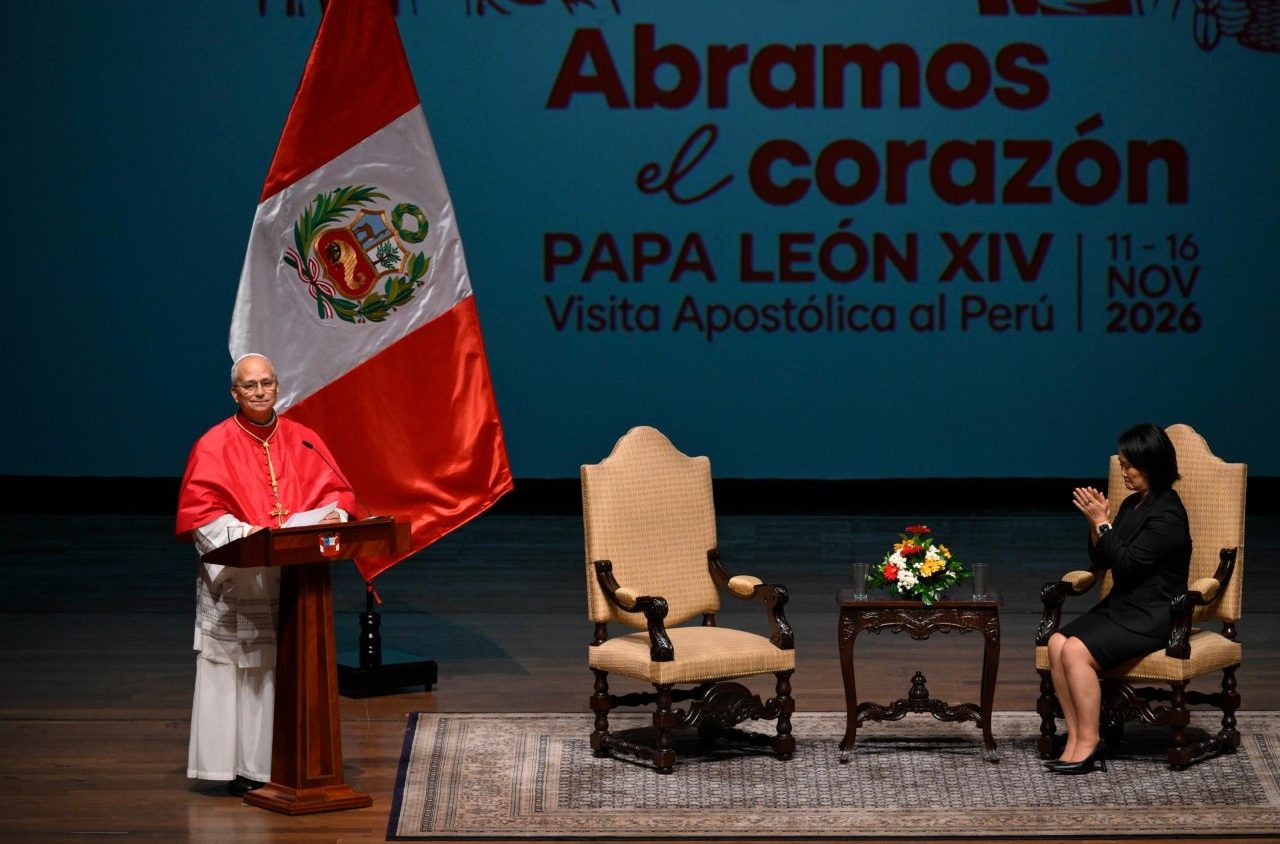
Pope Leo XIV delivers his address to the authorities at the Gran Teatro Nacional in Lima on Nov. 11, 2026. VATICAN MEDIA
By Francis X. Rocca EWTN News November 12, 2026
LIMA, Peru — Pope Leo XIV arrived in Peru on Wednesday, Nov. 11, in a spectacular homecoming that drew an estimated three million people to the streets to greet him.
Leo, a U.S. citizen but also a naturalized citizen of the country where he served as a missionary and bishop for about 20 years before becoming pope, met privately with President Keiko Fujimori, then addressed her and other dignitaries about Peru’s current state and prospects.
“For decades, I shared in the lives of its people, listened to their concerns, and learned from their faith,” the pope said, drawing laughter when he noted that he also ate ceviche, a traditional Peruvian dish based on raw fish.
“Today I understand how much of this land remains with me and how much of my own story also belongs to you.”
Invoking his deep personal experience — “I recall seemingly simple conversations in which the difficulties of a family or the hopes of an entire community came to light” — Leo called on Fujimori and other public officeholders to listen to their citizens.
The pope referred gently to the national reconciliation process still underway in Peru after decades of left-wing terrorism, followed by years of a counterterrorism campaign led by President Alberto Fujimori, which was denounced for violations of human rights. The future Pope Leo, then Father Robert Prevost, criticized both the left-wing insurgents and the government at the time. He also called on the elder Fujimori to ask forgiveness.
In his speech on Wednesday the pope addressed the related problem of polarization, encouraging everyone “to cultivate honesty, integrity, and a willingness to engage with others — qualities that sustain trust among people and give strength to the life of institutions.”
He also addressed the issue of violent crime, an urgent concern not just in Peru but across Latin America.
“For families, peace has a very concrete meaning: going out to work without fear, caring for one’s children, and returning home with peace of mind. These are simple aspirations, but no one should be deprived of them. The Church is aware of the suffering caused by violence and wishes to remain close to those who endure it, encouraging the efforts of all who work to protect the life, dignity, and rights of people through law and justice,” the pope said.
At a time when many Latin American governments have moved to the right and hence to favor less social spending, Leo took a contrary position:
“When a person falls ill or needs ongoing care, the lives of those around them also change. Anyone who has cared for a loved one knows how much timely medical care, a friendly presence and a word of comfort mean. I think of the elderly, people with disabilities, and those suffering from loneliness or mental health challenges. Many families quietly shoulder this burden, often with great sacrifice. I encourage the authorities to support this dedication by providing them with accessible health services and strengthening preventive medicine.”
After the speech, Leo went to the apostolic nunciature in Lima, where a large crowd was waiting for him. On Thursday he is scheduled to meet Peru’s bishops, visit Lima’s cathedral and lead an evening vigil with young people.
A 45-foot statue of Pope Leo XIV is unveiled in Peru in time for his arrival
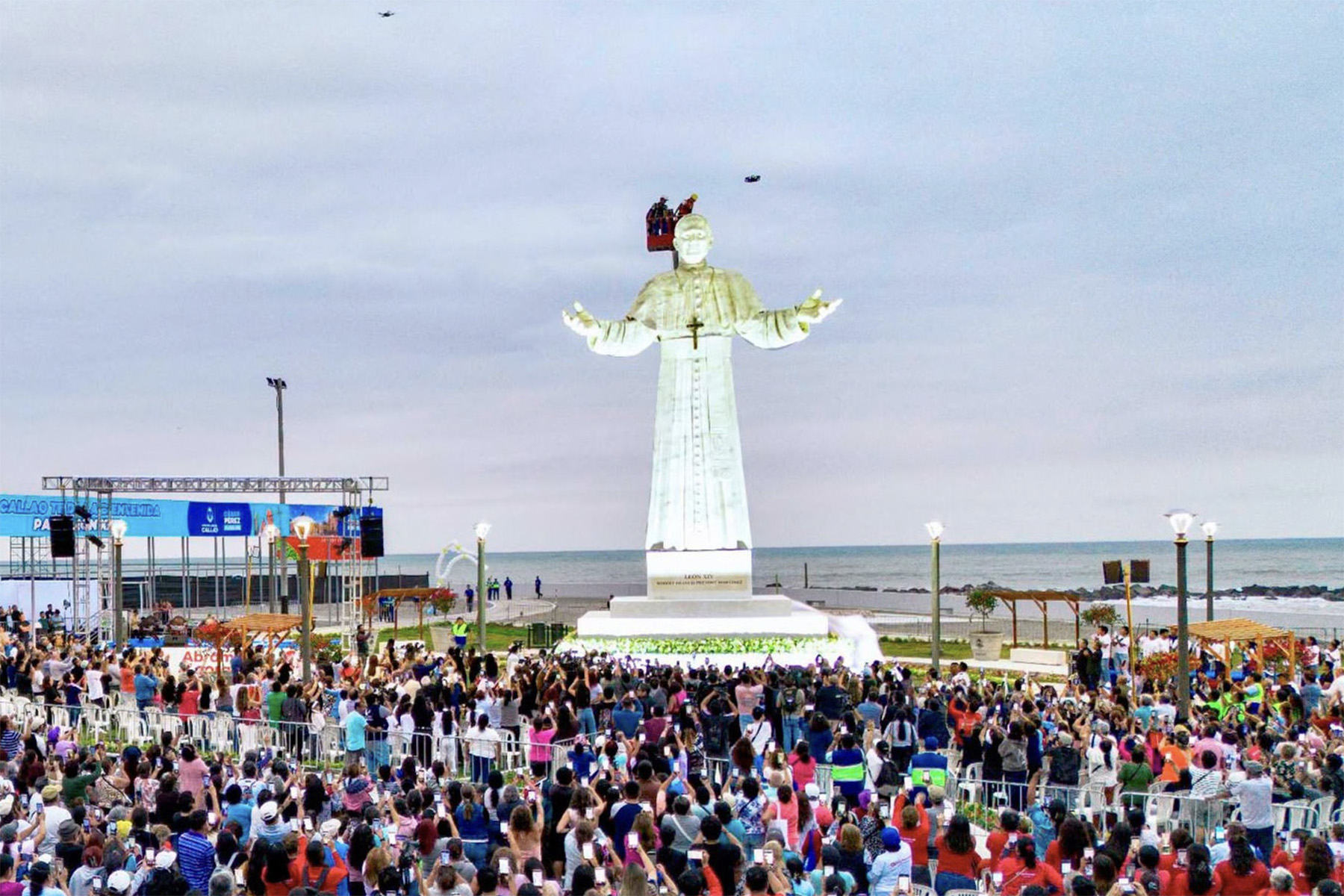
A 14-meter (45-foot)-tall statue is unveiled in Callao, Peru, in honor of Pope Leo XIV. PROVINCIAL MUNICIPALITY OF CALLAO
By Walter Sánchez Silva EWTN News November 12, 2026
LIMA, Peru — The provincial municipality of Callao in Peru has unveiled a monumental 14-meter (45-foot)-tall statue of Pope Leo XIV, the tallest statue dedicated to a pontiff in Peru.
The statue is located in the new Niño Gaelito Park, named in honor of Jesús Gael Alejandro Rodríguez, a 4-year-old boy who died while rescuing his sister during a fire in March.
The figure has a 12-meter (39-foot) metal framework and is constructed from polyurethane foam, fiberglass, and polyester resin, with a finish that resembles marble. The statue itself stands 12 meters (13 feet) tall and is set upon a 2-meter (6-foot) pedestal.
It was created by sculptors Deyvi Wong Arana and Rafael Gutiérrez Quispe.
“This sculpture expresses the pride, gratitude, and faith of the people of Callao for someone whose evangelizing efforts made a profound impact in our diocese,” the municipality stated on its Facebook page.
The unveiling ceremony was led by Callao’s mayor, Cesar Pérez, who was accompanied by Bishop Luis Alberto Barrera Pacheco of Callao and Monsignor Guillermo Inca Pereda, deputy secretary of the Peruvian Bishops’ Conference and national coordinator for Pope Leo’s visit to Peru.
Also in attendance at the ceremony were Jorge Guillermo Solís Espinoza, president of Caja Huancayo, the institution that funded the project, and the governor-elect of Callao, Pedro Spadaro.
“We are just about to welcome the Holy Father to Peru! Callao awaits him with open arms and a heart full of faith,” the municipality stated.
In Peru, Pope Leo XIV served as bishop of Chiclayo from 2015 to 2023 and as apostolic administrator of Callao from 2020 to 2021. He also served as the second vice president of the bishops’ conference from 2018 to 2023.
The Holy Father begins his visit to Peru on Wednesday, Nov. 11, where he will be welcomed by President Keiko Fujimori. He will then hold an audience with her at the Government Palace before addressing officials at the Grand National Theater.
CBCP head urges clergy to steer popular devotions toward discipleship, charity
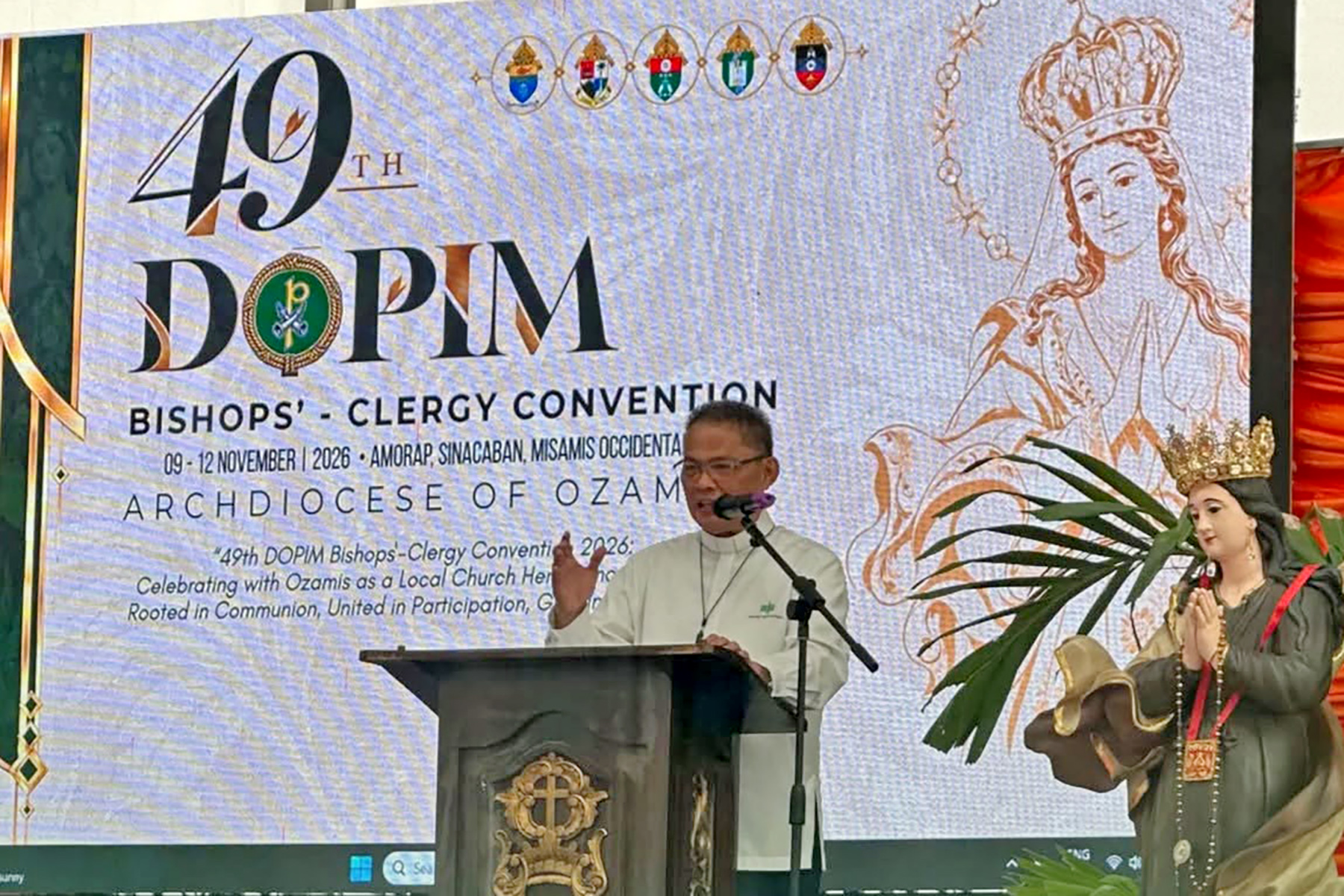
CBCP president Archbishop Gilbert Garcera of Lipa delivers the keynote address at the 49th DOPIM Bishops’-Clergy Convention at the Asenso Misamis Occidental Recreation and Adventure Park (AMORAP) in Sinacaban, Misamis Occidental. PHOTO FROM THE ARCHDIOCESE OF OZAMIS
By CBCP News November 11, 2026
OZAMIZ City — The president of the Catholic Bishops’ Conference of the Philippines on Wednesday urged bishops and priests to help Catholics turn popular devotions into deeper discipleship, charity and missionary action.
Speaking at the 49th DOPIM Bishops-Clergy Convention, Archbishop Gilbert Garcera said novenas, rosaries, processions and pilgrimages reflect the country’s rich Catholic heritage but must lead to a deeper encounter with Christ.
“Our task is not to extinguish the devotion of our people, but to accompany it — to help our faithful move from devotion to deeper discipleship, from religious practices to a more profound encounter with Christ, and from personal prayer to charity and mission,” Garcera said.
He said popular devotions should not remain external religious practices but transform how Catholics live their faith and serve others.
“Popular piety must lead our people toward the Eucharist, the sacraments, the Word of God, and a more authentic Christian life,” he said.
Garcera described the Philippines as an “Archipelago of Grace,” saying Catholicism has become deeply rooted in Filipino family life, traditions and culture.
He credited generations of parents, grandparents, catechists, missionaries, priests and religious for passing on the faith through family traditions and community life.
Citing the Vatican document Venite ad Me, issued Oct. 22, Garcera also stressed the importance of families in transmitting the Christian faith.
The convention brought together bishops and priests from the five ecclesiastical jurisdictions of Dipolog, Ozamiz, Pagadian, Iligan and Marawi, collectively known as DOPIM.
The annual gathering also marked the 75th anniversary of the Archdiocese of Ozamiz, providing Church leaders an opportunity to discuss pastoral priorities, synodality, communion, participation and mission.
New short film honors Filipino bishop whose beatification cause is underway
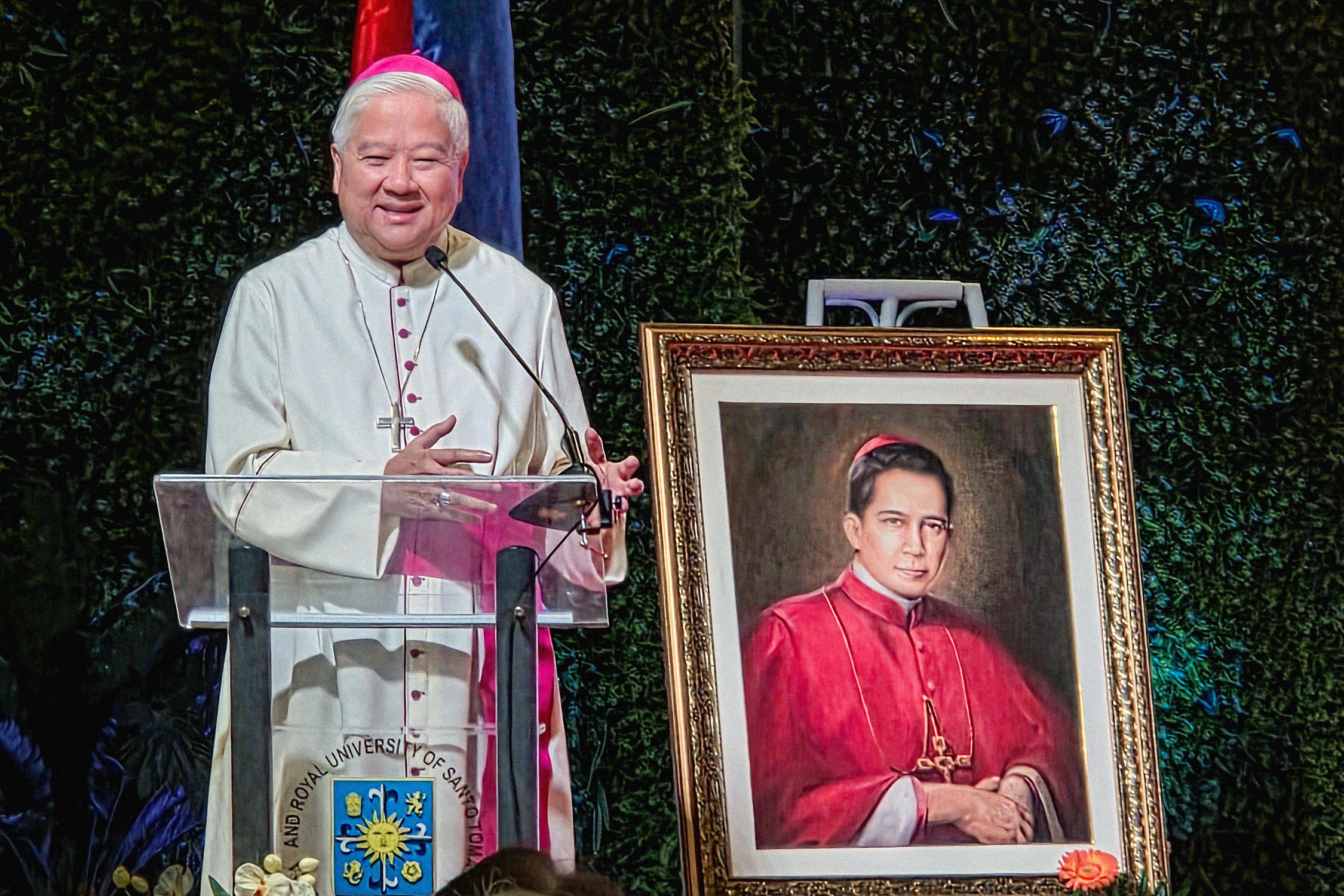
Archbishop Socrates Villegas of Lingayen-Dagupan speaks during the launch of “Pag-uwi,” a short film inspired by the life of Bishop Cesar Maria Guerrero, at the University of Santo Tomas in Manila on Nov. 11, 2026. The film aims to promote the cause for the bishop’s beatification. CBCP NEWS
By CBCP News November 11, 2026
MANILA — A short film inspired by the life of Bishop Cesar María Guerrero, whose beatification cause opened this year, premiered Wednesday at the University of Santo Tomas.
Titled “Pag-Uwi,” the 19-minute film traces the struggles and decades of service of Guerrero, the first bishop of Lingayen, and his dedication to God and the Church.
The Archdiocese of Lingayen-Dagupan produced the film, with the University of Santo Tomas and DivinaLaw serving as co-producers.
The film premiered at UST, where Guerrero studied philosophy, letters and civil law before pursuing theological and canon law studies in Rome.
Using two fictional characters, Attorney Cesar and Father Mario, the film dramatizes Guerrero’s journey from a promising legal career to the priesthood.
The archdiocese announced Feb. 21 that the Vatican had approved the opening of Guerrero’s beatification cause. The diocesan inquiry began March 27, 65 years after his death.
Archbishop Socrates Villegas of Lingayen-Dagupan said the two characters reflect the complexity of Guerrero’s life, marked by personal struggles and challenging pastoral assignments.
The film portrays Guerrero’s transfer from a wealthy parish in Binondo to an orphanage, followed by missionary work in the mountain communities of San Mateo, Rizal.
“God is present among the orphans. God is present among those whom others ignore,” Villegas said.
He also described hardship as an important teacher, saying some of life’s most meaningful lessons can only be learned through suffering and tears.
“Comfort and the pleasures of life are not good teachers, because there are lessons in life that we can learn only through hardship and tears,” he said.
UST Vice Rector for Religious Affairs Father Pablo Tiong, O.P., said the film’s title carries a meaning beyond Guerrero’s return to his alma mater.
He said “Pag-Uwi,” or “coming home,” highlights how holiness can grow through ordinary acts of service, not only through martyrdom.
“The martyrs show us how far love can go. But Bishop Guerrero shows us how long love can last,” Tiong said.
He added that Guerrero placed his education, talents and authority at the service of God and other people.
“Bishop Guerrero had talent, education and authority. And he placed it all at God’s disposal,” Tiong said.
Villegas said Guerrero’s example continues to inspire the Church, describing the bishop as a gift from God whose legacy transcends generations.
“Bishop Guerrero is not merely a figure confined to the years 1885 to 1961. He is a gift from God, meant to endure for all generations,” he said.
Reflecting on the film, Villegas urged audiences to pursue wisdom and holiness, describing “sabio at santo” (wise and holy) as the legacy worth leaving behind.
Born Jan. 26, 1885, in Ermita, Manila, Guerrero was ordained a priest in 1914 and served at Binondo parish and as chaplain of Hospicio de San Jose.
He became the first bishop of Lingayen in 1929 before serving as auxiliary bishop of Manila and later as the first bishop of San Fernando, Pampanga.
Guerrero also established seminaries in Pangasinan and Pampanga and helped organize Catholic Action of the Philippines to encourage lay participation in the Church’s mission.
He retired in 1957 because of illness and spent his remaining years at Hospicio de San Jose. He died on March 27, 1961, at age 76.
Pope Leo XIV urges youth to shun ‘the idols of our time’ and turn to Christ
Pope Leo XIV speaks during a youth vigil at the Monumento de los Españoles in Buenos Aires, Argentina, Nov. 10, 2026. VATICAN MEDIA
By Francis X. Rocca EWTN News November 11, 2026
BUENOS AIRES, Argentina — Pope Leo XIV appealed to young people to reject worldly distractions and follow Christ, assuring them that their past mistakes are no obstacle to joining the Church.
“Dear young people, Christ loves us and wants us to share in his own life,” Leo told an estimated 1 million participants at a vigil on Nov. 10, his last night in Argentina. “Christ offers you a life that not even death can take away.”
The event took place at the same site in northern Buenos Aires where Leo had celebrated Mass the previous day, drawing an estimated 2.5 million people. The crowds in Argentina have been by far the largest of his pontificate.
The pope’s speech came after testimonies and questions from young people, including a man recovering from drug addiction.
Leo urged his listeners to reject what he called “the idols of our time,” which cannot provide happiness or life.
“Idols arise and demand our worship: success at any cost, money, an obsession with appearance, popularity or the unrestrained pursuit of pleasure. Sometimes, in order to win the approval of others, we may go so far as to lie, betray or humiliate someone on social media,” the pope said.
“There are also those who make a business of offering pleasures that ultimately enslave us, such as pornography and addictive substances,” he added.
Leo cited Pope Francis’ insistence that “everyone, everyone, everyone” is welcome in the Church.
“Whoever you are and whatever you may have done, Jesus Christ knows you, loves you and wants you to be close to him,” the pope said. “No one has fallen so low that Christ cannot raise them up.”
He added that “we all need conversion” and that welcome is not the equivalent of moral indifference.
“Christ loves us as we are, but his love is too great to leave us prisoners of sin, of what destroys us,” Leo said. “There are wounds to be healed, failings to be acknowledged and, whenever possible, wrongs to be made right.”
He urged his listeners to confess their sins, pray, read Scripture and receive the Eucharist in order to be transformed by Christ.
“Share your bread with those who are hungry, open your doors to those who have no home, visit the sick and those whom no one wants to visit,” the pope told his young listeners, as part of his program for their pursuit of sanctity.
On Wednesday, following a pilgrimage to Argentina’s most prominent Marian shrine, in Luján, Leo was scheduled to leave for Peru, the last stop on his tour of South America.
Western Visayas bishops join opposition to Boracay casino
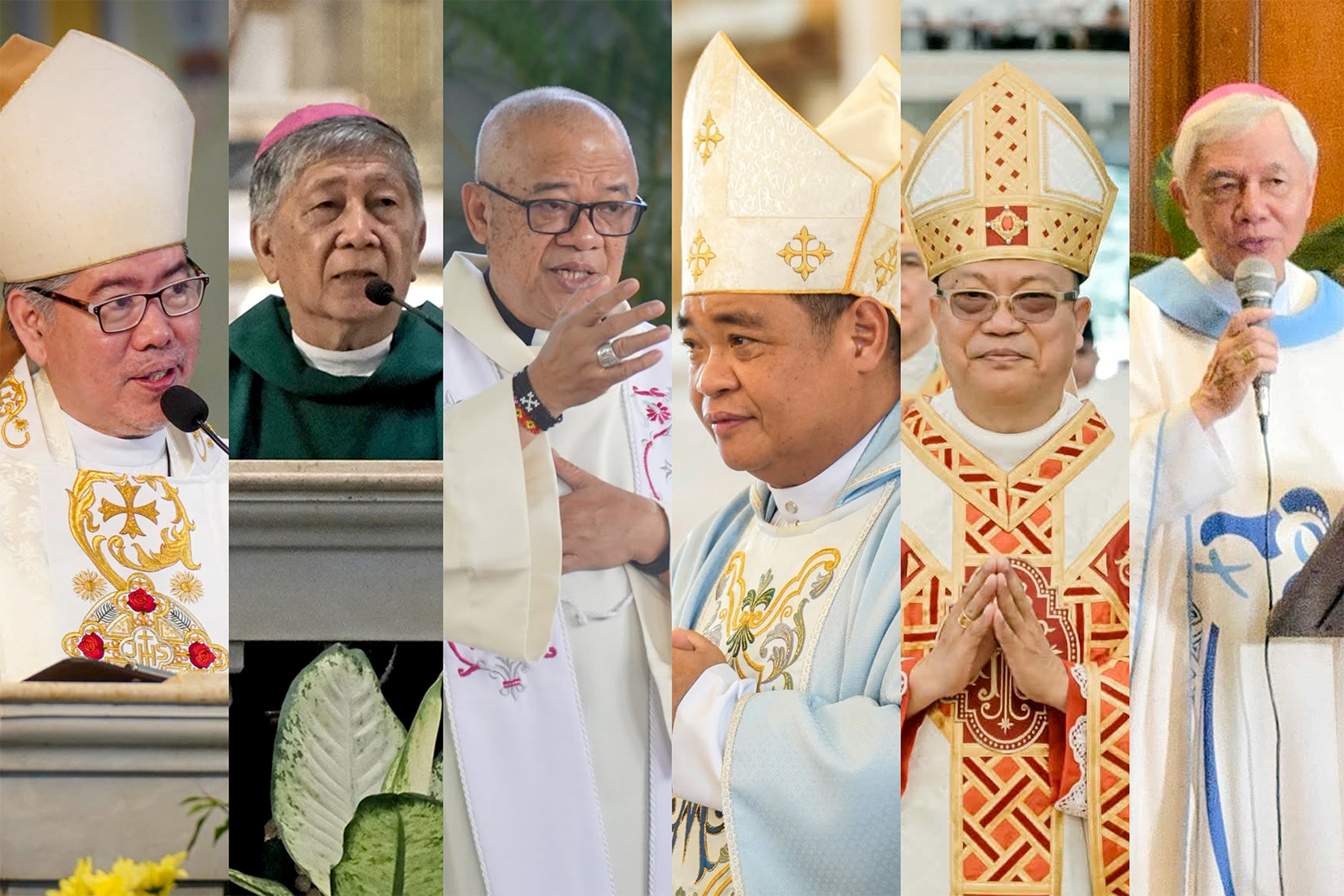
From left, Archbishop Midyphil Billones of Jaro, Archbishop Emeritus Jose Romeo Lazo of Jaro, and Bishops Gerardo Alminaza of San Carlos, Marvyn Maceda of San Jose de Antique, Louie Galbines of Bacolod, and Emeritus Patricio Buzon of Bacolod.
By CBCP News November 10, 2026
MANILA — Catholic bishops in Western Visayas have joined growing Church opposition to casino operations in Boracay, saying they could harm families and vulnerable communities.
In a joint statement, the bishops backed Bishop Cyril Villareal of Kalibo, who earlier spoke against gambling on the island resort. The Ecclesiastical Province of Capiz had issued its own statement opposing the casino.
“Gambling is not merely a personal choice when its consequences extend to the entire family and community,” the bishops said.
They said gambling addiction can lead to heavy debts, lost savings, marital conflict and neglected children, taking money away from food, education and health care.
The bishops also said bigger casino operations could raise the risk of exploitation, human trafficking, drug abuse, fraud and other crimes. They said, however, that these problems should not automatically be blamed on every casino.
They acknowledged the benefits of investment and jobs in Boracay but said economic progress should not come at the cost of human dignity.
“Development must serve the human person, not sacrifice human dignity and family welfare for profit,” they said.
They urged government officials, business leaders and other groups to weigh the long-term social costs of casinos and listen to affected communities.
The bishops said Boracay’s future should rest on responsible tourism, decent jobs and environmental protection. They also asked Catholics to support people struggling with gambling addiction.
The statement was signed by Archbishop Midyphil Billones of Jaro, Archbishop Emeritus Jose Romeo Lazo of Jaro, and Bishops Gerardo Alminaza of San Carlos, Louie Galbines of Bacolod, Marvyn Maceda of San Jose de Antique and Emeritus Patricio Buzon of Bacolod.
“No to gambling casinos in Boracay. Yes to development that protects families, dignifies work, and serves the common good,” the bishops said.
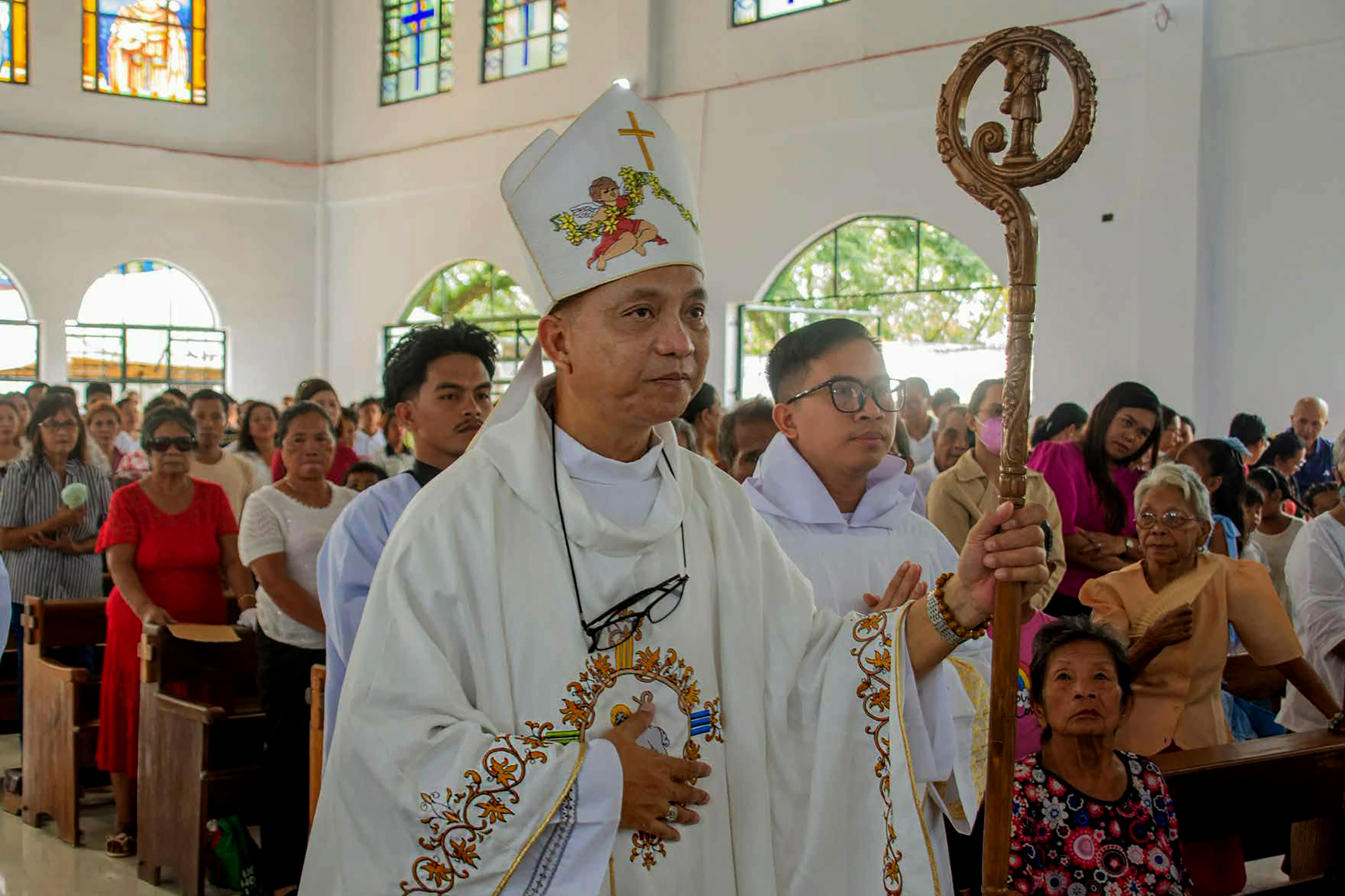
Fr. Liberato Ortega, the diocesan administrator of Bangued. HOLY SPIRIT ACADEMY OF BANGUED
By CBCP News November 10, 2026
MANILA — The Diocese of Bangued on Tuesday elected a new administrator, three days after Bishop Leopoldo Jaucian resigned for health reasons.
The College of Consultors elected Father Liberato Ortega to oversee the diocese until a new bishop is appointed.
“Let us keep him in our prayers as he leads our local Church in accordance with the sacred canons until a new bishop is appointed,” the diocese said.
Ortega, who was ordained a priest in 1986, holds a licentiate in philosophy from the Pontifical Gregorian University in Rome.
The 65-year-old priest currently serves as president of the Abra Diocesan Clergy, director and chaplain of Holy Spirit Academy of Bangued, and professor at two seminaries.
He teaches at the Immaculate Conception School of Theology in Vigan City and Our Lady of the Visitation Seminary in Ilagan City.
During nearly four decades of priestly ministry, Ortega has held several leadership positions, including rector of San Pablo Seminary in Baguio City from 2000 to 2002 and again from 2011 to 2018, and St. Joseph Seminary in Bangued from 2003 to 2007.
He also served in the United States as an assistant parish priest in several parishes in New Jersey and Pennsylvania and as chaplain of a nursing home in the Diocese of Greensburg, Pennsylvania, from 2018 to 2023.
Ortega’s election came as Bangued clergy held their annual spiritual retreat in Baguio City.
The diocese also thanked Jaucian, 66, for his service and urged the faithful to continue praying for him.
“Your faithful shepherding, loving service, and dedication to our diocese will always be remembered with gratitude,” it said.
Filipino migrants in Hong Kong find comfort in Padre Pio devotion
By CBCP News
Archbishop Gilbert Garcera of Lipa, CBCP president, presides over Mass at the Holy Family Parish in Choi Hung Estate, Kowloon, Hong Kong, on Nov. 8, 2026. PHOTOS FROM THE SHRINE OF SAINT PADRE PIO November 10, 2026
HONG KONG — Filipino migrant workers in Hong Kong found spiritual comfort in a series of healing Masses and liturgies led by the head of the Catholic Bishops’ Conference of the Philippines.
Archbishop Gilbert Garcera of Lipa, CBCP president, led a 78-member delegation from the International Shrine of St. Padre Pio during a five-day mission in Hong Kong.
The Nov. 5-9 visit brought the devotion to the Italian saint to several churches and the Diocesan Pastoral Centre for Filipinos, where migrant workers gathered for prayer and spiritual support.
During a Nov. 7 Mass at St. Alfred’s Church in the New Territories, Garcera acknowledged the sacrifices of Filipinos who leave their homes and families to provide better future for their loved ones.
He reminded them that their separation from family was an expression of love, while encouraging them to draw strength from their faith amid the difficulties of working abroad.
The delegation also held healing liturgies at churches in Kowloon, Central and North Point, where devotees received individual anointing with holy oil and venerated the sacred relics of St. Padre Pio.
At the Diocesan Pastoral Centre for Filipinos on Nov. 6, Garcera reminded migrant workers that the greatest blessing was not simply receiving what they prayed for but growing closer to Jesus.
He encouraged them to trust God through their difficulties and become instruments of love to others.
At the mission’s final Mass on Nov. 8 at Holy Family Parish in Kowloon, the CBCP head also challenged devotees to look beyond religious objects and outward expressions of faith.
“It is not enough to carry a rosary or wear a religious medal,” Garcera said. “Our devotion to St. Padre Pio must lead us to a deeper relationship with Jesus and inspire us to become better Christians.”
The delegation included 21 priests from the Archdiocese of Lipa and the CBCP General Secretariat, as well as members of the Confraternity of St. Padre Pio.
The mission sought to bring the saint’s message of prayer and hope to Filipino communities overseas, particularly those facing the challenges of separation, sacrifice and life away from home.
Pope appoints Bishop Apigo as new Davao archbishop
By CBCP News
Archbishop-designate Abel Apigo of Davao. DIOCESE OF MATI Archbishop Romulo Valles of Davao presides over Mass, with Bishop Abel Apigo among the concelebrants, at Mati Cathedral on Sept. 2, 2026. DIOCESE OF MATI November 9, 2026
MANILA — Pope Leo XIV on Monday appointed Bishop Abel Apigo of Mati as the new archbishop of Davao, accepting the resignation of Archbishop Romulo Valles.
Valles, who turned 75 in July, reached the mandatory retirement age for bishops. He led the Archdiocese of Davao for about 14 years.
The pope accepted Valles’ resignation on Nov. 9, the same day he named Apigo as his successor.
Valles celebrated the 50th anniversary of his priestly ordination in April. Before his appointment to Davao, he served as bishop of Kidapawan from 1997 until 2006, when he was named archbishop of Zamboanga.
He also served as president of the Catholic Bishops’ Conference of the Philippines (CBCP) from December 2017 to November 2021.
Apigo studied philosophy and theology at St. Francis Xavier Regional Major Seminary of Mindanao (SFX-REMASE) before being ordained a priest for the Archdiocese of Davao on April 18, 1994.
He served as a parish vicar at San Pedro Cathedral from 1994 to 1996 before pursuing further studies in Rome, where he earned a licentiate in Church history from the Pontifical Gregorian University in 2000.
Upon returning to Davao that year, he held various positions at SFX-REMASE, including professor, vice rector and dean.
He became rector of the seminary in 2006 and was later appointed episcopal vicar for the clergy of the archdiocese in 2014.
Pope Francis appointed Apigo bishop of Mati on Feb. 10, 2018. He was ordained a bishop on April 24 that year and installed as the diocese’s second bishop the following day.
No date has been announced yet for his installation as the fifth archbishop of Davao.
Antipolo diocese to help build chapel on Pag-asa Island
Bishop Socrates Mesiona of Puerto Princesa leads the March 28 groundbreaking of Pag-asa Island’s first Catholic church, joined by retired Justice Antonio Carpio, Philippine Coast Guard spokesperson for the West PH Sea RADM Jay Tarriela and PCSDS Executive Director Atty. Teodoro Matta. KATYA SANTOS
By Alena Castillo November 9, 2026
MANILA — The Diocese of Antipolo will build a Catholic chapel on Pag-asa Island in the West Philippine Sea, bringing a permanent place of worship to one of the country’s most remote communities.
Bishop Ruperto Santos said the chapel will be dedicated to Our Lady of Peace and Good Voyage, the patroness of the Antipolo diocese.
The project responds to an appeal from Bishop Socrates Mesiona of the Apostolic Vicariate of Puerto Princesa and has received the endorsement of the Catholic Bishops’ Conference of the Philippines.
Santos described the chapel as “a gift of faith from the people of Antipolo to the Philippine Church,” offering spiritual support to residents, workers and visitors.
The initiative builds on an earlier effort by Mesiona, who led the groundbreaking for a chapel on the island on March 28, envisioning it as a mission station for the remote community.
Located about 280 nautical miles northwest of Puerto Princesa City, Pag-asa is one of the inhabited islands in the Kalayaan Island Group and has been at the center of maritime and territorial disputes with China.
The proposed chapel is expected to serve about 400 civilian residents, most of whom are Catholics, and provide a permanent space for worship and community gatherings.
The initiative also forms part of Antipolo’s celebration of the 400th anniversary of the arrival of Our Lady of Peace and Good Voyage and the centenary of her canonical coronation.
To raise funds, the diocese will hold a second collection in all its churches over five consecutive Sundays, beginning Nov. 15.
Santos appealed to Catholics to support the construction, saying every contribution would help bring a chapel dedicated to the Blessed Mother on the island.
“This mission allows us to continue the pilgrimage of our beloved Birhen ng Antipolo beyond our shores. She now journeys to another corner of our country, bringing her maternal care to her children across the seas,” he said.
He described the project as an expression of faith and solidarity with the island community, calling on the faithful to take part through generosity and shared sacrifice.
In Argentina, Pope Leo XIV highlights social problems
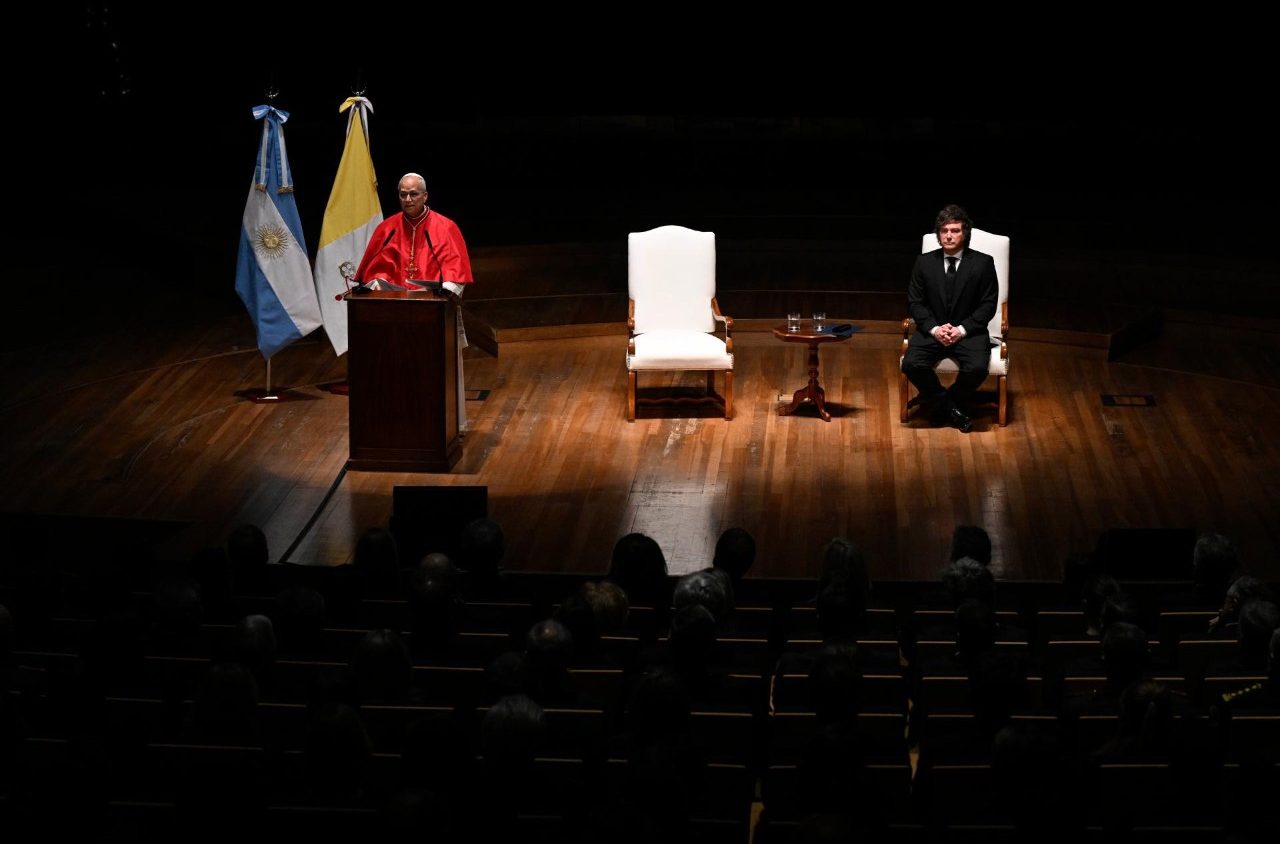
Pope Leo XIV addresses civil authorities and diplomats at Palacio Libertad, Centro Cultural Domingo Faustino Sarmiento, in Buenos Aires, Argentina, on Nov. 8, 2026, the third day of his 12-day apostolic journey to South America. VATICAN MEDIA
By Francis X. Rocca EWTN News November 9, 2026
BUENOS AIRES, Argentina — Pope Leo XIV spoke about crime, economic inequality, and political polarization, among other topics, in a wide-ranging speech to President Javier Milei and other dignitaries Nov. 8, the pope’s first day in Argentina.
Milei is a self-described “anarcho-capitalist” whose policies of austerity have drawn criticism from Argentina’s Catholic bishops. Though Leo did not directly criticize the president, his speech was the most political he has given so far on his tour of South America, which began Nov. 6 in Uruguay and will conclude Nov. 16 in Peru.
The pope opened by stating that he had come to Argentina “as a pastor,” but that the Church wishes “to propose to those who hold public office a message inspired by the Gospel and aimed at safeguarding the dignity of every person, civic concord, and the common good.”
Leo highlighted several widespread social problems, including public safety. “Organized crime, human trafficking networks, arms and drug trafficking together with corruption all undermine social cohesion, fuel violence and divert resources necessary for the common good,” the pope said.
Violent crime is an urgent concern across the region. According to a U.N. report, the homicide rate for Latin America and the Caribbean was the world’s highest in 2023, and nearly four times the world average.
Addressing the question of inequality, the pope said that efforts should be made to ensure “that economic growth also benefits those who are disadvantaged. Here I think of families facing an uncertain future, the unemployed, the elderly who for years contributed to society, and all those who, despite hard work, nonetheless struggle to meet their household’s needs.”
Leo pointed to the plight of young people driven to emigrate in search of opportunities. “A nation must seriously ask itself where it has failed when its young people have to leave their homeland in order to make their dreams come true,” he said.
He also addressed what he described as a threat to democracy from political polarization, a widely noted trend in Latin America and beyond.
The pope said democracy is strengthened “through willingness to listen, through careful use of words, through the patient search for agreement, and through the ability to see those who think differently as fellow citizens with whom we share a common future. In this way, a spirit of trust is created, one that enables a society to deal with its differences without losing sight of the things that keep it united,” Leo said.
Milei campaigned for president as a firebrand, wielding a chainsaw to show what he would do to government budgets and deriding his fellow Argentine Pope Francis as, among other things, a “filthy leftist,” though he later said he apologized personally to Francis. On Sunday, speaking right before the current pope, the president lauded the late pontiff as “an exceptional figure who inspired us all with his humanity, regardless of our creed. A person of immense generosity, whom I had the honor of knowing personally.”
Leo opened his own speech by recalling his predecessor, saying the universal Church had “listened to the voice of an Argentinian pope” for years. The pope also urged the countryʼs leaders to make room for the unborn.
The audience of foreign diplomats and Argentine civil and political leaders frequently interrupted Leo’s speech with vigorous applause and cheering reminiscent of a parliament or a political convention.
Earlier on Sunday, Milei met Leo’s plane at the airport and met with him privately at the seat of government, the Casa Rosada, before he and the pope gave their speeches.
Pope Leo XIV’s appeal to mothers: ‘Never tire of passing on the faith!’
Pope Leo XIV celebrates Mass at the Shrine of Our Lady of the Thirty-Three in Florida, Uruguay on Nov. 8, 2026. VATICAN MEDIA
By Francis X. Rocca EWTN News November 9, 2026
FLORIDA, Uruguay — Pope Leo XIV celebrated Mass at Uruguay’s most prominent Marian shrine on Sunday, where he paid tribute to women’s role in transmitting the Catholic faith and urged them to continue doing so despite secular trends.
“Mothers and grandmothers: never tire of passing on the faith!” Leo told a congregation in the square outside the cathedral of Florida, a city in south-central Uruguay. “Even if your loved ones seem far from God, continue to place them before him. Do not stop blessing them, accompanying them, and simply reminding them of what they once received.”
Uruguay is one of Latin America’s most secular countries, where the majority of people are not affiliated with any organized religion and 28% identity as atheist or agnostic.
The cathedral in Florida houses the Virgin of Thirty-Three, a small wooden sculpture of Mary named for the number of early 19th-century patriots who entrusted their efforts for Uruguay’s independence to her intercession.
Leo noted the history to underscore, as he has done throughout his visit, that Catholicism has deep roots in the country.
The patriots’ “gesture reminds us that the history of peoples, too, cannot be fully understood without reference to God. Thus, from the earliest days of the nation’s founding, Uruguay has been intimately linked to a Mother,” the pope said.
He linked the figure of Mary to the tradition of mothers and grandmothers teaching children how to pray and “live out Christian charity.”
Thanking such women for their efforts, the pope commiserated with them over a widespread decline in religious practice.
“I know that many of you carry a very specific sorrow. You taught your children to pray, and today they no longer do so. You used to attend Mass together, and it has been years since they entered a church. You spoke to your grandchildren about God, and now you do not know if those words left a mark. Sometimes you wonder if you did something wrong or if it was all futile,” Leo said.
He encouraged them with the example of St. Monica, mother of St. Augustine, the inspiration for Leo’s religious order, who never despaired of her son’s eventual conversion and sanctity.
The pope also urged fathers and grandfathers to foster faith in the young. “Children learn a great deal by seeing that their father can kneel before God without feeling that he is any less of a man doing it,” he said.
Leo concluded by urging all Uruguayan Catholics to evangelize in their daily lives.
“You must enter people’s homes once more, draw near to them, listen to their questions and bring them to Christ! Each of you knows a person toward whom you need to take that step: perhaps a child, a friend, a neighbor, someone who stopped believing long ago or who has never had anyone close to them to speak to them about God,” the pope said.
At the end of the Mass, Leo placed a golden rose before the image of the Virgin, a traditional papal devotion. But his homily contained a note of caution about veneration of Mary, recalling the Vatican’s decision last year to reject the title of “co-redemptrix” for her as potentially confusing.
There is “one mediator between God and humankind, Christ Jesus,” the pope said, quoting St. Paul. The he added: “All of Mary’s greatness is based on her relationship with Christ: she welcomes him, lives by him, and leads others to him. An encounter with the Master is the goal of all evangelization and of all authentic Marian devotion.”
Silvia, from Uruguay, shared her excitement about serving as a Eucharistic minister at the Mass.
“It truly is a beautiful moment, very, very moving. I’m eager to help people and to be part of this celebration, which belongs to all of us. It is also a privilege to be able to distribute the Eucharist,” she said.
She said being from the city hosting the Holy Father is “a tremendous gift from God,” especially on the feast day of its patroness, Our Lady of the Thirty-Three, celebrated on Nov. 8.
Reflecting on the three days the Holy Father has spent in her country, she recalled the pope’s homily during Mass in Paysandú, in which he encouraged the faithful to be bridges, build communities, and accompany others.
“I think it is a challenge and an invitation that we need in Uruguay,” she said.
Later in the afternoon, the pope is scheduled to depart for Argentina, where he is set to visit the Monument to General San Martín and meet with President Javier Milei.
Pope Leo XIV encourages Uruguay’s Catholic minority to keep — and spread — the faith
Pope Leo XIV waves upon arriving for a prayer vigil with young people at Estadio Centenario in Montevideo, Uruguay, on Nov. 7, 2026. VATICAN MEDIA
By Francis X. Rocca EWTN News November 8, 2026
MONTEVIDEO, Uruguay — Pope Leo XIV on Saturday encouraged practicing Catholics in a secular society, and especially young people, to keep their faith strong and to live in virtuous ways that can attract people to the Church.
The pope made his remarks at an evening prayer vigil in a stadium in Uruguay’s capital, with about 70,000 people in attendance. Local authorities estimated that another 30,000 people were following the event nearby.
Uruguay is one of Latin Americaʼs most secular societies, where a majority of people have no affiliation with organized religion and the official state calendar has renamed Catholic holidays with secular terms, such as substituting Tourism Week for Holy Week.
Leo said the experience of faithful Uruguayan Catholics “can help brothers and sisters in other parts of the world who are beginning to discover, in different ways, what it means to be a minority.”
The pope consoled Uruguayan Catholics for their small numbers, noting that Bethlehem, the birthplace of Jesus, was proverbially small and that, in the Eucharist, “the Lord of the universe is present under the humble appearances of bread and wine.”
Yet he said that Christians can draw others into their ranks by behaving in exemplary ways.
“Perhaps there are people who would never open a Bible on their own, who have not set foot in a church in years, or who cannot even say whether they believe in God. But when they see you, the desire for God may be awakened in them; they may even discover that it is worth risking their lives to find him,” the pope said.
“Christ did not call us to mediocrity,” Leo said. He urged his listeners to pursue excellence in the pursuit of holiness.
“When being just and honest comes at a price, pay it. When forgiving seems like a defeat, forgive. When everyone tells you to think of yourselves first, do not be afraid to put yourselves in the last place,” he said.
“Be willing to give up time, money, comfort and plans to serve others. May those who see you find themselves asking: ‘Why do they live in this way? Where do they get this freedom? Why do they love one another so much?’”
The vigil ended with a spectacular fireworks display.
Earlier, the pope spoke at the Catholic University of Uruguay, where he shared thoughts on the intellectual formation of young people in the Church.
“Our Catholic education cannot be confined to a closed circle. Rather, it must learn to listen to families, civil society, political and administrative authorities, as well as representatives of the various economic sectors and professional groups,” Leo concluded.
But he warned that “generations are changing far more rapidly than in the past and that keeping pace with the times — without abandoning sound tradition — is a real challenge.”
The pope was scheduled to leave Uruguay on Sunday for Argentina, where he will spend three days before moving on to his former home of Peru, where he will spend five days before returning to Rome.