By Roy Lagarde
November 18, 2026
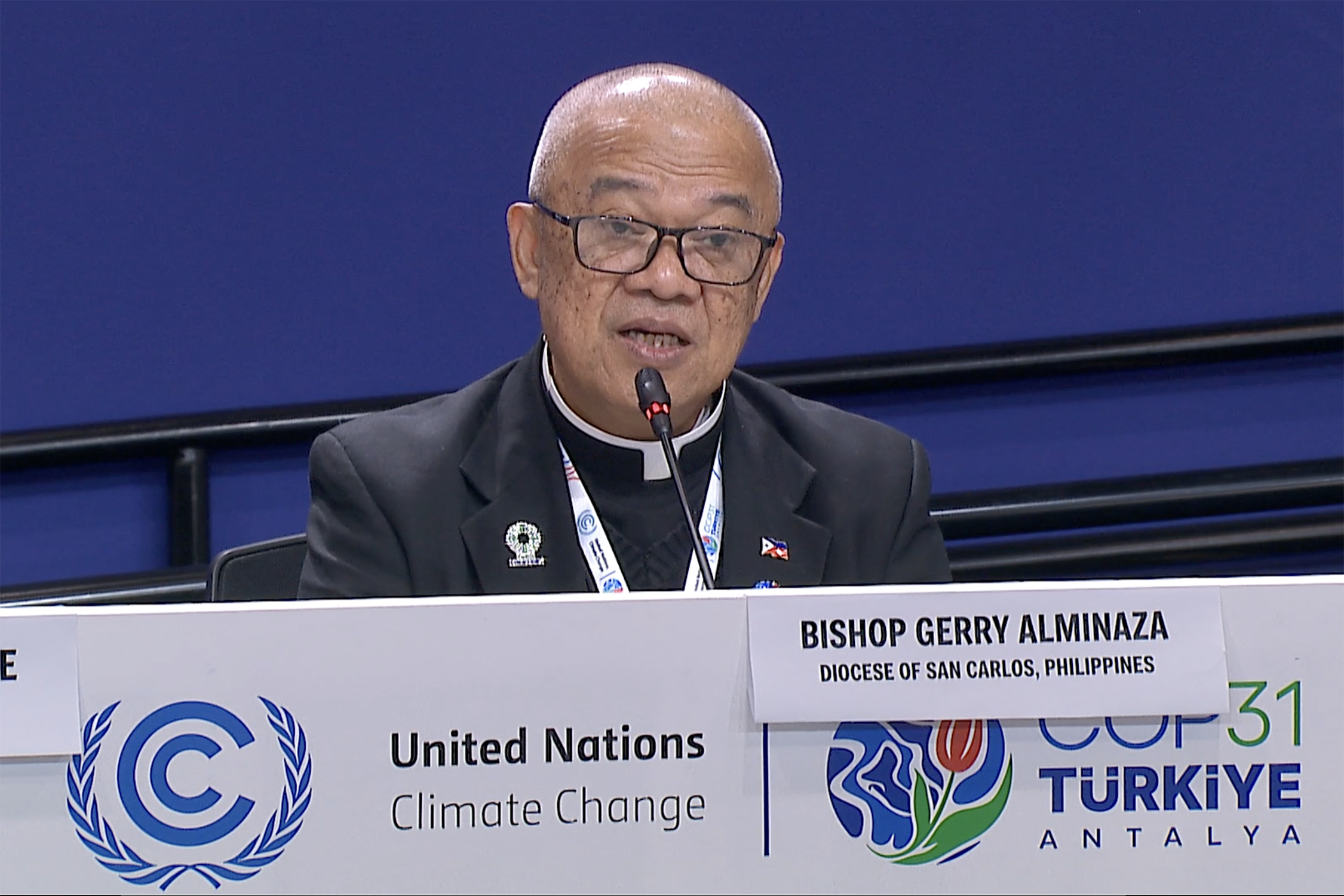
MANILA — A Philippine Catholic bishop has challenged world leaders at COP31 to make room for three often-missing voices at the negotiating table: the poor, the planet and future generations.
Bishop Gerardo Alminaza, president of Caritas Philippines, said their interests are often overlooked in climate decisions, even though they bear many of the consequences of environmental destruction.
“Let us remember the three empty chairs often absent in negotiation tables. The poor, our common home, and the future generations,” Alminaza said Tuesday during a press conference at the climate summit in Antalya, Turkey.
“Are their voices present in these negotiations? Are we protecting their future? Or sacrificing it for short-term gains?” he asked.
Alminaza urged governments to accelerate the shift away from fossil fuels and halt new oil and gas exploration in biodiversity-rich and ecologically sensitive areas.
He cited Palawan as an example of how fossil fuel development threatens communities and fragile ecosystems, questioning who benefits from resource extraction and who bears its costs.
Despite decades of gas extraction from its waters, Palawan continues to struggle with costly electricity, he said.
The bishop warned that offshore exploration and drilling threaten marine life through underwater noise, habitat destruction and the risk of spills.
“The cry of the Earth and the cry of the poor cannot be separated,” he said, citing Pope Francis’ environmental encyclical Laudato Si’.
Fishing communities and indigenous peoples depend on the sea for food and livelihoods but often bear the environmental costs of development, Alminaza said.
He called for a shift from coal, oil and gas to renewable energy that protects ecosystems, supports livelihoods and respects human dignity.
“Fossil gas must not become another excuse to prolong dependence on fossil fuels,” he said.
Alminaza warned that Palawan and the Coral Triangle must not become “sacrifice zones” for further fossil fuel development.
“We cannot save the climate while destroying biodiversity,” he said.