Fr. Bill Hao
Holy Name of Jesus
over 2 years ago
SMALL GROUP REFLECTION FOR SEPTEMBER 24, 2023
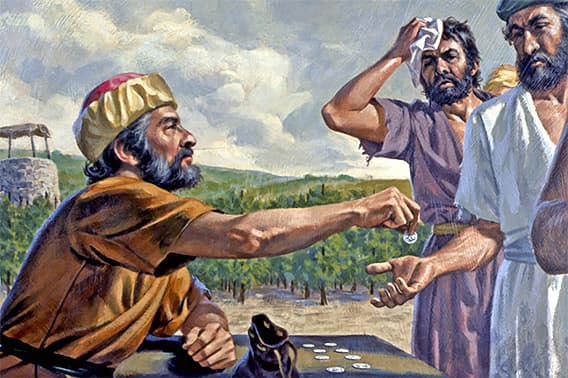
The Workers in the Vineyard Scripture Passage (Matthew 20:1-16) The kingdom of heaven is like a landowner who went out at dawn to hire laborers for his vineyard. After agreeing with them for the usual daily wage, he sent them into his vineyard. Going out about nine o’clock, he saw others standing idle in the marketplace, and he said to them, ‘You too go into my vineyard, and I will give you what is just.’ So they went off. [And] he went out again around noon, and around three o’clock, and did likewise. Going out about five o’clock, he found others standing around, and said to them, ‘Why do you stand here idle all day?’ They answered, ‘Because no one has hired us.’ He said to them, ‘You too go into my vineyard.’ When it was evening the owner of the vineyard said to his foreman, ‘Summon the laborers and give them their pay, beginning with the last and ending with the first.’ When those who had started about five o’clock came, each received the usual daily wage. So when the first came, they thought that they would receive more, but each of them also got the usual wage. And on receiving it they grumbled against the landowner, saying, ‘These last ones worked only one hour, and you have made them equal to us, who bore the day’s burden and the heat.’ He said to one of them in reply, ‘My friend, I am not cheating you. Did you not agree with me for the usual daily wage? Take what is yours and go. What if I wish to give this last one the same as you? [Or] am I not free to do as I wish with my own money? Are you envious because I am generous?’ Thus, the last will be first, and the first will be last.” Commentary The workers who came first to the vineyard complained to the landowner: “These last ones worked only one hour, and you have made them equal to us, who bore the day’s burden and the heat.” (Matthew 20:12) The owner of the vineyard responded: “My friend, I am not cheating you. Did you not agree with me for the usual daily wage? Take what is yours and go. What if I wish to give this last one the same as you? [Or] am I not free to do as I wish with my own money? Are you envious because I am generous?” (Matthew 20:13-15) Then Jesus said, “Thus, the last will be first, and the first will be last.” (Matthew 20:16) The parable of the workers in the vineyard has been interpreted in many ways. However, the meaning of the parable can become quite clear after we figure out who is represented by what: • The owner represents God. • The workers represent those who are called to follow Jesus Christ. • The vineyard represents the world. • The work in the vineyard represents following Jesus Christ by LOVING GOD AND NEIGHBOR. • The daily wage represents the kingdom of heaven. Many are called to follow Jesus Christ in this world – by LOVING GOD AND NEIGHBOR. But we are called at different times in our lives. Some of us are called early in life, while others are called later in life. But the kingdom of heaven is promised to those who follow Jesus Christ in this world. “The last will be first, and the first will be last.” (Matthew 20:16) Within the context of the parable of the workers in the vineyard (cf. Matthew 20:1-16), the ‘last’ refers to the workers who came to work in the vineyard at the last hour, or those who have come to follow Jesus later in life, even if it is at their last hour. The ‘first’ refers to the workers who came to work in the vineyard at the first hour, or those who have come to follow Jesus early in life, even since childhood. That the ‘last’ will be first and the ‘first’ will be last suggests that those who respond to the call of Jesus, whether first or last or in between, will obtain the same reward of inheriting the kingdom of God. There are two things that we can learn from this parable: first, that God is generous – regardless of how late in life someone started to follow His Son, God gives him the same great reward, which is the kingdom of heaven. Second, we should not be envious of God’s generosity to others; i.e., we should not be envious of the good fortune of others. In many instances, envy is caused by seeing or knowing about things that others have which we don’t; e.g., my neighbors have a bigger house or a new car, or someone I used to work with now has a better job, or my friends always get new things. But in other cases, envy is caused when one senses unfairness; e.g., I work harder, but my co-worker got promoted, or my co-workers get the same pay for less work, as was the case in the parable. Still, some say that the root cause of envy is connected to a person's inability to see what God has provided in their life and a lack of thankfulness. St. Paul identifies envy as one of the works of the flesh and he admonishes against it: Now the works of the flesh are obvious: immorality, impurity, licentiousness, idolatry, sorcery, hatreds, rivalry, jealousy, outbursts of fury, acts of selfishness, dissensions, factions, occasions of envy, drinking bouts, orgies, and the like. I warn you, as I warned you before, that those who do such things will not inherit the kingdom of God… Now those who belong to Christ [Jesus] have crucified their flesh with its passions and desires. If we live in the Spirit, let us also follow the Spirit. Let us not be conceited, provoking one another, envious of one another. (Galatians 5:19-21, 24-26) How can we overcome envy? 1. Gratitude – whenever we begin to feel that we are not getting what we deserve in life, we must count your own blessings and thank God for them. We believe that all things come from God; and instead of complaining that God is unfair, we defer to God’s judgment and infinite wisdom. 2. Contentment – many times we belittle the blessings that we receive in life. We tend to think that since many people have the same things that we enjoy in life, it is nothing special. But there are more people in the world that do not have the most ordinary things that we enjoy. Let us learn not only to be thankful for these things, but also learn to be content with what we have received. 3. Brotherly love – brotherly love does not only mean doing charity work or helping others; it also includes being happy for the good fortune of others. Having a benevolent attitude towards others means that we look at their gains as our gain and their successes as our success. In a deeper sense, this is what it really means to love your neighbor. Questions for reflection 1. Do you think that the owner cheated the first workers by giving them the same wage as the last workers? Why? 2. Do you sometimes think that God is unfair? Why?